





Garlic (Allium sativum) is grown from cloves planted in mid-autumn to early winter, pointed end up, and in regions with very cold winters also in late winter to early spring. Green garlic is ready 2 to 3 months after planting, while full bulbs are harvested 6 to 8 months later, once most of the leaves have yellowed and bent over. It is one of the easiest crops in the vegetable garden, provided it gets sun, free-draining soil and enough winter cold, and it grows well in a container on a balcony too. This guide covers when and how to plant it, which cloves to choose, how to water and feed it, when and how to harvest and cure it, and how to grow it in pots, indoors and in water.
When to plant garlic
| Climate or goal | Planting time | Harvest |
|---|---|---|
| Bulbs, mild and Mediterranean climates | October to November | Early summer, 6 to 8 months later |
| Bulbs, cold climates | Mid-autumn, a few weeks before the ground freezes, or late winter to early spring | Summer, smaller bulbs with spring planting |
| Green garlic | Throughout autumn and into late winter | 2 to 3 months later |
Autumn planting produces the largest bulbs for one key reason. According to the Royal Horticultural Society (RHS), most varieties need one to two months at 0 to 10°C to form a proper bulb with cloves. When garlic does not get enough cold, it often forms a single undivided bulb, like a small onion. In very warm areas or for spring planting, many gardeners chill the cloves in the fridge at 2 to 4°C for 3 to 6 weeks before planting to make up for the missing cold. Garlic therefore goes in alongside the other autumn planting jobs in the vegetable garden.
Which cloves to plant
Garlic is not grown from seed but from the cloves of the bulb, sold as seed garlic. The choice of cloves decides much of the outcome:
- Certified seed garlic: preferred, because it is disease-free and from a variety suited to your climate. Browse the garlic varieties, hardneck for cold winters and softneck for milder climates
- Large outer cloves: they give bigger bulbs than the small inner cloves, which are better used in the kitchen or for green garlic
- Skin left on: do not peel the cloves, because the papery skin protects them from rot
- Separated just before planting: break the bulb into cloves a day or two before, carefully, so the base is not damaged
- Reject any with problems: discard soft, mouldy or bruised cloves
Supermarket garlic can sprout, but it often comes from varieties or regions with a different climate, and it is sometimes treated to delay sprouting.
Position and soil
Garlic needs a sunny spot with at least 6 to 8 hours of direct sun a day. It performs best in light, loose, free-draining soil with a pH of 6 to 7, and according to the RHS it does poorly in acid soil below pH 6.5, which can be corrected with lime in autumn. In heavy clay soils that hold water, bulbs stay small and rot easily, so raised beds help.
Before planting, dig the soil to a depth of 20 to 30 cm, clear it of weeds, and enrich it with compost or well-rotted manure, about two bucketfuls per square metre. Manure must be well rotted, because fresh manure encourages rot and onion fly.
How to plant step by step
- Orientation: plant each clove with the flat base, where the roots emerge, facing down and the pointed tip facing up
- Depth: the tip sits about 2.5 cm below the surface. In light soils deeper planting produces larger bulbs, while in heavy soils cloves go in shallow
- Spacing: 10 to 15 cm between cloves and 25 to 30 cm between rows
- Watering: water once after planting if the soil is dry
- Protection: birds often pull up freshly planted cloves, so cover the bed with netting or fleece until they root
- Mulching: a 5 to 8 cm layer of straw keeps moisture in and suppresses weeds, which garlic competes against very poorly
Watering
Garlic is fairly drought-tolerant, and too much water is a greater risk than too little, especially after planting, when cloves rot easily. In winter, rain is usually enough. Watering becomes regular in spring, when the bulbs form, because drought at that stage produces small bulbs. Stop watering two to three weeks before harvest, so the bulbs mature and store without rotting.
Feeding
With a good base of compost or manure at planting, garden garlic needs little else. In spring, once the plants have plenty of leaves, a light nitrogen feed supports the foliage, on which final bulb size depends. Stop nitrogen well before harvest, though, because late feeding produces bulbs that store poorly. Potassium matters for size and quality, which is why the RHS recommends a high-potassium general fertiliser in the base dressing.
Garlic scapes
Hardneck varieties send up a tall, curling flower stalk in spring, known as a scape. Left in place, it draws nutrients from the bulb, so it is cut off as soon as it forms its first curl. The scapes are edible, with a mild garlic flavour, in omelettes, sauces and stir-fries.
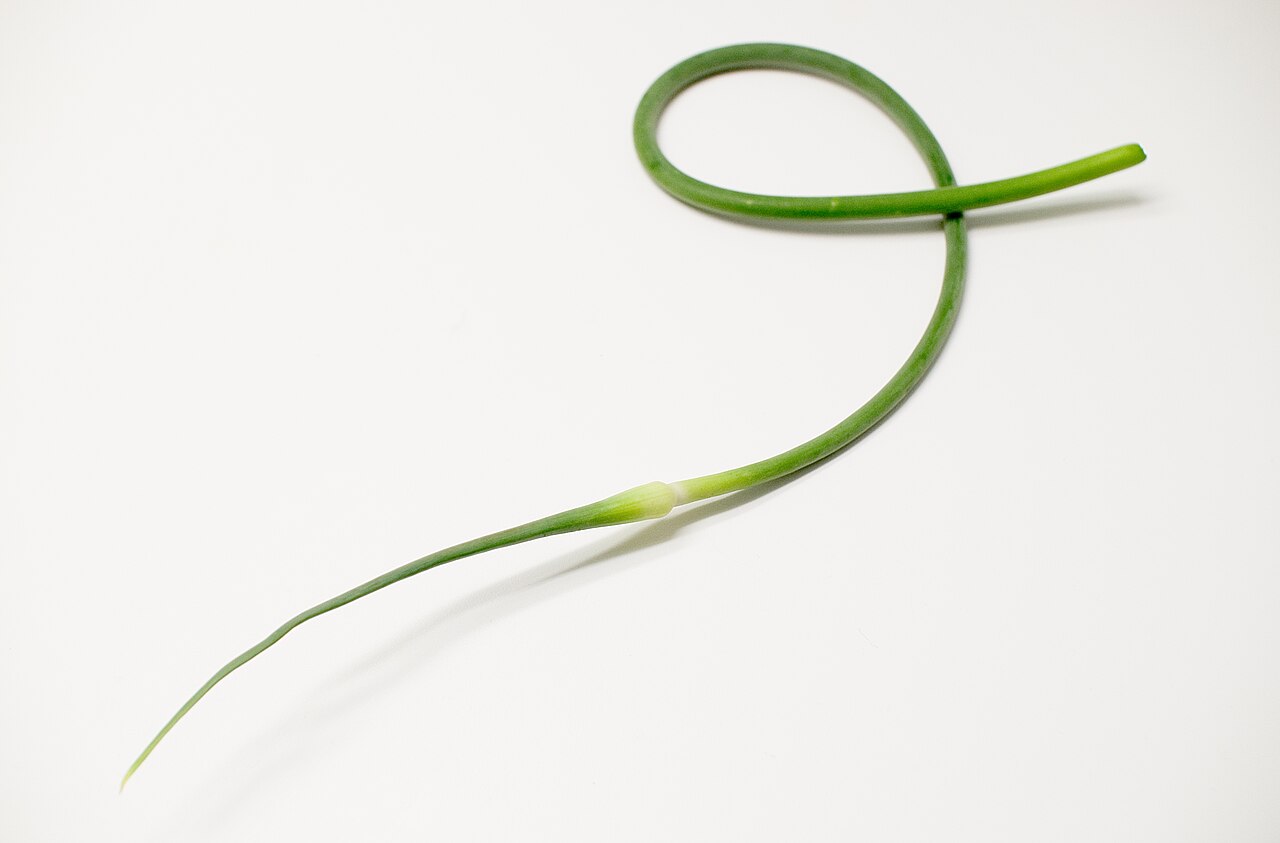
The scape is cut as soon as it forms its first curl, so the plant puts its energy into the bulb.
Green garlic
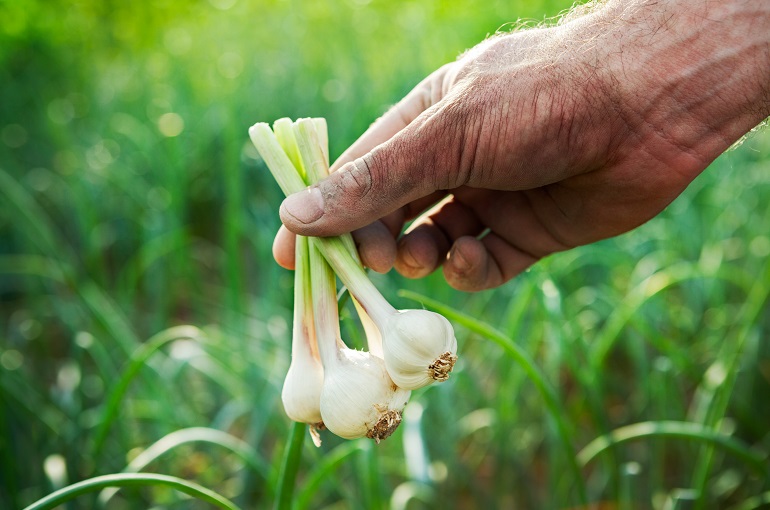
For green garlic, plant cloves more closely, and the small inner cloves can be used too. Harvest 2 to 3 months after planting, when the foliage reaches 20 to 30 cm, and eat the whole plant, like a spring onion.
When to harvest garlic
Bulbs are harvested 6 to 8 months after planting, when most of the leaves have yellowed and bent over. A practical check is to dig up one bulb and see whether the cloves have filled out and the outer skin is still intact. Leaving it too long makes the bulbs split open and store poorly. Lift the bulbs with a garden fork rather than pulling them by the leaves, and carefully, because every wound becomes a point of rot in storage.
Curing and storage
After harvest, cure the whole plants with their leaves for 2 to 4 weeks in a cool, dry, shaded and well-ventilated place. If they stay on the ground for a few days, cover them with their own leaves to protect them from sunscald. Once the outer skin is dry and papery, trim the roots and tops, or braid the plants, and store them somewhere cool, dry and dark. Storing garlic in larger quantities follows the same principles.
Growing garlic in pots
Without a garden, garlic grows well in a pot or window box on a balcony:
- Container: at least 25 cm deep, with drainage holes. Plastic or glazed pots resist cracking in hard frosts better than unglazed terracotta
- Growing medium: loose potting compost with perlite or pumice for good drainage
- Number of cloves: as a rule of thumb, 2 to 3 cloves in a 15 cm pot, 4 to 6 in a 20 cm pot and 8 to 10 in a 25 cm pot, at the same spacing as in the ground and not too close to the edge
- Position: a south- or west-facing balcony, with 6 to 8 hours of sun
- Watering: moderate, when the surface dries, without water standing in the saucer, because pots rot cloves more easily than open ground
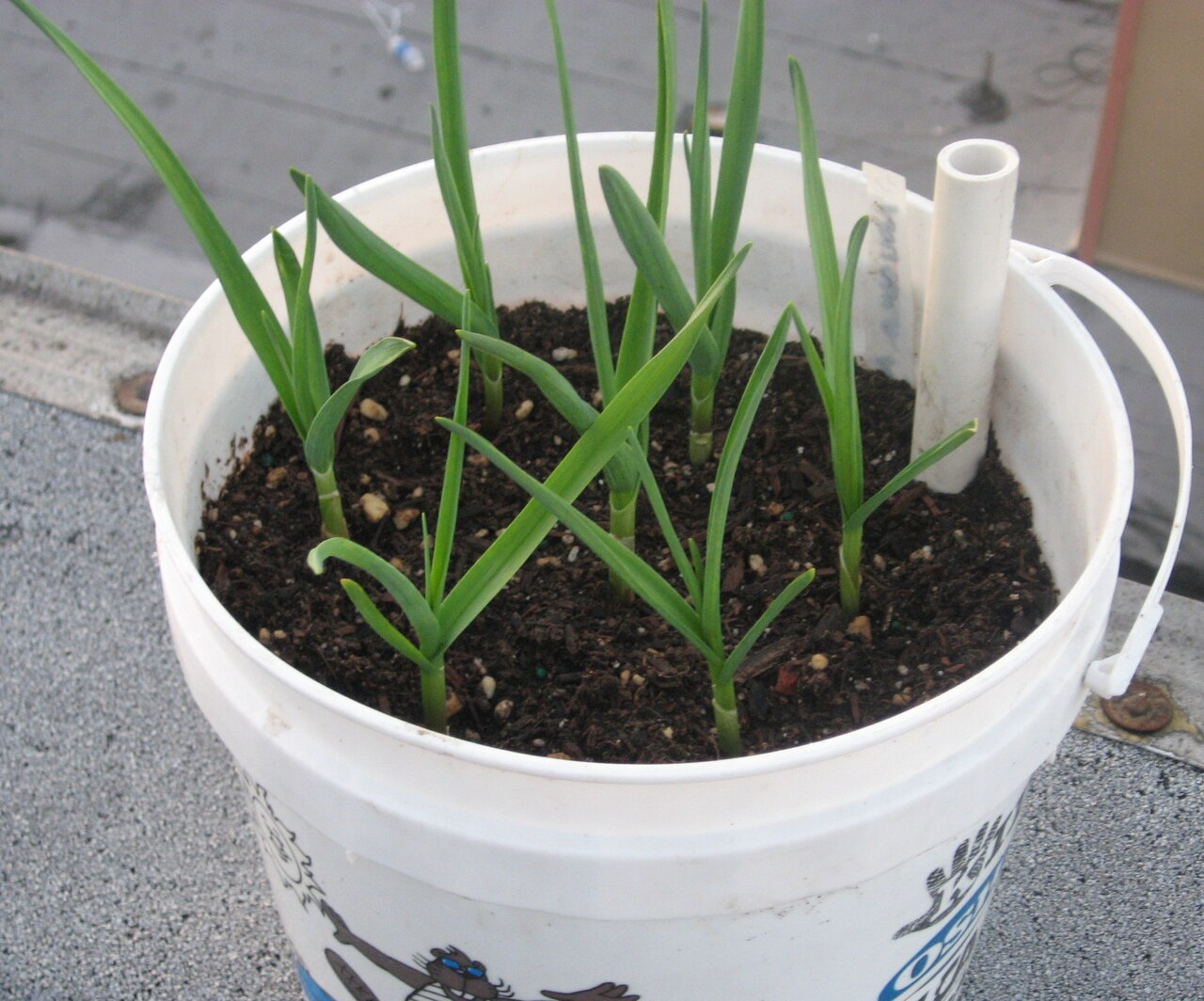
A container at least 25 cm deep with drainage holes is enough for a few garlic plants on a balcony.
Growing garlic indoors and in water
Indoors, garlic easily produces greens but not bulbs, because it needs strong sun and the winter cold that a home does not provide. For greens, place the cloves in a shallow container, base down, so that only the base touches the water, since fully submerged cloves rot. Change the water every 2 to 3 days, and within one to two weeks roots and green shoots appear, which are snipped with scissors and used like chives.
Companion planting
Garlic grows well alongside lettuce, spinach, parsley and celery, which makes better use of garden space. It should not follow onions or leeks, though, because they share the same diseases and pests, and it returns to the same spot only after three years.
Common problems
- Cloves rotting after planting: from overwatering, heavy soil or infected cloves
- Early yellowing of the leaves: possibly white rot, Fusarium or spring drought
- Silvery flecks on the leaves: a sign of thrips
- Small bulbs: from too little sun, overcrowding, spring drought or weed competition
- A bulb with no cloves: from insufficient winter cold or very late planting
Frequently asked questions
What is the best month to plant garlic
In mild and Mediterranean climates, October to November. In cold climates, mid-autumn a few weeks before the ground freezes, or late winter to early spring. Autumn planting gives bigger bulbs, because the plant gets the cold it needs to form cloves.
Can I plant garlic from the supermarket
It may sprout, but it often comes from varieties with different climate needs and is sometimes treated to delay sprouting. For a reliable result, certified seed garlic is preferred.
How deep and how far apart should garlic be planted
The tip of the clove sits about 2.5 cm below the surface, with 10 to 15 cm between cloves and 25 to 30 cm between rows. In light soils planting can be slightly deeper.
Why did my garlic form one bulb with no cloves
Usually because it did not get enough winter cold. Most varieties need one to two months at 0 to 10°C, which is why spring and very late planting often produce single-clove garlic.
Can garlic grow in water
Yes, but only as greens. A clove with its base in water produces roots and green shoots within one to two weeks, but it will not form a full bulb without soil, sun and a cold period.
How many garlic cloves fit in a pot
About 2 to 3 in a 15 cm pot, 4 to 6 in a 20 cm pot and 8 to 10 in a 25 cm pot. The pot should be at least 25 cm deep with good drainage.
Important notes
Every garden differs, and planting dates shift with region, altitude and each year's weather. For persistent disease problems, a local agronomist can help with an accurate diagnosis.
References
- Royal Horticultural Society, How to grow garlic.
- Savvy Gardening, How to grow garlic in pots.