




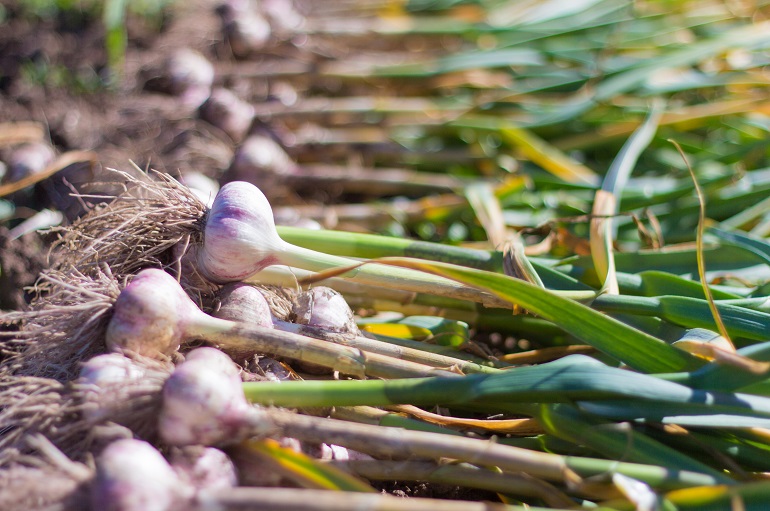
Dry garlic is harvested 6 to 8 months after autumn planting, in Mediterranean regions from May to August, once the neck above the bulb softens and the leaves yellow while still keeping a little green. The best time is when about 80 to 90% of the crop has matured. After harvest, garlic is cured for about a week in the field or in a drying facility, graded by size, and stored at 0 to 1°C with about 60 to 70% relative humidity, where it keeps for 6 to 7 months. This guide covers when and how to harvest, how garlic is cured and graded, the quality classes used in trade, how to store garlic for eating and for planting, and the yields it gives per hectare.
When garlic is ready
Maturity shows in two signs. The stem softens just above the bulb, and the leaves yellow while keeping a little green. A practical check is to lift a few bulbs from different parts of the field and see whether the cloves have filled out and the outer scales are intact.
Timing matters in both directions. Delaying harvest several weeks beyond this stage makes cloves separate, discolour and suffer sunscald, while in humid areas bulbs split and cloves become exposed. Harvesting too early, on the other hand, gives smaller bulbs with thin scales.
The three forms of garlic on the market
Garlic is sold in three forms, which are also defined in the UNECE FFV-18 marketing standard:
| Form | Characteristics | When it is harvested |
|---|---|---|
| Fresh | Green stem and fresh outer skin | Early spring, from successive plantings |
| Semi-dry | Stem and outer skin not completely dry | Close to maturity, for immediate sale |
| Dry | Stem, outer skin and the skin of each clove completely dry | At maturity, for storage |
For fresh garlic, growers plant cloves in successive plantings from autumn to early spring, so harvest and sales are staggered.
How harvest is done
Harvest starts once the soil has dried and the weather is settled. On small areas it is done by hand with a fork, on larger ones mechanically. A common system is a tractor pass with a blade that cuts the roots just beneath the bulbs and loosens the soil, after which the bulbs are lifted by hand. Either way, harvest is done carefully, because every wound becomes an entry point for Penicillium, Fusarium and mites, the main storage garlic diseases.
Curing
Curing dries the scales so they become protective, and it is the precondition for long storage. Growers follow two routes:
- In the field: bulbs are left in the field for about 7 days, depending on the weather, covered with the plants' own leaves to protect them from sunscald. If they will be exposed for more than an hour or two, they are covered. If rain or dew threatens, they are moved to a well-ventilated shed
- In a drying facility: bulbs are taken the same day to a dryer or drying space with controlled temperature, humidity and airflow
After curing, the dry tops are cut about 2 cm above the bulb and the roots are trimmed, by hand or with a machine that can also grade by size. These machines do not work well when the tops are still green. Garlic sold in braids is not trimmed but braided with its leaves, usually in braids of 25 bulbs. Softneck varieties braid more easily than hardnecks.
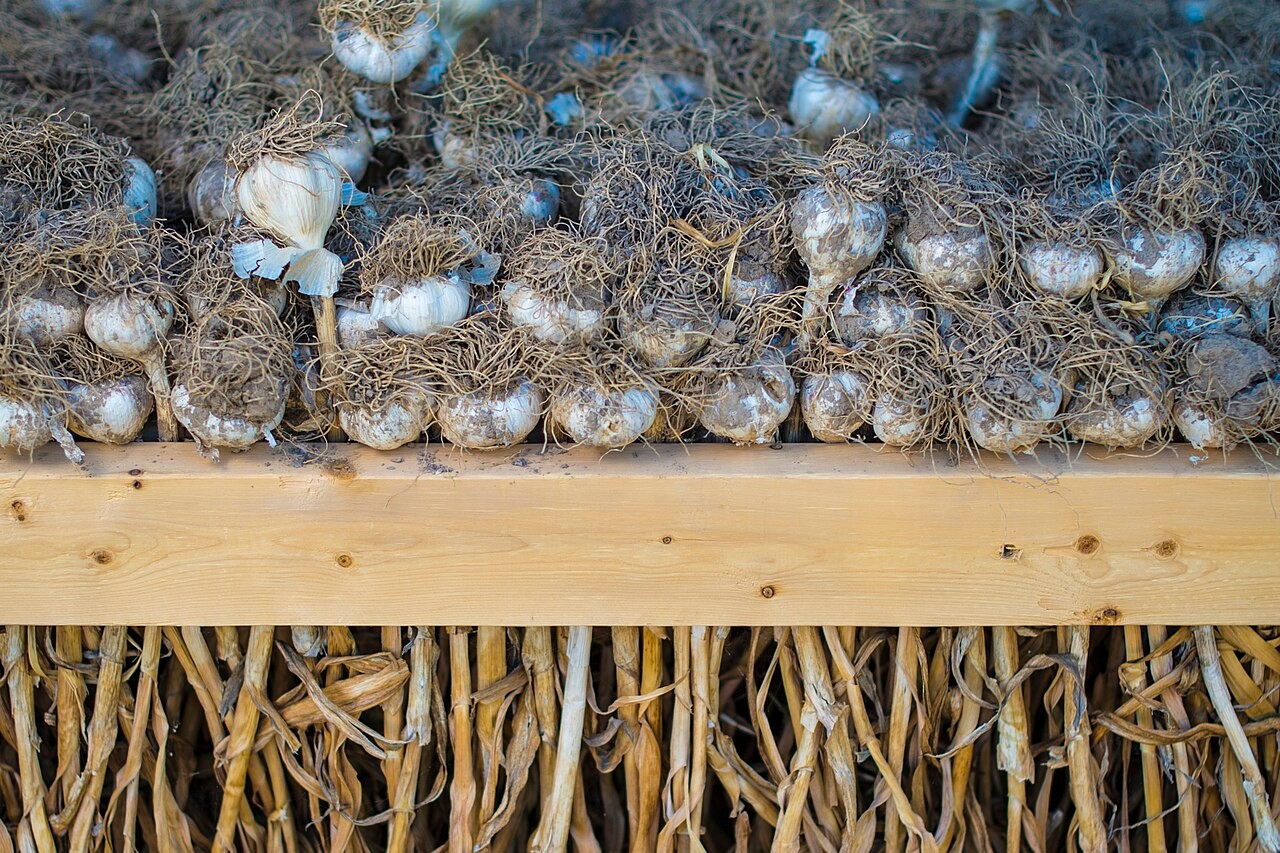
Curing dries the outer scales so they protect the bulb, and it is the precondition for long storage.
Grading and quality classes
The price of garlic depends mainly on bulb size and appearance, so grading is one of the most important post-harvest jobs. In international trade, including the European market, the UNECE FFV-18 standard applies, with three classes:
| Class | Minimum diameter | Quality |
|---|---|---|
| Extra | 45 mm | Superior quality, free of defects |
| Class I | 30 mm | Good quality, with slight defects such as minor tears in the outer skin |
| Class II | 30 mm | Tears, healed injuries, slight bruising, irregular shape and up to three missing cloves allowed |
Size is measured at the maximum diameter of the bulb's equatorial section. For uniformity, the difference in diameter between the smallest and largest bulb in the same package may not exceed 15 mm when the smallest is under 40 mm, and 20 mm when it is 40 mm or more. Bulbs with cloves showing externally visible sprouts are limited to 1% by weight in Class I and 5% in Class II. In practice, garlic is packed in 10 kg cartons, sacks or mesh bags, and small or defective bulbs go for processing.
Storage
| Purpose | Conditions | Duration |
|---|---|---|
| Long-term storage for eating | Cold store at 0 to 1°C, 60 to 70% relative humidity, no light | 6 to 7 months, depending on variety |
| Storage without refrigeration | Cool, dry, dark, well-ventilated space, in mesh bags or crates | At least 3 months |
| Seed garlic for planting | Whole bulbs at about 10°C, within limits of 5 to 18°C | Until planting |
Two conditions must be avoided. Sprouting is fastest at temperatures around 4°C, so intermediate temperatures between a cold store and a cool room do not suit garlic. Relative humidity above 70% in storage causes mould and root growth. The basic precondition for any storage is that bulbs are properly cured and injured bulbs removed at grading. For seed garlic, correct storage until garlic planting decides sprouting and bulb size the following season.
Yields per hectare
Yields vary widely with variety, planting density and season. According to Greek cultivation guides, they range from 5 to 20 tonnes per hectare, or from 200,000 to 300,000 bulbs, of which around 150,000 are first-size bulbs. In Australia, most crops yield 6 to 8 tonnes per hectare. Dense planting raises total yield but lowers the share of large bulbs, which command better prices.
Frequently asked questions
When should garlic be harvested
Dry garlic 6 to 8 months after autumn planting, in the Mediterranean from May to August. Harvest when 80 to 90% of the crop has matured, with dry soil and settled weather.
How do I know garlic is ready to harvest
The stem softens just above the bulb and the leaves yellow while keeping a little green. A sample of bulbs shows whether the cloves have filled out and the scales are intact.
How long does garlic take to cure
In the field about 7 days, depending on the weather, covered with its own leaves. Alternatively, it is taken the same day to a drying facility with controlled conditions.
At what temperature should garlic be stored
For long-term storage at 0 to 1°C with 60 to 70% relative humidity, where it keeps 6 to 7 months. Without refrigeration, in a cool, dry, dark, ventilated space, it keeps at least 3 months.
Why does garlic sprout in storage
Sprouting is fastest at temperatures around 4°C, like the main compartment of a household fridge. Humidity above 70% also encourages mould and root growth.
What is the minimum size for Extra Class garlic
Under the UNECE FFV-18 standard, the minimum diameter is 45 mm for Extra Class and 30 mm for Classes I and II, measured at the bulb's maximum diameter.
Important notes
Harvest timing and curing and storage conditions are adapted to the variety, the season's weather and the market destination. For organising storage of large quantities, advice from a local agronomist helps avoid losses.
References
- Plant Protection, Garlic cultivation technique (in Greek).
- NSW Department of Primary Industries, Growing garlic in NSW, Primefact 259.
- UNECE, Standard FFV-18 concerning the marketing and commercial quality control of garlic.
- CBI, Entering the European market for fresh garlic.
- Ypaithros Chora, Garlic cultivation, what growers need to know (in Greek).