






Garlic has a shallow root system, concentrated mainly in the top 60 cm of soil, and it performs best when moisture in that layer stays close to field capacity throughout spring growth. In measurements by the United States Department of Agriculture, the crop used about 426 mm of water from March to late May, or around 4,260 cubic metres per hectare including rainfall. Irrigation is light and frequent, and it stops 1 to 3 weeks before harvest, at the first signs of maturity. This guide covers how much water garlic needs, which stages are critical, when and why irrigation stops, and which irrigation system suits each field.
How much water garlic needs
Water needs depend on weather, soil, variety and planting season. Autumn-planted garlic needs little until spring, because winter rain usually covers its slow growth, while spring-planted garlic needs irrigation earlier.
The most detailed measurement comes from a USDA trial in California. From 1 March to 21 May the crop used 426 mm, of which 108 mm was rainfall. Maximum yield was reached at 100% replacement of crop evapotranspiration, and extra water gave no further gain. The peak crop coefficient reached 1.3 to 1.4, higher than the FAO 56 guideline values, which shows that garlic's spring water demand is substantial. Other studies found higher yields with water applications of 1.2 to 1.4 times cumulative pan evaporation.
The role of soil
Because roots are confined to the top 60 cm, the soil's water-holding capacity decides how often to irrigate. Trials on light and heavy soils showed the difference:
- Sandy loam soils: yield fell linearly as water was reduced, because the soil does not store enough moisture. Regular irrigations covering full evapotranspiration are needed here
- Clay loam soils: there was no yield loss with less water, because garlic drew moisture from deeper than 1 m when the profile was full from winter
On heavy soils the bigger risk is the opposite, excess water that rots the cloves, and tensiometers help schedule irrigation accurately.
Critical growth stages
| Stage | Water need | Risk |
|---|---|---|
| Planting and emergence | One irrigation only if the soil is dry | Excess water rots the cloves |
| Winter | Usually covered by rain | Standing water on heavy soils |
| Spring vegetative growth | Rising quickly | Shortage limits the foliage on which bulb size depends |
| Bulbing and bulb fill | The highest | Shortage gives small cloves and irregular bulbs, excess causes rots |
| Maturity | Irrigation stops | Discoloration, rot and splitting bulbs |
When to stop irrigating
Irrigation stops at the first signs of maturity, when the leaves begin to yellow and the neck above the bulb softens. In practice that is 1 to 3 weeks before harvest. Greek cultivation guides cite stopping 7 to 10 days before, depending on the weather, while the international literature recommends up to 3 weeks. The difference depends mainly on soil, because heavy soils hold moisture longer.
Continued irrigation, or rain at this stage, discolours the outer bulb scales, causes rot and exposes the outer cloves, which lowers market value. Once the plant matures its water use drops, so the soil stays wet longer and damages the roots.
Irrigation systems
| System | Advantages | Drawbacks |
|---|---|---|
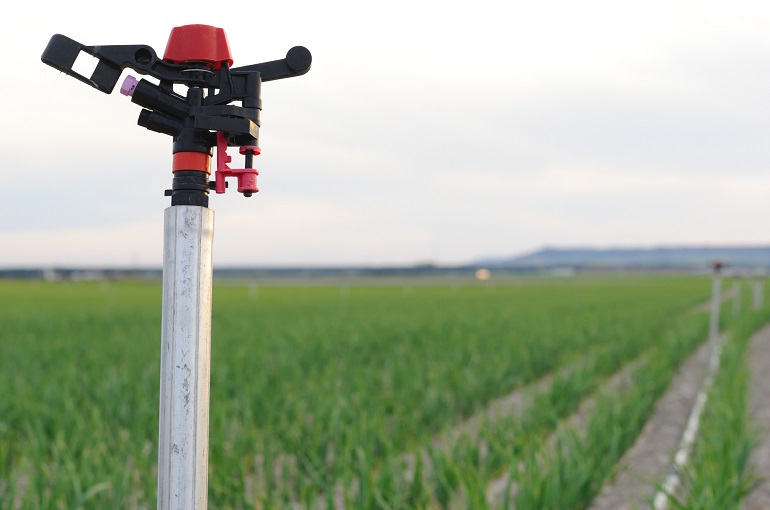
| Micro-sprinklers | The most common system in Greece, easy to install, even coverage | Wets the foliage, favouring downy mildew and rust |
| Drip | Precise control, dry foliage, water savings, allows fertigation | Higher installation cost, needs good filtration |
| Overhead sprinklers | Covers large areas, partly suppresses thrips | Wets the foliage and wastes more water |
| Furrows | Low cost | Poor water efficiency, hard to control quantities |
The striking finding of the USDA study is that, with full replacement of crop water needs, yield hardly differed between subsurface drip, surface drip and furrows. The difference lies in the water used for the same crop. In another study, drip irrigation produced an average of 5.2 kg of garlic per cubic metre of water, against 2.7 kg with furrows, and other work reports water savings of 30 to 40% compared with surface irrigation. Drip also allows garlic fertilisation through the water in small, frequent doses.
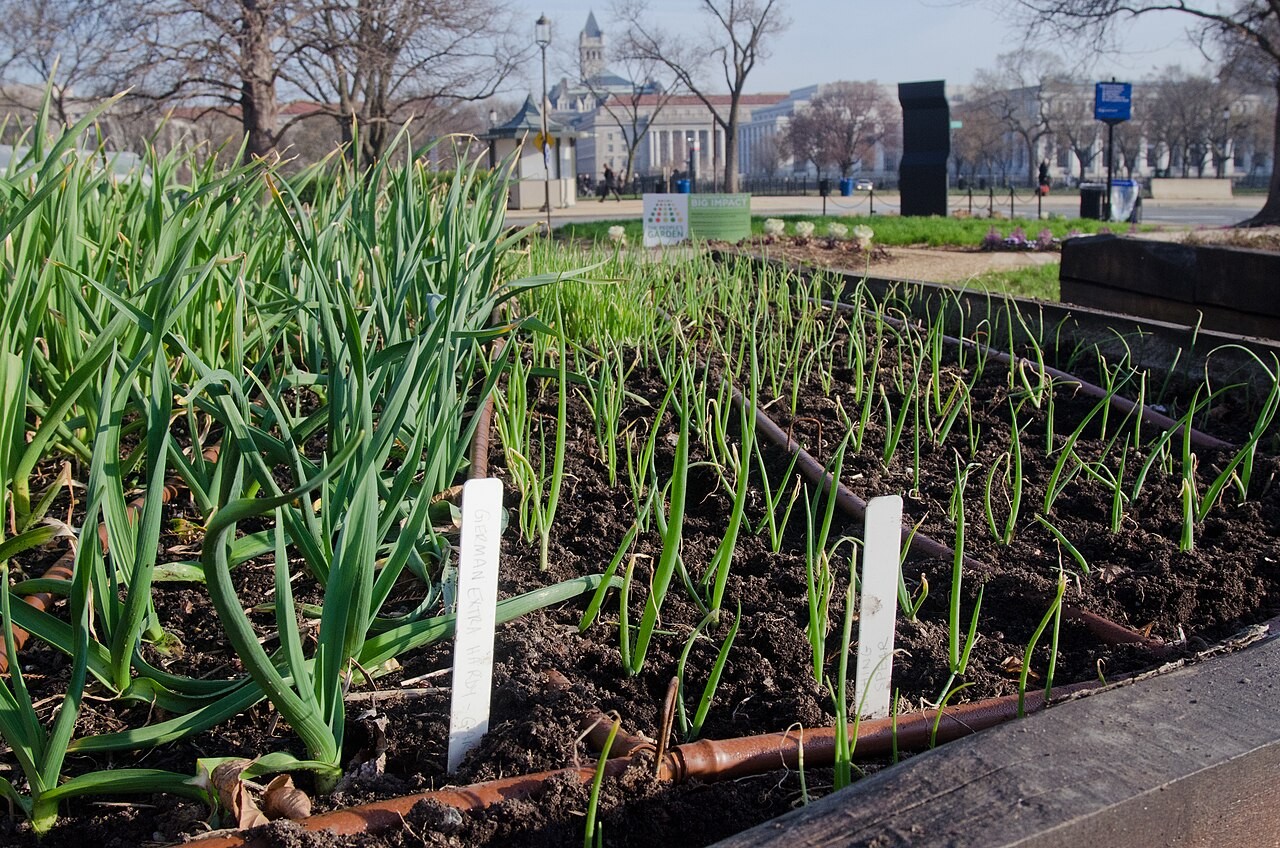
Drip lines laid along the rows water the root zone directly and keep the foliage dry.
Practical tips
- Irrigate in the morning, so the foliage dries during the day and fungal infections are limited
- Use good-quality water, because garlic is sensitive to salinity
- Use tensiometers or moisture sensors, to irrigate on actual soil moisture rather than a fixed calendar
- Mulch with film or straw, which reduces evaporation and weeds
- Take care in late spring, when moisture on the foliage favours Botrytis and other garlic diseases
Frequently asked questions
How much water does garlic need
In USDA measurements, about 426 mm from March to late May, including rainfall. Maximum yield was reached at 100% replacement of crop evapotranspiration, and extra water gave no further gain.
How often should garlic be irrigated
With light, frequent irrigations in spring that keep the top 60 cm of soil close to field capacity. Sandy soils need more frequent irrigation, heavy soils less.
When should you stop watering garlic
At the first signs of maturity, when the leaves yellow and the neck softens, which is 1 to 3 weeks before harvest. Late watering discolours and rots the bulbs.
Drip or sprinklers for garlic
Micro-sprinklers are the most widespread in Greece, but they wet the foliage and favour disease. Drip keeps the foliage dry, saves water and allows fertigation, while with full replacement of water needs the yield is similar.
What does water stress do to garlic
During bulbing it produces small cloves and irregular bulbs. Earlier in spring it limits the foliage, on which final bulb size depends.
What does overwatering do to garlic
It rots cloves after planting, favours fungal disease in spring, and near harvest discolours and rots the bulbs.
Important notes
Irrigation amounts and frequency are adapted to the soil, each season's weather and the irrigation system. For scheduling irrigation on large areas, advice from a local agronomist helps with correct application.
References
- Ayars J. E., Water requirement of irrigated garlic, USDA Agricultural Research Service, 2008.
- Response of garlic to irrigation water, Agricultural Water Management, 2002.
- NSW Department of Primary Industries, Growing garlic in NSW, Primefact 259.
- Plant Protection, Garlic cultivation technique (in Greek).
- Water use efficiency and yield of garlic responses to the irrigation system, intra-row spacing and nitrogen fertilization, 2010.