




The most serious diseases of garlic are white rot (Sclerotium cepivorum), Fusarium rot, Penicillium decay, downy mildew and rust, while the most important pests are thrips, nematodes and bulb mites. Most of these problems share one feature. They are carried into the field with the planting material itself, meaning infected cloves, or they survive in the soil for years. That is why healthy seed cloves and crop rotation achieve more than any spray programme. This guide covers how to recognise each problem from its symptoms, what causes it, and how prevention and control are organised.
Symptom table
| What you see | Likely cause | When and where |
|---|---|---|
| Yellowing from the oldest leaves, fluffy white growth at the base with tiny black bodies, plants that pull out easily | White rot | Cool, moist soil, in patches across the field |
| Leaf-tip dieback and a brown watery rot rising from the bulb base | Fusarium rot | From mid-season, continuing in storage |
| Gaps in emergence, cloves with blue-green mould | Penicillium decay | After planting and in storage |
| Pale oval lesions on the leaves covered with greyish fuzz | Downy mildew | Spring, in high humidity |
| Orange rust-like pustules on the leaves | Rust | Mild temperatures with prolonged moisture |
| Rot starting at the neck and moving down | Botrytis or bacterial rot | After rain at harvest and in storage |
| Silvery-white flecks and speckling on the leaves | Thrips | Spring and early summer |
| Stunted plants, distorted, swollen or split bulbs | Stem and bulb nematode | Cool, moist soils |
| Dehydrated, shrivelled cloves with yellow spots | Bulb mites | Mainly in storage |
| Yellow streaks along the leaves and delayed growth | Viruses | From the start, through infected cloves |
One practical rule helps with diagnosing rots. Fusarium and white rot progress from the bulb base upward, while Botrytis and bacterial rots progress from the neck downward.
The main diseases
White rot
White rot is caused by the fungus Sclerotium cepivorum, whose sexual stage is Stromatinia cepivora, and it is considered worldwide the most serious disease of crops in the genus Allium. It attacks only garlic, onion, leek and related species. Leaves decay at the base, turn yellow, wilt and topple, starting with the oldest, while the roots rot and the plant pulls out of the ground easily. A fluffy white fungal growth forms around the base, dotted with tiny black bodies, the sclerotia.
The sclerotia are what make this disease so difficult. They survive in soil for over 20 years, even with no host crop. According to UC IPM, a single sclerotium per 10 kg of soil is enough to start disease, one per kilogram causes measurable yield loss, and 10 to 20 per kilogram infect essentially every plant. One sclerotium can infect a group of 20 to 30 neighbouring plants, which is why symptoms appear in patches across the field.
Infection is favoured by cool, moist soil, at soil temperatures from 10 to 24°C with an optimum of about 16 to 18°C, and it is markedly inhibited above 25°C. Sclerotia spread with infected cloves, irrigation water, machinery and anything that moves soil. The most effective defence is avoidance and sanitation, meaning healthy planting stock, cleaning machinery between fields, and keeping Allium crops out of an infested field for many years.
Fusarium rot
Garlic suffers two forms. Basal rot, caused by Fusarium oxysporum f. sp. cepae, and bulb rot, caused by Fusarium proliferatum. Foliage shows wilting and a yellow-tan dieback of the leaf tips, often from mid to late season, while the bulb develops a brown watery rot that starts at the basal plate and moves up into the cloves. The fungus lives for many years in soil and infection is often linked to mechanical or insect injury. Its most insidious feature is that bulbs can look sound at harvest while the rot progresses in storage.
Penicillium decay
Penicillium decay, also called blue mould, is caused mainly by Penicillium hirsutum. It shows up in two ways, as poor stands in the field when infected cloves rot before they sprout, and as bulb decay in storage. The first symptoms are water-soaked or pale yellow areas on the surface of the scales, later covered by blue-green mould. The fungus enters mainly through wounds, which is why cloves are separated shortly before planting and with care, so they are not bruised.
Downy mildew
Downy mildew is caused by Peronospora destructor and is favoured by high humidity. Oval, pale to yellowish lesions appear on the leaves and, under favourable conditions, are covered by greyish, fuzzy growth. Young plants can be killed, and infected bulbs shrivel and rot, in the field and in storage. In humid areas, wider spacing, rows aligned with the prevailing wind and avoiding sprinkler irrigation all help.
Rust
Rust is caused by Puccinia allii and is favoured by mild temperatures with prolonged periods of moisture. It forms orange, rust-like pustules, mainly on the undersides of the leaves, which later darken. Experienced growers know that timely planting, though not too early in the season, reduces the risk of infection.
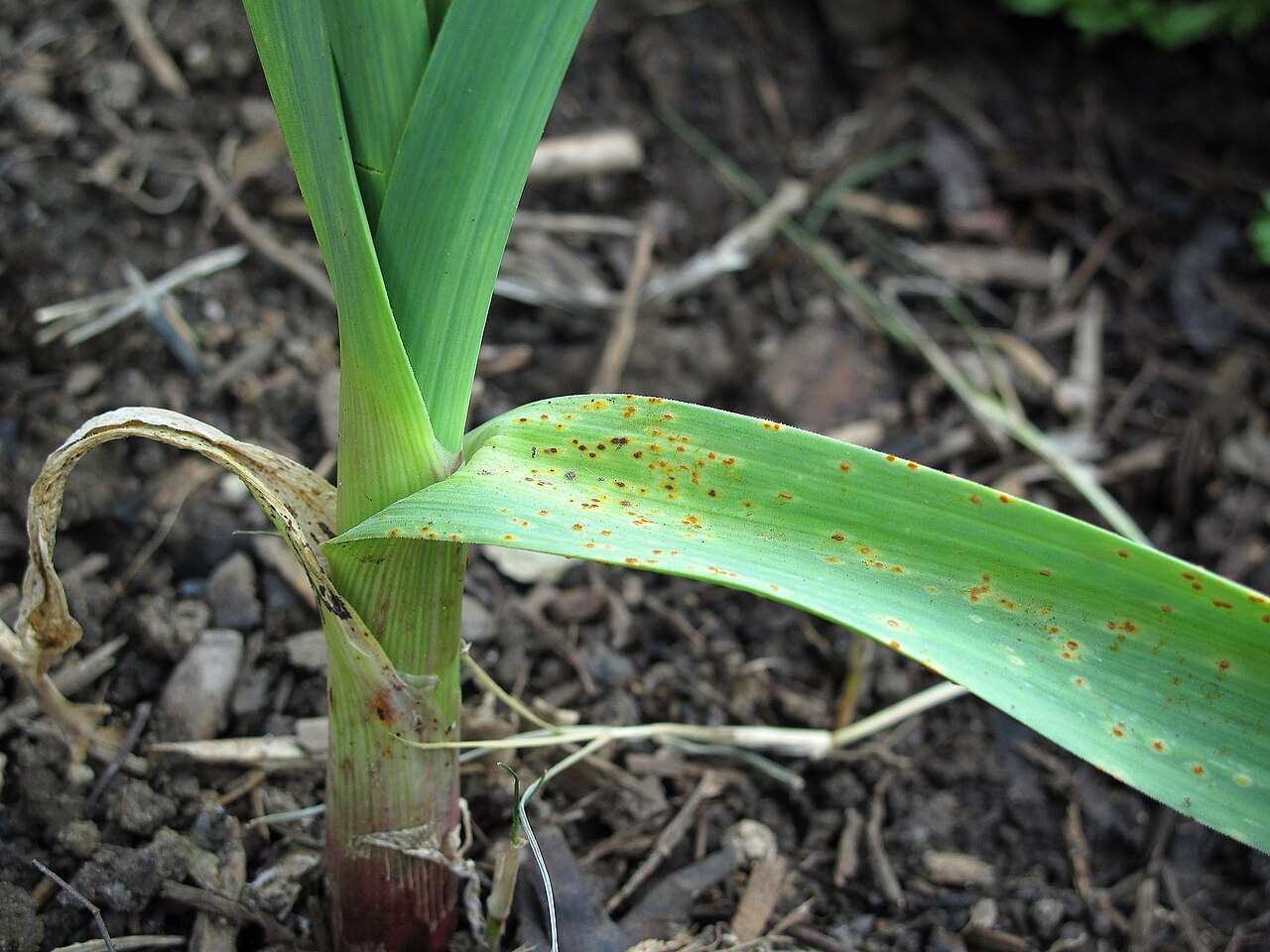
Rust forms orange pustules on the leaves and is favoured by mild temperatures and long spells of moisture.
Botrytis and bacterial rots
Botrytis causes neck and bulb rot that progresses from the top down and produces mycelium and sclerotia when conditions allow. Bacterial rots need water to enter and spread, are favoured by warm, wet conditions, and get in through the neck or through wounds. In both cases, harvesting in dry weather, curing the bulbs properly and avoiding injury are the key measures.
Viruses
Onion yellow dwarf virus (OYDV), leek yellow stripe virus (LYSV) and related viruses, which often occur together in the same plant, cause chlorotic yellow streaks on the leaves and delayed growth. Because garlic is propagated from cloves, viruses pass from one crop to the next, while in the field they are spread by aphids and thrips. There is no cure, so the only measures are healthy planting stock from a reliable source and control of the vectors.
The main pests
Thrips
Onion thrips (Thrips tabaci) and western flower thrips (Frankliniella occidentalis) are tiny insects 0.5 to 2 mm long. They cause damage in two ways, by sucking sap from the foliage and by transmitting viruses. They hide in the leaf axils, close to where the leaves join the stem, and the characteristic symptoms are silvery-white flecks and speckling on the leaves. Monitoring intensifies in spring and early summer, with coloured sticky traps and regular checks of random plants. According to the New South Wales Department of Primary Industries, treatment is usually needed when counts average 5 adult thrips per plant, while rain and sprinkler irrigation partly suppress populations. Because thrips develop resistance easily, where treatment is needed products with different modes of action are rotated.
Nematodes
The stem and bulb nematode (Ditylenchus dipsaci) is the most serious nematode of garlic. It is favoured by moist, cool soils, enters plants through wounds and natural openings, and causes stunting, distortion, swelling and splitting of the bulbs. Root-knot nematodes (Meloidogyne spp.) form galls on the roots and considerably reduce bulb size. Nematodes are usually introduced into a field with infected cloves, so certified planting stock is the first measure. Deep ploughing and soil solarisation during the hottest months follow.
Bulb mites
Two groups of mites attack garlic. Mites of the genus Rhizoglyphus overwinter in soil and in stored bulbs, and in the field feed mainly on the roots and basal plate. The eriophyid mite Aceria tulipae, known as the four-legged mite, is mainly a storage problem, where it dehydrates the cloves. Its relative the wheat curl mite (Aceria tosichella), which lives mainly on cereals and grasses, causes similar damage, which is why garlic is not grown in succession on the same field or straight after maize or wheat. Both groups open wounds through which Fusarium and Penicillium enter, so their damage multiplies.
Onion fly
The larvae of the onion fly (Delia antiqua) tunnel into the base of the plant and the bulb, causing wilting and rot. Damage is worse in cool, moist conditions and in soils rich in undecomposed organic matter, so any manure applied must be well rotted.
How problems are prevented
- Healthy planting stock: the single most important measure. White rot, Fusarium, Penicillium, nematodes, mites and viruses are all carried on cloves. Certified seed garlic is preferred, and at planting any clove with spots, soft areas or mould is discarded
- Crop rotation: garlic does not return to the same field for at least three years, and never after onion or leek. In fields with white rot, the break from Allium crops must be far longer
- Drainage and spacing: well-drained soils and planting distances that allow airflow limit most fungal diseases
- Irrigation at the root: drip irrigation keeps the foliage dry, unlike sprinklers
- Sanitation: clean machinery between fields, remove crop debris and the weeds that host thrips
- Careful harvest: in dry weather, without injury, and with proper curing before storage
Chemical control
Where prevention is not enough, chemical control is used only after diagnosis by an agronomist and only with products registered in your country for garlic and for the specific pest or disease. Registrations change frequently, and active substances listed in older or foreign guides may no longer be permitted, particularly within the European Union. For foliar fungal diseases, registered fungicides are used, often preventively in humid seasons, while for thrips modes of action are rotated to avoid resistance. Protecting beneficial insects helps keep thrips and aphid populations low. In any commercial garlic crop, prevention remains the foundation.
Frequently asked questions
What is the most serious garlic disease
White rot (Sclerotium cepivorum), because its sclerotia survive in soil for over 20 years. Once it becomes established in a field, growing garlic and onion there becomes very difficult for many years.
Why is my garlic rotting
The usual causes are Fusarium and white rot, which start at the bulb base, and Botrytis or bacterial rots, which start at the neck. Overwatering, poor drainage and harvesting in wet weather favour all of these rots.
Why are my garlic leaves turning yellow
When they yellow at the end of the season, it is a sign of normal maturity. When they yellow earlier, possible causes are white rot, Fusarium, downy mildew or viruses, and the diagnosis rests on the other symptoms.
What are the silvery spots on garlic leaves
They are the characteristic symptom of thrips, tiny insects that suck sap from the leaves. They hide in the leaf axils and transmit viruses.
Can I plant garlic after onions
It is not recommended, because garlic and onion share the same diseases and pests, including white rot, Fusarium and thrips. A rotation of at least three years with crops from other families is preferred.
How do I protect garlic in storage
Cure the bulbs properly before storage, sort out and discard injured bulbs, and store them in a cool, dry, well-ventilated space. Penicillium, Fusarium and mites enter mainly through wounds.
Important notes
Treatment dates vary by region and season, so follow local plant protection guidance.
Use only products registered for garlic in your country, follow the label and the maximum number of applications per season, and apply cultural measures first. For serious or persistent problems, consult a local agronomist for an accurate diagnosis.
References
- UC Statewide IPM Program, White rot in onion and garlic.
- UC Statewide IPM Program, Fusarium basal rot in onion and garlic.
- UC Statewide IPM Program, Onion and garlic pest management guidelines.
- UMass Amherst, Alliums, post harvest and storage diseases.
- Pacific Northwest Pest Management Handbooks, Garlic white rot.
- NSW Department of Primary Industries, Growing garlic in NSW, Primefact 259.