

Olive oil market digest for week 45 of 2026
Spain's agriculture ministry published on 30 October the order that sets the olive oil marketing standard for 2026/27, under which mills can be required to withdraw up to 20% of estimated production, with the actual percentage due in a separate resolution before 15 November. Poolred data published on 3 November put extra virgin at €3.152/kg for 28 October to 3 November, and the Junta de Andalucía's price observatory put it at €3.03/kg for week 44. In Tunisia, two farm leaders expect the 2026/27 crop to fall by 40%, one to about 250,000 tonnes and the other to about 300,000 tonnes, while in Italy the industry association Assitol puts output at about 260,000 tonnes.
Stay up to date with our Weekly Olive Oil Market Digest
Spain's olive oil market
The agriculture ministry (MAPA) published Orden APA/1145/2026 of 29 October in the official gazette (BOE) on Friday 30 October, and it entered into force the next day. The order sets the olive oil marketing standard for the 2026/27 campaign, which runs from 1 October 2026 to 30 September 2027, under article 167 bis of the EU regulation on the common organisation of agricultural markets. Producing mills can be required to withdraw part of their oil and keep it off the market until the next marketing campaign, and the share to be withdrawn cannot exceed 20% of estimated production.
The standard can apply when opening stocks plus estimated production reach 120% or more of the average of that same sum over the six previous campaigns (article 4). The percentage itself is calculated from the gap between estimated resources, meaning opening stocks, production and the average imports of the last six campaigns, and 120% of the average of the two highest marketing levels of the last six campaigns (article 5). The Directorate-General for Agricultural Production and Markets must publish the percentage in the BOE before 15 November 2026, in a resolution that also sets the start date, at the latest 15 November, and from 31 December 2026 the quantity can be adjusted downwards.
The order contains no percentage and no tonnage, and no resolution setting the percentage had been published by 3 November. Minister Luis Planas had said on 26 October that the decision would come in the first days of November, according to Oleorevista. On 21 October the farm organisations ASAJA, COAG, UPA and Cooperativas Agro-alimentarias said origin prices for extra virgin were below €3.20/kg and asked for the standard to be applied.
The ministry's note on the order puts opening stocks for 2026/27 at 357,040 tonnes, 23.3% above the start of the previous campaign, from the data of its olive oil market information system (SIMO) of 28 October, and repeats the production estimate of 1,602,596 tonnes, 23% above the previous campaign. The AICA figure for stocks at 30 September is 356,914 tonnes, so the two releases differ by 126 tonnes, and both are shown here.
Poolred data published by ASAJA-Jaén on the morning of Tuesday 3 November put extra virgin at €3.152/kg, virgin at €2.886/kg and lampante, the lowest grade of virgin olive oil, at €2.756/kg for 28 October to 3 November, with 29 trades, outflows of 1,482 tonnes and an average of €3.071/kg across all grades. ASAJA's own report of the same morning rounds the three prices to €3.15/kg, €2.88/kg and €2.75/kg. It came out on the last day of the period it covers, so it is a snapshot rather than a closed week, and as the previous snapshot of 26 October, at €3.07/kg, €2.93/kg and €2.79/kg, was also published before its week closed, no weekly change is calculated here.
The Junta de Andalucía's price observatory put extra virgin at Andalusian mills at €3.03/kg for week 44, 26 October to 1 November, with virgin at €2.93/kg and lampante at €2.84/kg. Its page now shows extra virgin falling every week since week 40, from €3.36/kg to €3.18/kg in week 41, €3.14/kg in week 42 and €3.09/kg in week 43. The values for weeks 40 and 42 differ from those in our earlier digests and are corrected at the end of this article.
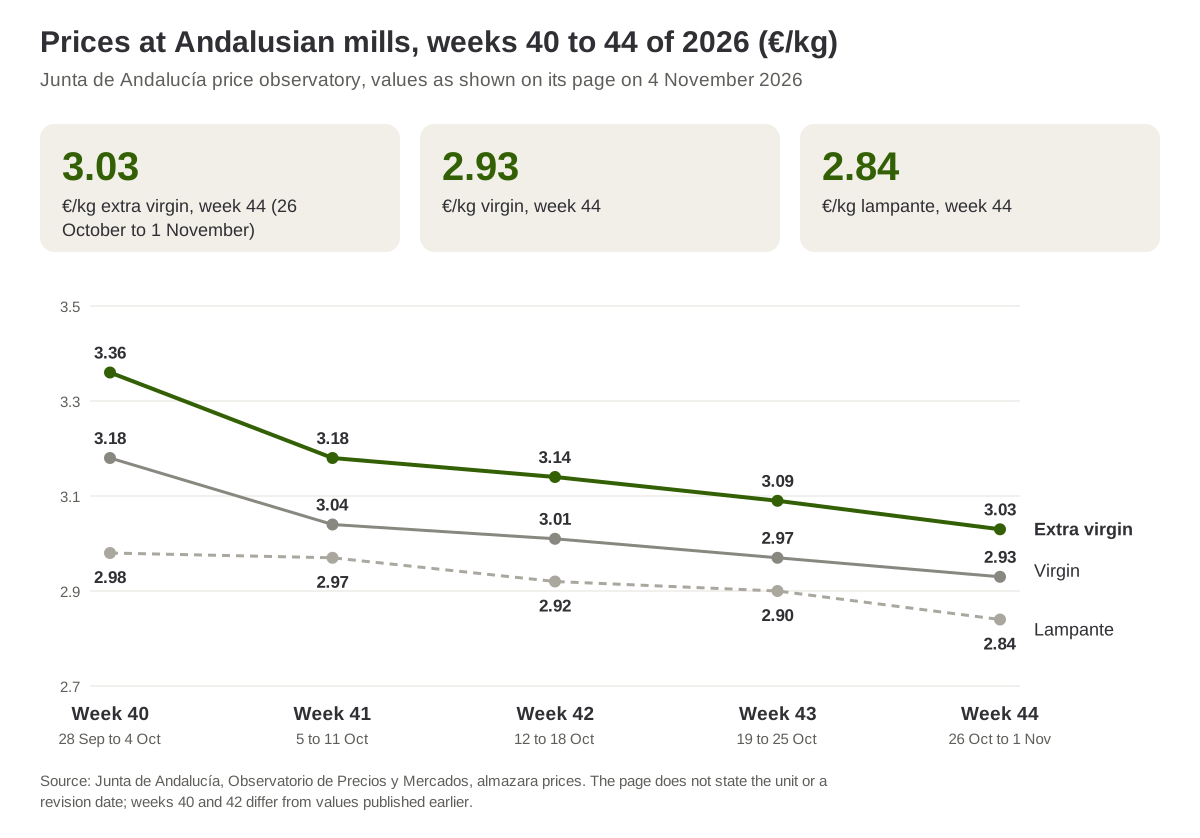
Extra virgin, virgin and lampante olive oil at Andalusian mills, weeks 40 to 44 of 2026, in €/kg, as shown on the Junta de Andalucía's price observatory page on 4 November 2026. The page does not state the unit. Source: Junta de Andalucía, Observatorio de Precios y Mercados.
El Español reported on 30 October that two alliances, Dcoop with Acesur and Coricelli with Migasa, are competing for Deoleo and that the sellers, CVC and Alchemy, are studying binding offers. The report names no sources, the company has published no statement or filing, and the bid amounts in circulation have not been confirmed by any named party.
Current origin quotations (Poolred via ASAJA-Jaén, 28 October to 3 November):
- Extra Virgin Olive Oil (EVOO): €3.152/kg
- Virgin Olive Oil (VOO): €2.886/kg
- Lampante Olive Oil: €2.756/kg
Greece's olive oil market
Kostas Apostolopoulos, president of the Chandrinou farmers' association in Messinia, says prices in the area range from €3.00 to €3.10/kg, AgroTypos reported on 3 November. Mavroelia is being harvested and the Koroneiki harvest has started early in small quantities, with very good quality olives but lower yields, and the article does not state the grade or say whether the price is for new oil.
On 23 October Apostolopoulos had put the price at €3.20 to €3.30/kg and the production cost at about €3.50/kg. Messinia growers have prepared a letter of demands for Prime Minister Kyriakos Mitsotakis, who is due in Kalamata on Thursday 5 November.
No new cooperative sale in Laconia was reported between 28 October and 3 November. The tax authority AADE refers, in circular E.2065 of 26 October on the areas where collective olive fly control was carried out in 2026/27, to the olive oil price of €1.524/kg set in circular E.2050 as the base for the olive fly levy, which is 2% of that value. This is a tax base and not a market price. Oleista's Greek row for week 44, unchanged since the previous week, gives extra virgin at €3.41/kg, virgin at €2.80/kg and lampante at €2.35/kg.
Current quotations (Greece):
- Producer price reported in Messinia, 3 November: €3.00 to €3.10/kg
- EVOO, Oleista, week 44: €3.41/kg
- VOO, Oleista, week 44: €2.80/kg
- Lampante, Oleista, week 44: €2.35/kg
Italy's olive oil market
Assitol, the association of the Italian oil industry, estimates national olive oil output for 2026/27 at about 260,000 tonnes, according to its release of 26 October. ItaliaOggi and TeatroNaturale published the same figure on 23 September, Assitol does not say how its estimate was reached, and ISMEA has not yet published a national estimate.
The market observatory of Certified Origins, a private olive oil trader, says Italian extra virgin traded at €4.30 to €4.90/kg in October, depending on quality, 38% to 46% below the roughly €8/kg of the end of 2025. It puts the gap with Spain at €0.40 to €0.60/kg, down from €2.55 to €3.05/kg in March. These are a trader's figures and not ISMEA data, and Oleista's Italian row for week 44, at €5.18/kg for extra virgin, comes from a different series.
The ICQRF inspectorate seized 465 quintals of irregular oil, a quintal being 100 kg, in two operations in Tuscany in the last week of October, first reported on 31 October. One involved 165 quintals of false extra virgin made from processing waste, without traceability. The other involved about 300 quintals of foreign oil declared as extra virgin for export outside the EU, which the ICQRF laboratory in Perugia classified as virgin.
The ICQRF stock report for 31 October has not been published yet, and last year's October report came out on 7 November 2025. The latest figure therefore remains 195,044 tonnes at 30 September.
Current quotations (Oleista, week 44):
- EVOO: €5.18/kg
- VOO: €3.00/kg
- Lampante: €2.69/kg
Portugal's olive oil market
The statistics institute INE expects olive productivity in 2026 to rise by 10% on 2025, for both oil and table olives, according to its October agriculture bulletin as reported by Agricultura e Mar, and hot summer weather brought the harvest forward. This is a yield forecast and not a production figure, and INE gives no tonnage. The ministry's SIMA bulletin for week 43, 19 to 25 October, puts bulk extra virgin at €3.55/kg, extra virgin in 5-litre containers at €5.39 per litre and virgin in 5-litre containers at €4.93 per litre, and the week 44 bulletin was not yet online on 4 November.
Tunisia's olive oil market
The support package of up to 150 million dinars for ONH purchases, approved by the ministerial council of 23 October, is now in the government's own communiqué with the same figures as in the press reports, but the government has still not published a forecast for 2026/27.
Midani Dhaoui, president of the farmers' union SYNAGRI, said on Jawhara FM on 28 October that production could be around 250,000 tonnes, a possible fall of 40%. According to Business News, some mills are selling new oil at 10 to 12 dinars per litre, with up to 15 dinars at some retail points, and Dhaoui expects a price of about 12 dinars per litre on the domestic market. Tuniscope's report of the same interview gives 10 to 15 dinars per litre at mills.
Mouldi Ramadhani, head of the UTAP regional union in Kairouan and a member of the National Olive Oil Council, told Radio Nationale on 2 November that this season's crop will be about 300,000 tonnes of oil, 40% below the roughly 500,000 tonnes of 2025/26. By our calculation, a 40% fall from 500,000 tonnes gives 300,000 tonnes, while Dhaoui did not state his baseline, so his two figures do not fit the government's 2025/26 figure of 500,000 tonnes.
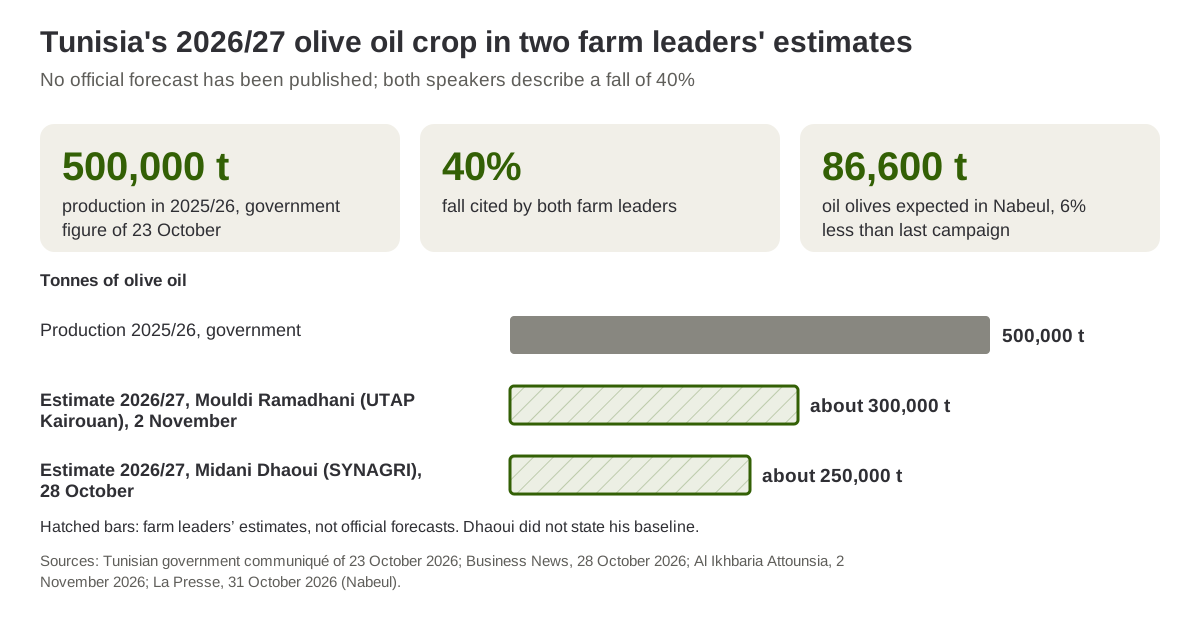
Tunisian olive oil production in 2025/26, as given by the government, and two farm leaders' estimates for 2026/27, in tonnes. The estimates are not official forecasts. Sources: Tunisian government communiqué of 23 October 2026; Business News, 28 October 2026; Al Ikhbaria Attounsia, 2 November 2026.
In the governorate of Nabeul the harvest opened on 1 November, and Slim Zouari of the farmers' union UTAP told the TAP news agency that about 86,600 tonnes of oil olives are expected, 6% less than the 92,040 tonnes of the previous campaign, La Presse reports. These figures are olives and not oil.
Olive oil estimates for Morocco and Turkey
Neither Morocco's agriculture ministry nor its olive interprofession published a 2026/27 estimate between 28 October and 3 November. In Turkey, the national olive council UZZK had not published its 2026/27 estimate by 3 November.
Olive oil tariffs in the United States
It is still not confirmed in a US government source whether olive oil is exempt from the 10% tariff on EU goods under the Section 301 notice. Joseph R. Profaci, executive director of the North American Olive Oil Association, told Olive Oil Times on 12 October that coconut oil was exempted and olive oil was not.
EVOO cross-market snapshot
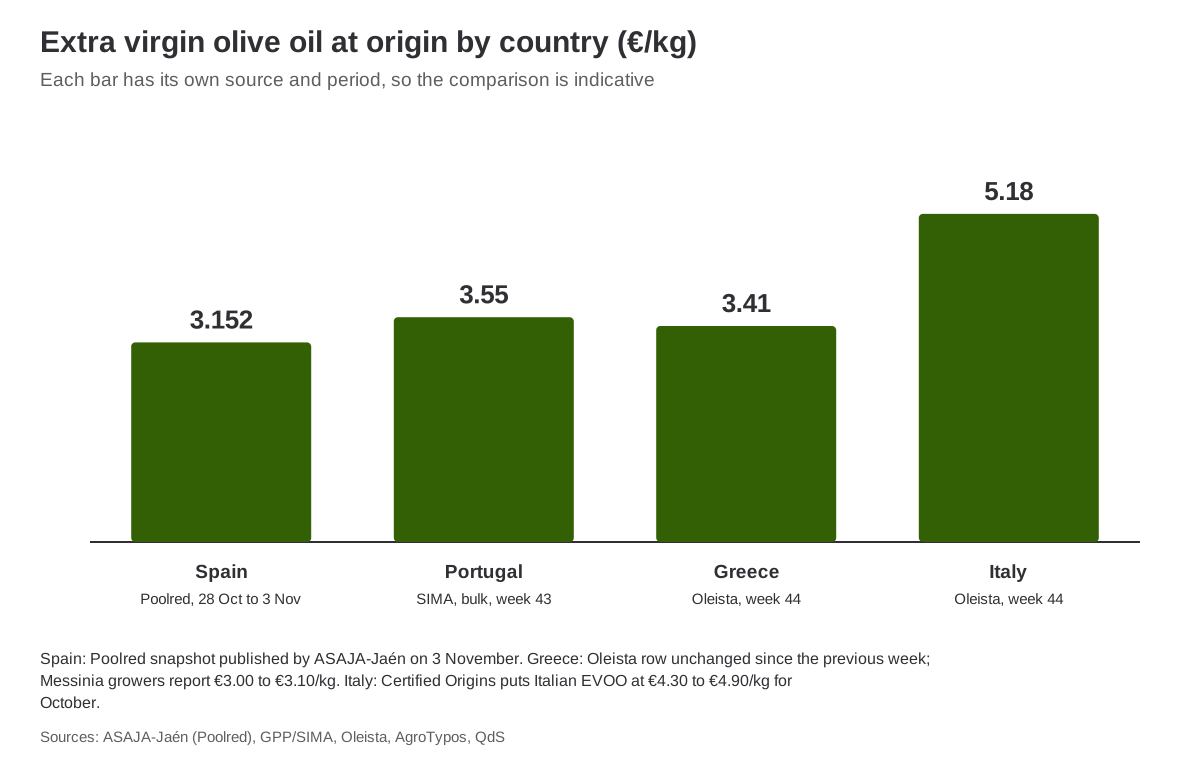
Extra virgin olive oil at origin, €/kg. Each bar comes from a different source and period, shown under the country name, so the chart is indicative. Messinia growers report €3.00 to €3.10/kg, and Certified Origins puts Italian extra virgin at €4.30 to €4.90/kg for October.
Market outlook
Spain starts the 2026/27 harvest with opening stocks of 357,040 tonnes according to SIMO, a ministry estimate of 1,602,596 tonnes for the new campaign and a rule that allows up to 20% of estimated production to be withdrawn, while Poolred put extra virgin at €3.152/kg for 28 October to 3 November and the Junta at €3.03/kg for week 44. Tunisia has no official forecast, with farm leaders' estimates of about 250,000 and about 300,000 tonnes, and Assitol expects about 260,000 tonnes in Italy. The percentage that Spain sets before 15 November matters most to Spanish mills and cooperatives planning their sales of new oil, and to buyers planning purchases for the first months of 2026/27.
The next figures to watch are the Spanish resolution on the withdrawal percentage before 15 November, the ICQRF stock report for 31 October, expected around 6 to 13 November, AICA's October data in mid-November, the UZZK estimate for Turkey and an official forecast for Tunisia.
Source olive oil with confidence on Wikifarmer's Marketplace
Looking for gold standard EVOO?
Disclaimer: The information provided on this website, including market prices, insights, and projections, is for general informational purposes only. While we strive to ensure accuracy and timeliness, we make no guarantees regarding the completeness, reliability, or suitability of the information presented. Users are solely responsible for independently verifying the data and assessing its relevance to their specific circumstances before making any decisions. Wikifarmer and its operators shall not be held liable for any losses, damages, or consequences arising from the use of the information provided herein.
Corrections to the week 43 and week 44 digests
Our articles of 22 and 29 October gave the Junta de Andalucía's observatory prices for week 42, 12 to 18 October, as €3.17/kg for extra virgin, €3.04/kg for virgin and €2.97/kg for lampante. The observatory page now shows €3.14/kg, €3.01/kg and €2.92/kg for week 42, and €3.18/kg, €3.04/kg and €2.97/kg for week 41. The article of 22 October also gave extra virgin at €3.53/kg for week 40, 28 September to 4 October, and the page now shows €3.36/kg for that week. The page has no revision log, so it is not possible to tell whether the observatory revised its figures or a row was misread.
The article of 22 October described the withdrawal trigger as opening stocks plus production reaching 120% of the average of the previous six campaigns, and the article of 29 October noted the different description given by the competition authority CNMC. Orden APA/1145/2026 contains both, the first as the condition for applying the standard (article 4) and the second as the basis for calculating the percentage (article 5).
Sources
- Boletín Oficial del Estado. (2026). Orden APA/1145/2026, de 29 de octubre, por la que se establece la norma de comercialización del aceite de oliva para la campaña 2026/2027. BOE-A-2026-22717, 30 October 2026.
- Ministerio de Agricultura, Pesca y Alimentación. (2026). El Ministerio de Agricultura, Pesca y Alimentación publica la norma de comercialización del aceite de oliva para la campaña 2026-2027. Press note, 30 October 2026.
- Oleorevista. (2026). La activación de la norma de comercialización de aceite de oliva se despejará a inicios de noviembre. 28 October 2026.
- Agronews Castilla y León. (2026). Aceite de oliva: ASAJA, COAG, UPA y Cooperativas exigen actuar ante precios inferiores a 3,20 €/kg. 21 October 2026.
- ASAJA-Jaén. (2026). Precio del aceite. Poolred data, week of 28 October to 3 November 2026.
- ASAJA-Jaén. (2026). Ligero incremento en el precio del aceite y descenso en las salidas. 3 November 2026.
- Junta de Andalucía. (2026). Observatorio de Precios y Mercados, aceites de oliva. Weeks 40 to 44 of 2026, read 4 November 2026.
- El Español. (2026). Las alianzas Dcoop-Acesur y Coricelli-Migasa pugnan para repartirse Deoleo por más de 500 millones. 30 October 2026.
- AgroTypos. (2026). Θερμή υποδοχή στον Πρωθυπουργό από ελαιοπαραγωγούς της Μεσσηνίας, με την τιμή στο ελαιόλαδο να είναι στα 3 ευρώ το κιλό. 3 November 2026.
- AgroTypos. (2026). Διαμαρτυρία στην Τρίπολη από ελαιοπαραγωγούς της Πελοποννήσου, καταγγέλλουν ότι οι τιμές είναι κάτω του κόστους. 23 October 2026.
- AADE. (2026). Circular E.2065/26-10-2026 on collective olive fly control in 2026/27. 26 October 2026.
- AADE. (2026). Circular E.2050/22-09-2026 on the olive oil price for the olive fly levy in 2026/27. 22 September 2026.
- Oleista. (2026). Olive oil prices at origin. Week 44, updated 3 November 2026.
- Agrapress. (2026). Olio oliva: Assitol, campagna difficile serve dialogo e unità della filiera. 26 October 2026.
- ItaliaOggi. (2026). Meno olio italiano sul mercato. Calo del 25%, a quota 260mila tonnellate. 23 September 2026.
- QdS. (2026). Olio di oliva, in III trimestre 2026 continua discesa prezzi. Askanews, 28 October 2026.
- GoNews. (2026). Falso extravergine e prodotto estero, sequestrati in Toscana oltre 450 quintali di olio. 31 October 2026.
- Olivo e Olio. (2026). Toscana, maxi sequestro di oltre 450 quintali di olio evo. 2 November 2026.
- MASAF. (2026). Frantoio Italia, reports on olive oil stocks. Read 4 November 2026.
- Agricultura e Mar. (2026). INE prevê aumento de 10% da produtividade na azeitona para azeite e de mesa em 2026. 28 October 2026.
- GPP/SIMA. (2026). Azeite, boletim semanal. Week 43, 19 to 25 October 2026.
- Business News. (2026). Huile d’olive : une production en baisse de 40%, le litre entre 10 et 15 dinars. 28 October 2026.
- Tuniscope. (2026). Huile d’olive en Tunisie : entre 10 et 15 dinars le litre dans certaines huileries. 29 October 2026.
- Al Ikhbaria Attounsia. (2026). هذه التقديرات الأولية لصابة الزيتون لهذا العام. 2 November 2026.
- La Presse. (2026). Oléiculture : Le gouvernorat de Nabeul lance sa récolte le 1er novembre avec une prévision de 86 600 tonnes d’olive. 31 October 2026.
- Presidency of the Government of Tunisia. (2026). متابعة تنفيذ الإجراءات الخاصة بإنجاح موسم زيت الزيتون 2026-2027 محور مجلس وزاري مضيق. 23 October 2026.
- Federal Register. (2026). Notice of Actions in Section 301 Investigations of Acts, Policies, and Practices of Various Economies. Document 2026-15181, 28 July 2026.
- Olive Oil Times. (2026). How Trump’s second term is affecting the olive oil industry. Daniel Dawson, 12 October 2026.