
Around Fès, in the eastern part of the Saïss plain between Fès and Meknès in Morocco, the 30 days to 22 November 2026 were 2.7 °C warmer than the 1991 to 2020 average, the third warmest such period since 1991, while rain reached only 37% of normal, although rain at 40% of normal or less occurred in 11 of the previous 35 years, according to a Wikifarmer analysis of NASA POWER data. The United States Department of Agriculture (USDA) writes that dry, warm weather favoured winter grain sowing in northwestern Africa but raised concern about possible drought, as Morocco's sowing of wheat and barley for the 2027 harvest has been under way since early November.
USDA sees rapid sowing but also concern about drought
In its Weekly Weather and Crop Bulletin of 24 November, covering 15 to 21 November, USDA reports that, with the storm track shifted northward over Europe, mostly dry and warm weather prevailed in northwestern Africa. Winter grain sowing proceeded at a rapid pace after showers early in the month in Morocco and from eastern Algeria into northern Tunisia, but rainfall deficits since 1 September persisted across the region.
Temperatures were 2 to 5 °C above normal in Morocco and 4 to 7 °C above normal in Algeria and Tunisia, with daytime highs near or above 30 °C, which according to USDA kept evapotranspiration and crop water demand high. In its summary the bulletin says the dry, warmer-than-normal weather promoted sowing but raised concerns over potential developing drought.
Rain in the last 30 days around Fès was 37% of normal
In the NASA grid cell around Fès, which covers the eastern part of the Saïss, rain from 24 October to 22 November 2026 was 32.3 mm, against an average of 87.7 mm on the same days in 1991 to 2020. It was the 12th driest such period in the 36 years since 1991, and in 11 of the 35 years from 1991 to 2025 rain on the same days was 40% of normal or less. Six of those years came from 2015 onwards: 2015, 2017 and every year from 2020 to 2023.
A dry start is therefore not rare for the area in recent years, and this year winter wheat in southern Russia in October also had a dry start to sowing. In Berkane, in northeastern Morocco, rain was 34% of normal, the 10th driest period since 1991, with 10 of the previous 35 years at 40% or less.
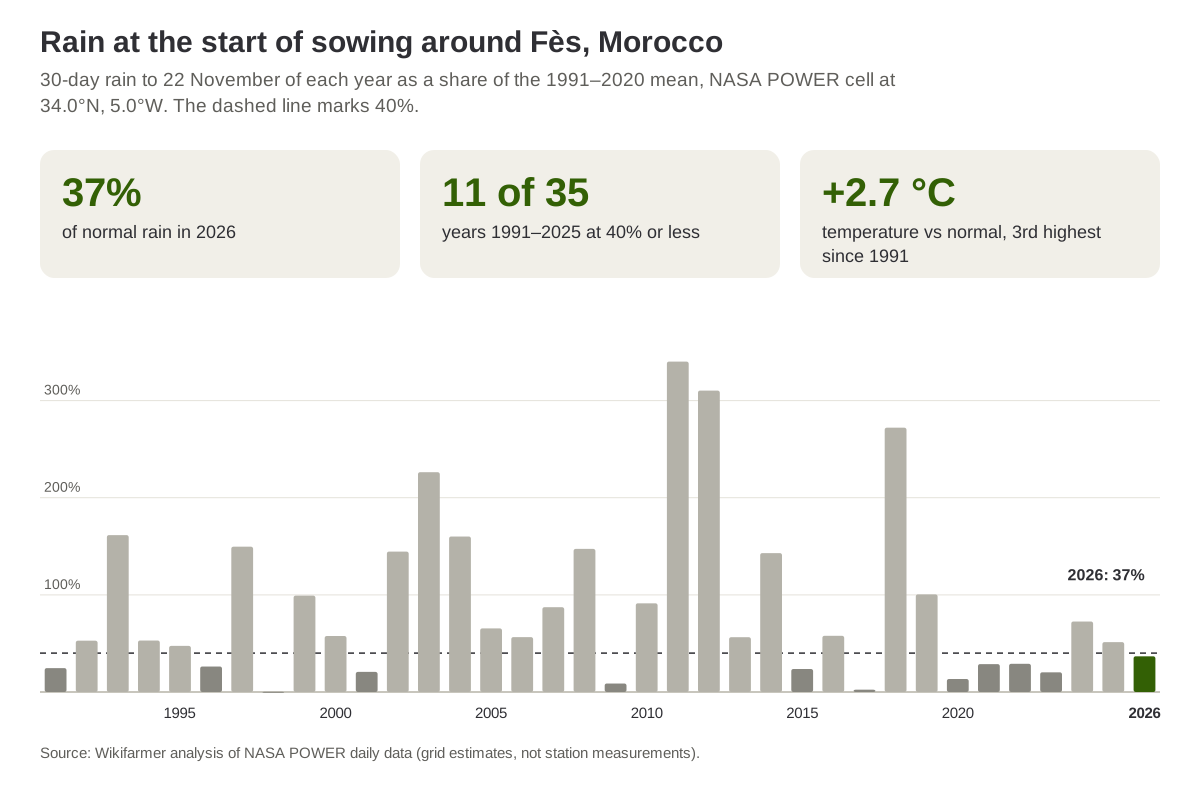
30-day rain to 22 November compared with normal, around Fès, 1991 to 2026
The warmth is the third highest since 1991
The mean temperature of the same 30 days in the same cell was 19.6 °C, 2.7 °C above the 1991 to 2020 average, and only 2022 and 1995 were warmer in the NASA data. The warmth also stands out elsewhere in the region: in Berkane the anomaly was +3.2 °C, the second largest since 1991, while in Sfax, Tunisia, where rain was closer to normal at 61%, the anomaly (+2.1 °C) was the third largest, as it was in Djerid in southwestern Tunisia (+2.9 °C).
Morocco starts sowing with reservoirs two-thirds full and a forecast of rain
In its country brief on Morocco of 24 November, the Global Information and Early Warning System (GIEWS) of the Food and Agriculture Organization of the United Nations (FAO) writes that planting of the 2027 winter wheat and barley crops began in early November and that the country's reservoirs were filled to nearly 66% of capacity in early November, against about 30% a year earlier. FAO notes that most of the country's cereal production remains rainfed and that seasonal forecasts point to above-average rainfall from December 2026 to February 2027 in the northwest of the country.
The forecast of the European Centre for Medium-Range Weather Forecasts (ECMWF) issued at 00:00 UTC on 25 November gives just 5.4 mm over the next ten days at the point 34.0°N, 5.0°W, near Fès. FAO estimates Morocco's 2026 cereal harvest at about 9 million tonnes, nearly 70% above the five-year average and almost double the drought-affected 2025 output.
Winter rain matters for growers and imports matter for buyers
For growers in North Africa, as for those sowing winter cereals in Europe this year, the start of sowing does not decide the season on its own, because rainfed cereals depend on the rain of the northern hemisphere winter, for which the seasonal forecasts cited by FAO point to above-normal amounts in northwestern Morocco. USDA noted, however, that in the week of 15 to 21 November the high temperatures kept crop water demand high. For grain traders and importers, FAO forecasts Morocco's cereal import requirements in 2026/27 at a below-average level. The picture will change with the rain of December and January, the next USDA and FAO reports, and the first official estimates of the area sown.
Frequently asked questions
Is North Africa in a drought?
No official body has declared a drought in the sources Wikifarmer examined. USDA writes of concern over potential developing drought and of rainfall deficits since 1 September, while around Fès rain in the last 30 days was 37% of normal, and rain at 40% of normal or less occurred in 11 of the 35 years from 1991 to 2025.
How warm has it been?
Around Fès the 30 days to 22 November were 2.7 °C warmer than the 1991 to 2020 average, the third warmest such period since 1991. For the week of 15 to 21 November, USDA reports temperatures 2 to 5 °C above normal in Morocco and 4 to 7 °C above normal in Algeria and Tunisia.
When is wheat sown in Morocco?
According to FAO, planting of the winter wheat and barley crops for the 2027 harvest began in early November 2026.
What do the forecasts say for the winter?
FAO reports that seasonal forecasts point to above-average rainfall from December 2026 to February 2027 in northwestern Morocco. For the next ten days, ECMWF's forecast of 25 November gives 5.4 mm near Fès.
Important notes
Wikifarmer carried out the analysis. Rain and temperatures come from NASA POWER daily data for the cells of about half a degree that include the points 34.0°N, 5.0°W (Fès, eastern Saïss), 34.9°N, 2.3°W (Berkane), 34.7°N, 10.8°E (Sfax) and 33.9°N, 8.1°E (Djerid), for the 30 days from 24 October to 22 November of each year from 1991 to 2026, with 1991 to 2020 as the reference average. They are estimates for the area of each cell, not station measurements, and NASA's data arrive with a delay of two to three days. The forecast is ECMWF's (IFS model, open data, 0.25° resolution), not Wikifarmer's. The article does not estimate effects on yields, because a dry start to sowing has occurred many times and the season is decided by winter and spring rain.
Sources
- USDA, World Agricultural Outlook Board. (2026, November 24). Weekly Weather and Crop Bulletin, Vol. 113, No. 47.
- FAO GIEWS. (2026, November 24). Country Brief: Morocco.
- NASA Langley Research Center. (2026). POWER, daily point data, PRECTOTCORR, T2M_MAX and T2M_MIN, 1991 to 2026, retrieved 23 October and 25 November 2026.
- ECMWF. (2026). Open data, IFS, run of 25 November 2026 00:00 UTC, total precipitation.