
Low soil moisture in parts of western, central and south-eastern Europe is holding back the emergence and early growth of rapeseed and raising concern about the establishment of winter cereals, while in the Baltic countries and Finland persistent rain has waterlogged soils and delayed winter sowing, according to the JRC MARS Bulletin of 26 October 2026 from the European Commission's Joint Research Centre (JRC). The winter crops going into the ground now, common wheat, barley and rapeseed, will be harvested in 2027. Their sowing follows a summer season that, according to the same bulletin, closed with below-average yield forecasts for most crops, including grain maize at 6.42 tonnes per hectare, 9% below the five-year average, in line with the lower maize and soybean yields already reported in early September.
Rapeseed emerged unevenly from France to Croatia
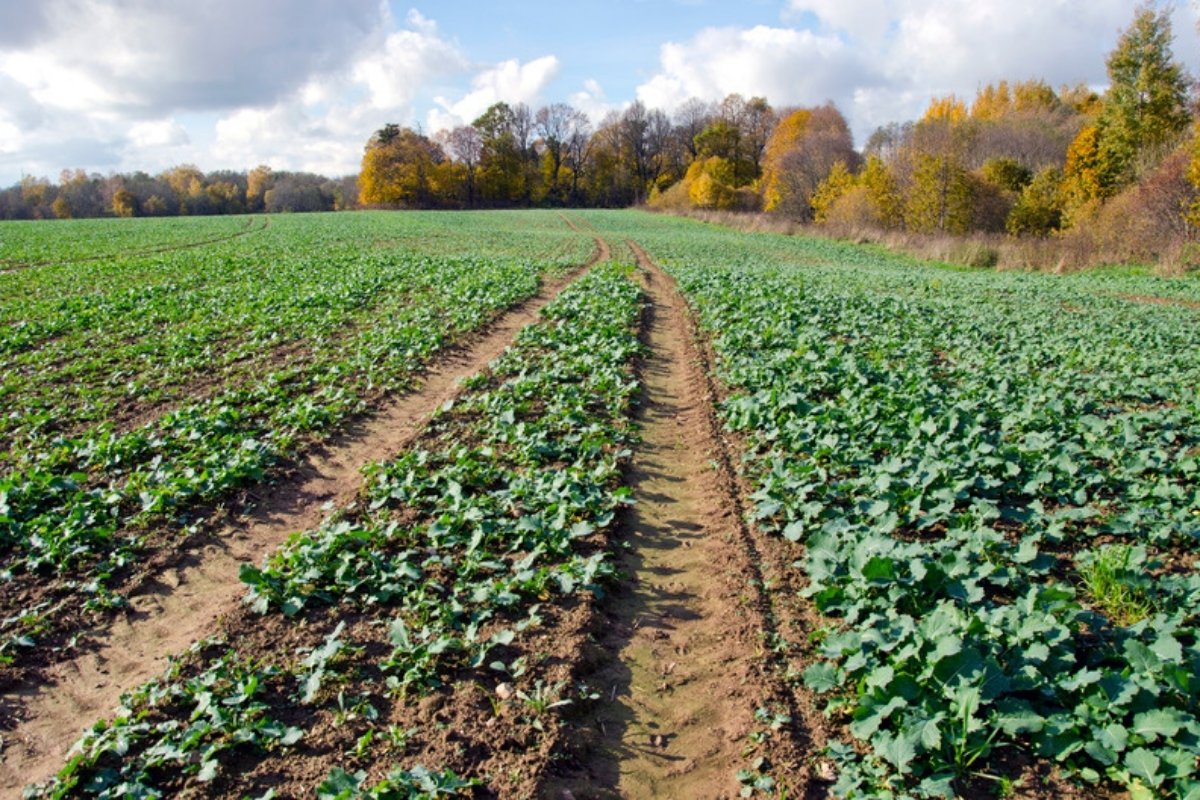
Between 1 September and 17 October, rainfall was 50 to 70% below average across much of France, Luxembourg, southern Belgium, southern Germany, Portugal and north-western Spain, according to the JRC. Isolated regions of Poland, southern Austria, Slovakia, Hungary, Slovenia and Croatia, and most of Romania, received half or less of their usual rain. Sowing of rapeseed, the crop from which canola was developed, is almost complete in France and Belgium, but the long drought of the summer and early autumn has led to irregular emergence and weak early growth in several regions, with locally severe water stress and increasing pest pressure. German farmers finished sowing early in September and the crops are generally in good condition, with uneven emergence on the drier soils. Early sowing and high temperatures have pushed plant development ahead, which the JRC says could potentially leave the crops more vulnerable to winter frost, especially in the south and west of the country.
Very dry seedbeds in Hungary and in western and south-western Romania produced poor and uneven emergence, and the final rapeseed area is expected to be smaller than planned, as some rapeseed is being replaced by wheat. Hungary's rapeseed sowing window closed in early October while farmers waited in vain for rain. When the rain came, in abundance around 10 October, it improved soil moisture and gave fair conditions for the germination of wheat and barley, whose sowing had started later than usual. Prolonged drought delayed winter sowing and hampered emergence in Slovakia, while in Croatia drought and high temperatures held back sowing and emergence remains uneven despite better soil moisture in September. Sowing in Bulgaria is generally progressing well, although particularly dry conditions reduced the area sown in the north-western region of Severozapaden.
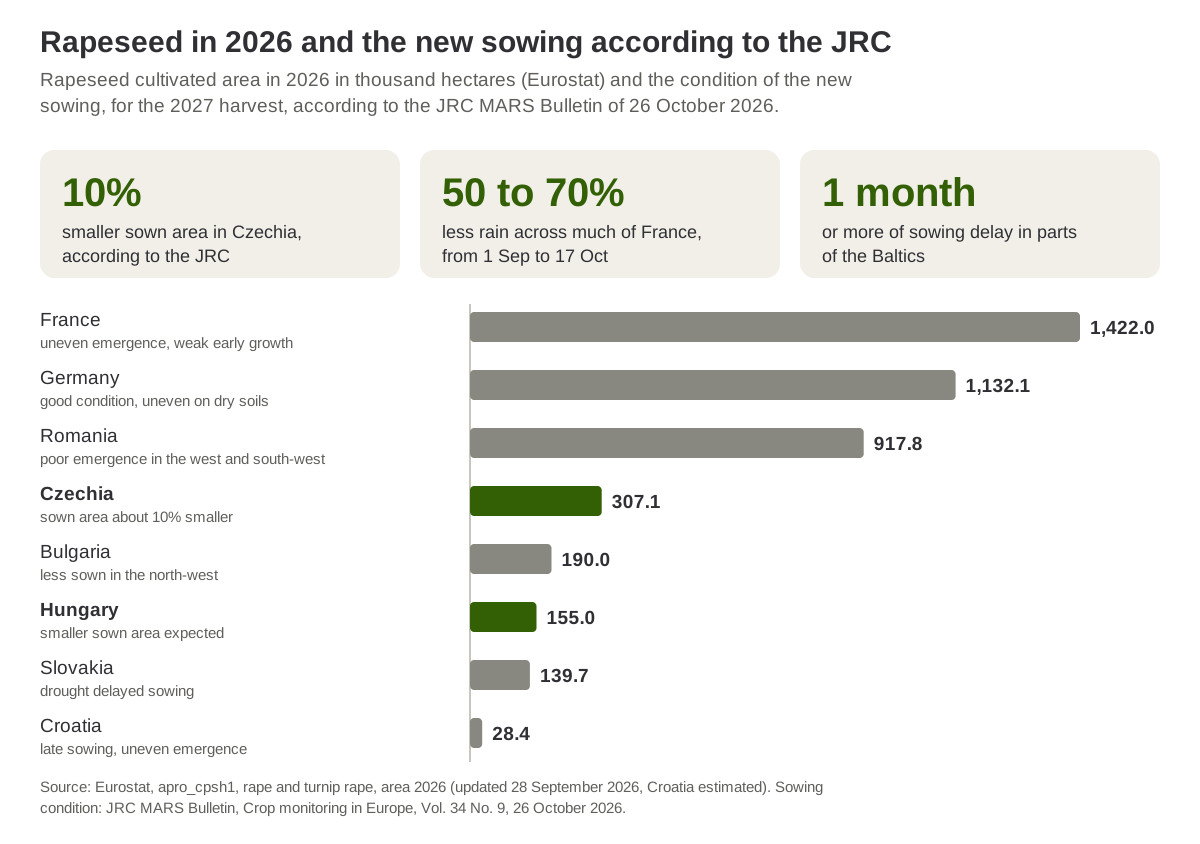
Source: Eurostat, apro_cpsh1, rapeseed cultivated area in 2026 in thousand hectares. Sowing condition: JRC MARS Bulletin, Vol. 34 No. 9, 26 October 2026.
Czechia's rapeseed area is estimated to be 10% smaller
Extreme drought and August heat delayed sowing in Czechia, where the rapeseed area is estimated to be about 10% smaller than last year. Sowing is complete, but low soil moisture continues to limit nutrient uptake and growth, especially in the south and east of the country. Eurostat puts the rapeseed area for the 2026 harvest at 307.1 thousand hectares in Czechia, 155.0 thousand in Hungary, 139.7 thousand in Slovakia and 1,422.0 thousand in France, the largest of the countries in the chart.
Sowing in parts of the Baltics is more than a month late
At the other end of the scale, Estonia recorded the largest rainfall anomaly of the four northern European countries that the bulletin reviews together, about twice the average at national level, with fields impassable in places. Rain in Latvia and Lithuania reached about 150% of the average, and despite drier days in early October, soils in some areas are still too wet for fieldwork. According to the JRC, sowing in the Baltic countries is progressing very slowly and in some cases is more than a month late, beyond the optimal window. With that window now closed, the winter crop area is expected to fall short of farmers' intentions. Rapeseed has been sown in Lithuania, although waterlogging affected crops that had only just emerged, while Latvian farmers are completing their sowing. In Finland the rain delayed the harvest of spring and summer crops and the winter crop area is expected to be below average, while in Latvia and Lithuania it is hampering the potato and sugar beet harvests.
The area of winter common wheat in the Baltics swings sharply from year to year. Eurostat data show that in Lithuania it was 25.4% smaller in 2018 than in 2017, falling from 620.6 to 463.2 thousand hectares, after an autumn 2017 with 249 mm of rain in September and October at the NASA POWER grid point in central Lithuania, the highest value since 1991. The same year the area fell by 33.7% in Latvia and by 26.8% in Estonia. Falls of a similar size in Lithuania also followed autumns without unusual rain, 25.1% in 2011 and 23.8% in 2014, so the data show no consistent relationship between autumn rain and the following year's area. In 2026, winter common wheat covered 793.8 thousand hectares in Lithuania and 433.8 thousand hectares in Latvia.
Seedbed preparation continues in Greece and Cyprus
For Greece and Cyprus, the JRC notes that seedbed preparation is continuing as the start of sowing approaches. Between 1 September and 17 October, the southernmost part of Greece, including Crete, and Cyprus received rainfall up to 150% above average, and locally more. The same bulletin places parts of Greece among the areas with 6 to 10 more hot days than usual over that period.
The JRC forecasts rain for parts of central and south-eastern Europe until 31 October
For 22 to 31 October, the JRC forecast gives moderate rain in parts of western, central and south-eastern Europe, with locally heavier showers, and above-normal temperatures in northern and easternmost Europe. According to the JRC, the rain forecast for most of Europe may improve soil moisture and help winter crops establish, while the drier conditions forecast for the Baltics could help ease the waterlogging.
What matters for farmers now is how well the plants establish before winter dormancy. For buyers of rapeseed and wheat, the JRC's descriptions of sowing and emergence are among the first published information on the 2027 harvest, in a market where a drought in one country can raise grain prices elsewhere. The next JRC MARS Bulletin for Europe is scheduled for 23 November.
Frequently asked questions
Which countries have problems with rapeseed sowing in autumn 2026?
According to the JRC, drought caused uneven emergence in France and Belgium, while sowing and emergence were hit particularly hard in Hungary, Slovakia, Croatia and neighbouring areas. In Czechia, the sown area is estimated to be about 10% smaller than last year.
Why is sowing delayed in the Baltic countries?
Rain between 1 September and 17 October reached about twice the average in Estonia and about 150% in Latvia and Lithuania. The soils became waterlogged and, according to the JRC, sowing is in some cases more than a month late.
Will the winter cereal area in Europe fall?
The JRC expects the winter crop area in the Baltics to fall short of farmers' intentions and the area in Finland to be below average. For rapeseed, it expects a smaller area in Hungary and in western and south-western Romania and estimates the Czech area to be about 10% smaller. For winter cereals, it reports difficult sowing and emergence across most of Europe, with delays in countries including France, Luxembourg, Italy, Czechia, Slovakia and Hungary, but gives no figure for their area.
What happened after Lithuania's wettest autumn since 1991?
After autumn 2017, the wettest since 1991 at the NASA POWER grid point in central Lithuania, the 2018 winter common wheat area was 25.4% smaller in Lithuania, 33.7% smaller in Latvia and 26.8% smaller in Estonia, according to Eurostat. Falls of a similar size in Lithuania also followed autumns without unusual rain, in 2011 and 2014.
When is the next JRC crop bulletin for Europe published?
The next JRC MARS Bulletin for Europe is scheduled for 23 November 2026.
Important notes
The descriptions of sowing, emergence and rainfall come from the JRC MARS Bulletin, Vol. 34 No. 9, of 26 October 2026, which covers 1 September to 17 October and uses 1991 to 2025 as the long-term average. The areas are Eurostat's (apro_cpsh1, cultivated area, updated 28 September 2026) and refer to the 2026 harvest, not this autumn's sowing, and the figure for Croatia is an estimate. The 2017 rainfall comes from NASA POWER monthly data for a single grid point at 55.5°N 24.0°E and does not describe the whole country, and the fall in area in 2018 shows an association with rainfall, not causation. The forecast for 22 to 31 October is the JRC's. The article does not estimate production or prices.
Sources
- Joint Research Centre, European Commission. (2026, 26 October). JRC MARS Bulletin, Crop monitoring in Europe, Vol. 34 No. 9.
- Joint Research Centre, European Commission. (2026, 23 October). Summer crop season closes with below-average yield prospects.
- Joint Research Centre. JRC MARS Bulletin, scheduled issues.
- Eurostat. Crop production in EU standard humidity (apro_cpsh1), updated 28 September 2026, retrieved 27 October 2026.
- NASA Langley Research Center. POWER Project, Monthly API.