
Two months after a record June heat dome raised fears for the 2026 harvest, the damage has been quantified. The European Commission's Joint Research Centre has cut its EU yield forecasts for every summer crop, with soybeans falling 14% below the five-year average, green maize 12% below and grain maize 7% below. When the June heatwave first put EU maize, vegetables and livestock under pressure, the official forecasts still described summer crops as close to trend. The August bulletin closes that gap.
The reporting period ran from 1 July to 15 August, and the weather over those six weeks did most of the harm. A persistent high-pressure system suppressed cloud and rain while holding temperatures up, so water loss ran ahead of replenishment and dryness deepened into August. Daily temperatures reached up to 4°C above average across western and south-central Europe, and 6°C above in parts of France and the Pyrenees. Much of the affected area recorded more than 15 days, locally more than 25, with maxima of 35°C or higher.
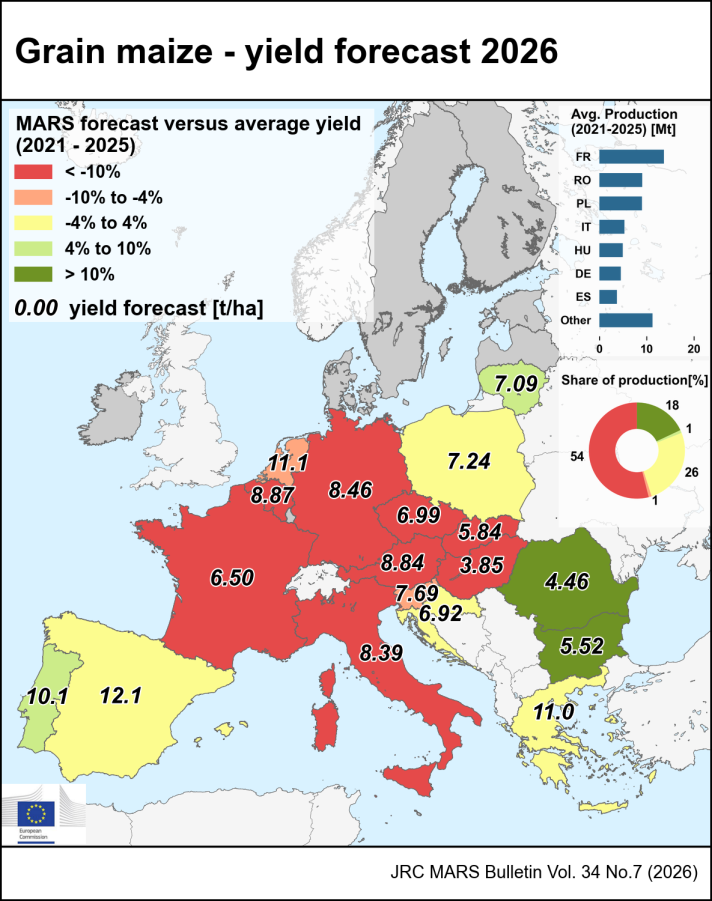
Grain maize yield forecasts against the 2021-2025 average. Red marks losses beyond 10%, with France at 6.50 t/ha and Hungary at 3.85 t/ha, while Romania and Bulgaria sit more than 10% above average.
The crops that lost the most
Soybeans took the heaviest EU-wide cut, dropping to 2.31 tonnes per hectare against a five-year average of 2.67, a 14% fall and a 12% cut from the July forecast alone. Green maize follows at 37.8 tonnes per hectare, 12% below average, which matters for livestock rather than for grain markets.
Grain maize, the crop with the largest exposure across the affected regions, is forecast at 6.61 tonnes per hectare, 7% below the five-year average and 5% below what the same team projected a month earlier. Potatoes are down 6% at 34.6 tonnes per hectare, sugar beet down 5% at 72.2, rapeseed down 4%, and sunflower down 3%.
The pattern in those numbers is consistent. Crops that were still forming yield in July and August took the damage, while anything that had finished did not.
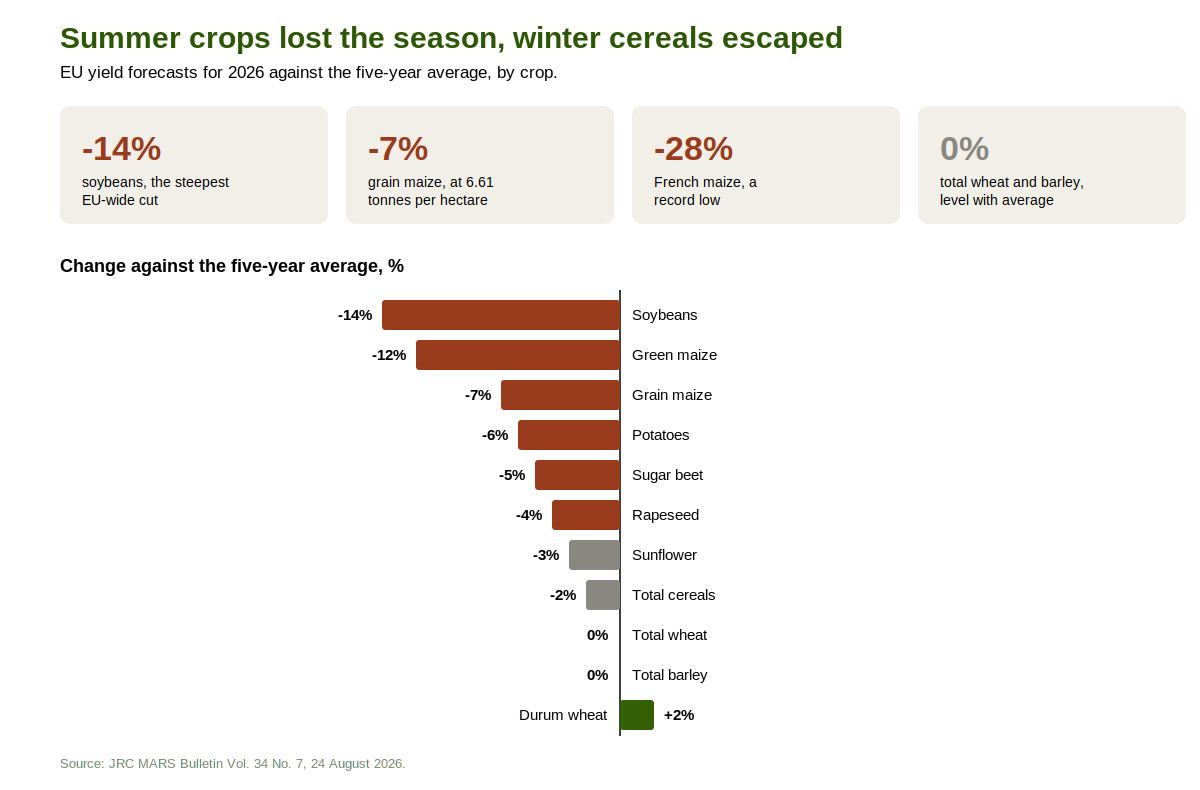
Every summer crop was cut, while winter cereals held at their five-year average, a split that reflects the timing of harvest rather than the crop's hardiness.
Winter cereals escaped almost entirely
With harvest largely complete, EU winter cereal yields have been confirmed at close to the five-year average. Total wheat comes in at 5.68 tonnes per hectare, level with average, soft wheat at 5.88, also level, and durum wheat 2% above. Total barley matches its average at 5.02 tonnes per hectare.
The reason is timing rather than resilience. Earlier heat had accelerated ripening and pulled the harvest forward by several weeks in many regions, moving winter crops out of the field before the July and August heat arrived. That early maturation carried its own cost in shorter grain filling, smaller grains, and locally reduced quality, particularly for later-maturing wheat in southern Germany, Czechia, Austria, and Slovakia. The yields held; the quality did not always.
France and Hungary took the worst of it
France recorded its hottest and second-driest summer in twenty years, behind only 2022. Three further heatwaves crossed the country during the reporting period. In west-central France the satellite biomass signal fell to the lowest value in the available record for that area. French grain maize is now forecast at 6.50 tonnes per hectare, 28% below the five-year average and a record low, with all summer crops between 7% and 30% below average, and soybeans at 30% below average.
Hungary is worse in relative terms. Grain maize is forecast at 3.85 tonnes per hectare, 34% below the five-year average, with sunflower 23% below. Rainfall over the period ranged from 5 to 25 mm across most of the country. By mid August, crop stands in the lowlands had already dried out, and several grain maize fields were harvested as green maize to salvage something from them. Hungarian winter cereals, harvested earlier, still came in 15% to 20% below average.
Italy recorded maximum temperatures above 35°C on roughly two days in every three, with rainfall in the north-west down by almost 50% compared with the long-term average. Its summer crop forecasts have been cut to around 15% below the five-year average, a level last seen in 2003 and 2022. Czechia sits at 19% below for maize, Slovakia and Belgium at 18%, Austria at 15% and Germany at 13%.
The Black Sea went the other way
Romania and Bulgaria had a different summer. Bulgarian grain maize is forecast 29% above the five-year average at 5.52 tonnes per hectare, helped by near-normal July rainfall and the absence of heat stress during flowering. Romanian maize sits 11% above average at 4.46 tonnes per hectare, and sunflower 10% above, on the strength of conditions in the east and centre that offset a severe rainfall deficit along the western border.
Both countries also expect record or near-record winter cereal yields. The east-west split is the clearest structural feature of this season, and it extends to Greece and Portugal, where maize forecasts sit 1% and 6% above average, respectively.
What happens next
Cooler and wetter conditions arrived across much of western and central Europe in late August, bringing 30 to 90 mm of rain and more than 90 mm in the Alpine region. For summer crops already past grain filling, the relief comes too late to recover what was lost.
The longer-range outlook offers little comfort. The forecast for September to November points to a high likelihood of warmer-than-average conditions across most of Europe, with central Europe running up to 2°C above the 24-year climatological median. Above-average rainfall is expected in southern Europe in September, shifting north through the autumn, though with greater uncertainty attached.
Sources
- European Commission Joint Research Centre. (2026). JRC MARS Bulletin, Crop monitoring in Europe, August 2026, Vol. 34 No. 7. Publications Office of the European Union, Luxembourg.