
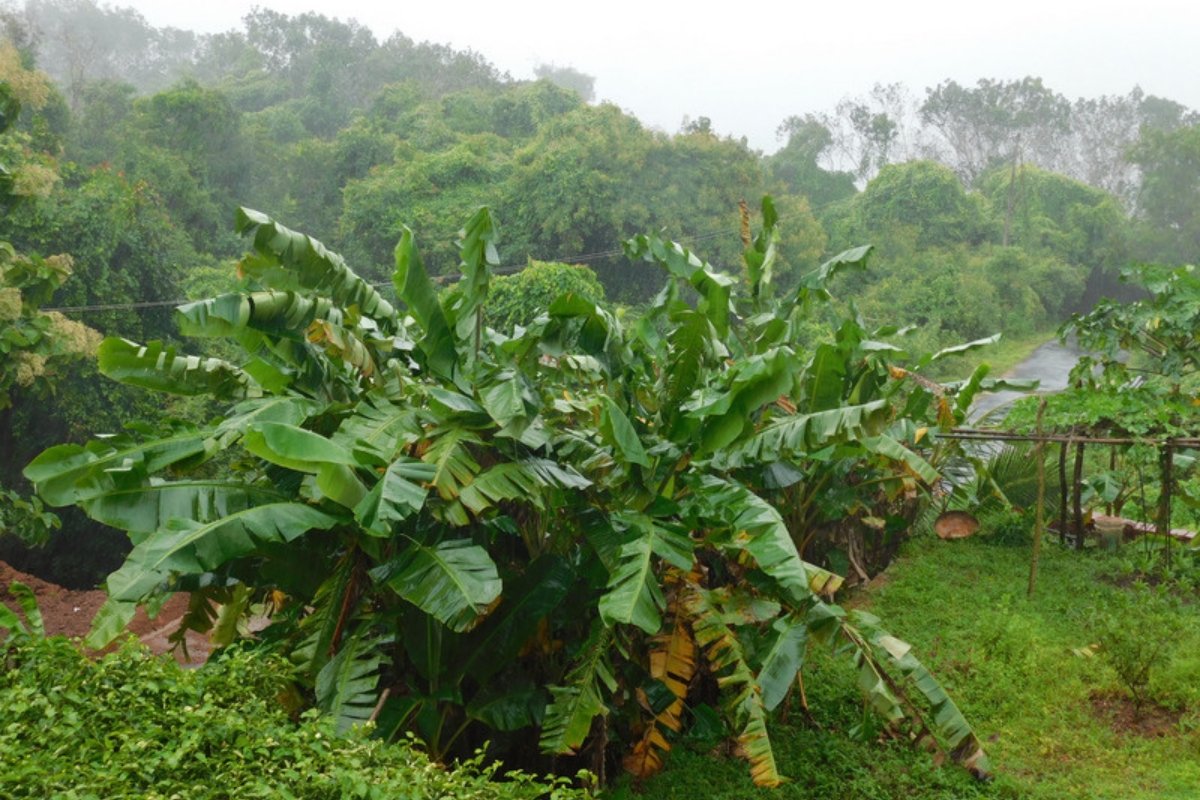
In Milagro, on Ecuador's coast, 195.9 mm of rain fell from 1 to 20 October 2026 against a normal of 4.2 mm for the whole of October, and four coastal stations had the wettest October in their records before the month was over, according to Ecuador's National Committee for the Regional Study of the El Niño Phenomenon (CN-ERFEN). Ecuador, the world's largest banana exporter according to the country's Ministry of Agriculture and Livestock (MAG), supplied 40.2% of the bananas the European Union imported from outside the EU in the first half of 2026, the highest of any half-year since comparable data begin in 2012, according to a Wikifarmer analysis of Eurostat data. In the three previous strong El Niño episodes, EU imports from Ecuador fell twice, by as much as 14.3% in one half-year, and rose once, and this year's trade data run only to August, before the rain.
Four coastal stations recorded the wettest October in their series
CN-ERFEN's members include the Navy's Oceanographic and Antarctic Institute (INOCAR), the national meteorological and hydrological service (INAMHI) and the National Secretariat for Risk Management (SNGR). In its technical report 011-2026, issued after its meeting of 22 October, the committee says that rain up to 20 October far exceeded the month's normals across much of the coast and that the Guayaquil-DGAC, Milagro, Portoviejo and La Maná stations had the wettest October in their available series. Tenguel, south of Guayaquil, received 159.5 mm in 24 hours and Puerto Santa Ana in Guayaquil 181 mm, while Manta stayed below normal, so the rain was uneven even within the coastal zone. In the Andean highlands and the Amazon, by contrast, rain was mostly below normal. The committee describes October's rain across much of the coast as exceptionally high for the season, at a time when El Niño is strengthening in the Pacific and the sea between the Galápagos and the mainland remains far warmer than normal, as part of the same episode that is affecting mango in neighbouring Peru this year.
For the coming months CN-ERFEN writes that El Niño is approaching its mature phase, expected in late 2026, and that the seasonal southward shift of the Intertropical Convergence Zone, if it coincides with the peak of El Niño, would make conditions more favourable for frequent and intense rain on the coast. In NASA's estimates, which give rainfall for grid cells of about half a degree, the only other year since 1981 with more than three times the normal rain from 1 September to 7 November, averaged over five coastal cells, was 1997, while in 2015 and 2023 rain over the same window was close to or below average in the same estimates.
Two coastal rivers were above their alarm thresholds
On 20 October the Payo river, before its confluence with the Bulubulu, recorded a flow of 220.1 cubic metres per second, above its alarm threshold of 217.9 although falling from the previous day, while in the Babahoyo basin the San Pablo river at the Palmar station rose to 219.3 cubic metres per second, against an alarm threshold of 177.5. According to CN-ERFEN the rain has already produced a significant response in several basins and drainage networks on the coast, and if it continues or intensifies, floods could recur or spread.
Ecuador's risk management secretariat counts 5,247 hectares of crops lost without singling out bananas
In situation report 79, covering the rains from 29 August to 15:00 on 9 November 2026, SNGR records 5,338.70 hectares of crops with partial damage nationwide and 5,247.23 hectares with total loss. For Guayas the report gives 2,992 hectares with partial damage and 4,801 hectares lost, for Los Ríos 1,302 and 332 hectares, and for El Oro 114 hectares with partial damage, without naming the crops. For the provinces of Los Ríos, Guayas and El Oro, which grew 89% of the country's bananas in 2024, total loss covers 5,133 hectares, which even if all of it were banana plantations would equal 2.9% of the 175,818 hectares of bananas the country grew in 2024, according to MAG.
According to the same ministry, Ecuador produced about 7.56 million tonnes of bananas in 2024 and exported 80.2%, and the EU accounted for 29.3% of banana export earnings, while Los Ríos province grew about 40% of the crop. The official sources Wikifarmer reviewed up to 10 November contain no ministry estimate of banana damage from this year's rain.
Ecuador supplied 40.2% of the bananas the EU imported in the first half of 2026
From January to June 2026 the EU imported 1,073,871 tonnes of bananas from Ecuador, 8.7% more than in the first half of 2025, out of 2,672,914 tonnes imported from outside the EU, Eurostat data show. Imports from Colombia fell by 27.1% and total imports from outside the EU by 6.2%, so Colombia's share fell to 19.7% while Costa Rica stood at 19.2%. Ecuador's share was 34.7% in the first half of 2025 and 34.6% in the first half of 2023, and since 2012, when the banana code in trade statistics changed, no other half-year has exceeded 36.2%. Ecuador's share is lower in the second half of every year, between 25.2% and 31.5% in 2022 to 2025, so the comparison is made between first halves.
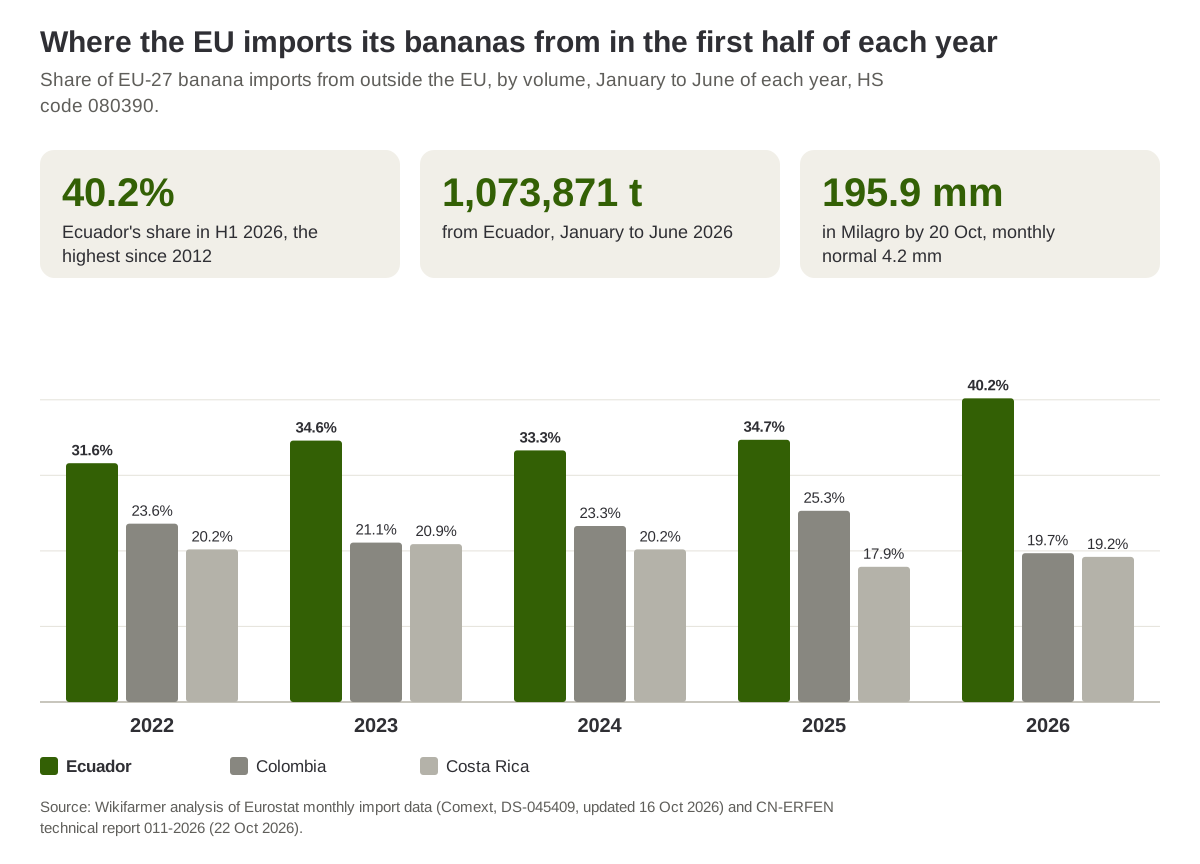
Source: Wikifarmer analysis of Eurostat monthly import data (Comext, DS-045409, HS code 080390, updated 16 Oct 2026) and CN-ERFEN technical report 011-2026.
EU imports from Ecuador fell in two of the three previous strong El Niño episodes
The analysis defines strong El Niño episodes as those with an Oceanic Niño Index (ONI) of 1.5 or more for November to January in the series of the US National Oceanic and Atmospheric Administration (NOAA), which leaves three within the Eurostat series, 2009/10, 2015/16 and 2023/24, and looks at the three half-years from the second half of the episode year to the second half of the next, each compared with the same half a year earlier. In the 2009/10 episode, EU imports from Ecuador fell in all three half-years, by 10.2%, 8.2% and 5.7%, and in the 2015/16 episode by 14.3% in the second half of 2015, then by 3.3% and 3.0%. In the 2023/24 episode, by contrast, they rose by 12.7% in the second half of 2023, fell by 2.4% in the first half of 2024 and rose by 14.0% in the second.
Falls of 5% or more occurred in 4 of the 9 episode half-years and in 9 of the other 42 half-years from 2000 to 2026, excluding 2012, so falls were more frequent during the episodes, although three episodes are not enough to establish a rule. In NASA's estimates the coast did not receive rain like this year's in the autumns of 2015 and 2023, while the autumn of 1997, the only one with comparable rain, falls outside the analysis because the Eurostat data used start in 1999.
Autumn trade data will show whether shipments changed
European importers, ripeners and retail chains took a larger share of their extra-EU bananas from Ecuador in the first half of 2026 than in any other half-year since comparable data begin in 2012, so a disruption to the country's shipments would weigh more on them than in previous episodes. Eurostat's monthly data for September to November, published about seven weeks after the end of each month, from mid-November to mid-January, will show whether the rain coincided with lower shipments. On prices, which shape banana exports and markets worldwide, the World Bank put the banana price for Europe at $1.10 per kilo in October 2026 and for the United States at $1.18. For growers on Ecuador's coast, CN-ERFEN reports and INAMHI warnings track rain and river levels as the rainy season approaches.
Frequently asked questions
How much rain fell on Ecuador's coast in October 2026?
Milagro received 195.9 mm by 20 October against a normal of 4.2 mm for the whole of October, and the Guayaquil-DGAC, Milagro, Portoviejo and La Maná stations had the wettest October in their records, according to CN-ERFEN. Manta stayed below normal.
Have banana plantations been destroyed?
From 29 August to 9 November SNGR records 5,247.23 hectares of crops with total loss nationwide, without naming the crops, and the official sources Wikifarmer reviewed up to 10 November contain no Ministry of Agriculture estimate for bananas. In the three banana provinces total loss covers 5,133 hectares, which even if all of it were bananas would be 2.9% of the country's banana area.
How many bananas does the EU buy from Ecuador?
In the first half of 2026 the EU imported 1,073,871 tonnes from Ecuador, 40.2% of its banana imports from outside the EU, according to Eurostat. Colombia followed with 19.7% and Costa Rica with 19.2%.
What happened to EU imports in previous strong El Niño episodes?
In the 2009/10 and 2015/16 episodes imports from Ecuador fell, with the largest drop, 14.3%, in the second half of 2015, while in the 2023/24 episode they rose in two of the three half-years. Three episodes are not enough for a rule, and in NASA's estimates the coast did not receive rain like this year's in the autumns of 2015 and 2023.
When will we know whether shipments changed?
Eurostat's monthly data for September to November are published from mid-November to mid-January, about seven weeks after the end of each month. Until then, CN-ERFEN and SNGR reports give the picture of rain and damage.
Important notes
The analysis was carried out by Wikifarmer. Rainfall totals and river flows are station measurements as reported in CN-ERFEN technical report 011-2026, with data up to 20 October, and the comparisons with 1997, 2015 and 2023 come from daily estimates by NASA's POWER service on a grid of about half a degree, averaged over five coastal cells, from 1 September to 7 November each year against the 1991 to 2020 average. Grid values for 2026 are much higher than the station measurements and are therefore not given as rainfall totals. Crop hectares come from SNGR situation report 79, which does not name the crops, and the provincial figures are rounded in the report. Imports refer to the EU-27, under HS code 080390 from 2012 and code 080300 up to 2011, which also included plantains, so the 2009/10 episode is measured with a broader code and shares are compared from 2012 onwards; the data run to August 2026. The ONI threshold of 1.5 for November to January is the analysis's own choice. The comparisons show coincidence, not cause.
Sources
- CN-ERFEN. (2026, 22 October). Informe Técnico Ejecutivo ERFEN Nro. 011-2026. INOCAR, INAMHI, IPIAP, SNGR, ESPOL, DGAC, UPSE.
- Secretaría Nacional de Gestión de Riesgos. (2026, 9 November). SitRep 79, Lluvias con incidencia del Evento El Niño, del 29 de agosto de 2026 a la fecha.
- Ministerio de Agricultura y Ganadería. (2024). Boletín situacional banano 2024. SIPA.
- Eurostat. (2026). EU trade since 1988 by HS2-4-6 and CN8 (DS-045409), EU-27 imports under code 080390, updated 16 October 2026.
- NOAA Climate Prediction Center. (2026). Oceanic Niño Index (ONI).
- World Bank. (2026, 3 November). Commodity Markets, Pink Sheet monthly prices.
- NASA Langley Research Center. (2026). POWER, daily point data, PRECTOTCORR, 1981 to 2026, retrieved 10 November 2026.