
Ecuador's National Institute of Meteorology and Hydrology (INAMHI) has extreme-level alerts for rain and thunderstorms in force until 28 October 2026 for the provinces of Guayas and El Oro, the northern part of Los Ríos province and Esmeraldas. The provinces of Los Ríos, Guayas and El Oro grew 89% of the country's bananas in 2024, according to a Wikifarmer analysis of data from the Ministry of Agriculture and Livestock (MAG). Ecuador is the world's largest banana exporter, according to MAG, and the rain comes after the National Secretariat for Risk Management (SNGR) has already recorded damage to 9,742.93 hectares of crops across the country since 29 August.
INAMHI has three extreme alerts in force until 28 October
INAMHI's alerts website, as updated on the morning of 26 October (Ecuador time), lists eight alerts in force for rain and thunderstorms. Three are at the extreme level, for Guayas and El Oro, for northern Los Ríos and for Esmeraldas. The others are at the severe or moderate level and cover the coastal region and the western cordillera, the western part of the highlands, Isabela Island, the Galápagos and the Amazon region. All of them expire at 23:00 on Wednesday 28 October, and for Guayas and El Oro the alert started at 16:00 on Sunday 25 October.
INAMHI weather warning bulletin no. 83, issued at 14:00 on 25 October, forecasts moderate to very heavy rain with thunderstorms and gusts in the coastal region, with greater emphasis on the interior and the western cordillera, and notes that the most intense events could occur on 26 and 27 October. In the coastal region the greatest intensity is expected in Esmeraldas, Santo Domingo, Los Ríos, Guayas, El Oro and inland Manabí and Santa Elena. The bulletin warns of a risk of rising rivers and other water bodies in Esmeraldas, Santo Domingo, Guayas, Los Ríos and El Oro, and in the western cordillera of Pichincha, Cotopaxi, Bolívar, Cañar and Azuay.
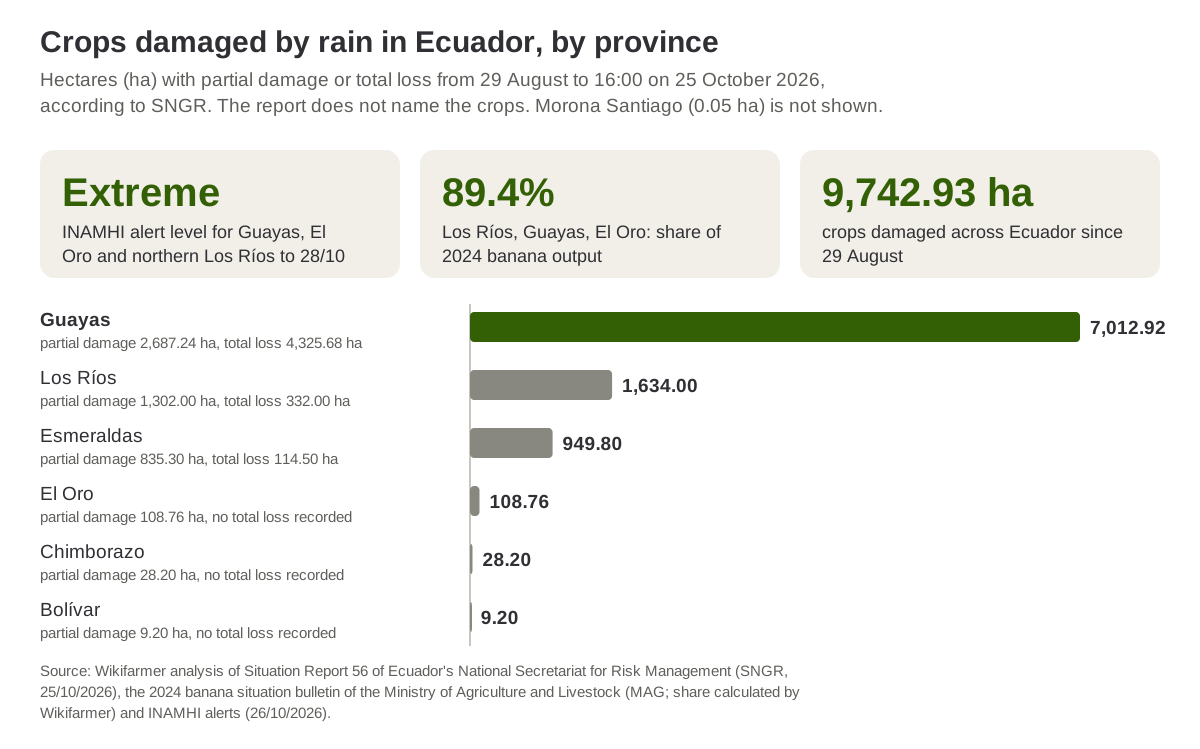
Source: Wikifarmer analysis of Situation Report 56 of Ecuador's National Secretariat for Risk Management (SNGR), the MAG banana situation bulletin for 2024 and INAMHI alerts of 26 October 2026.
The three provinces grew 89% of Ecuador's bananas in 2024
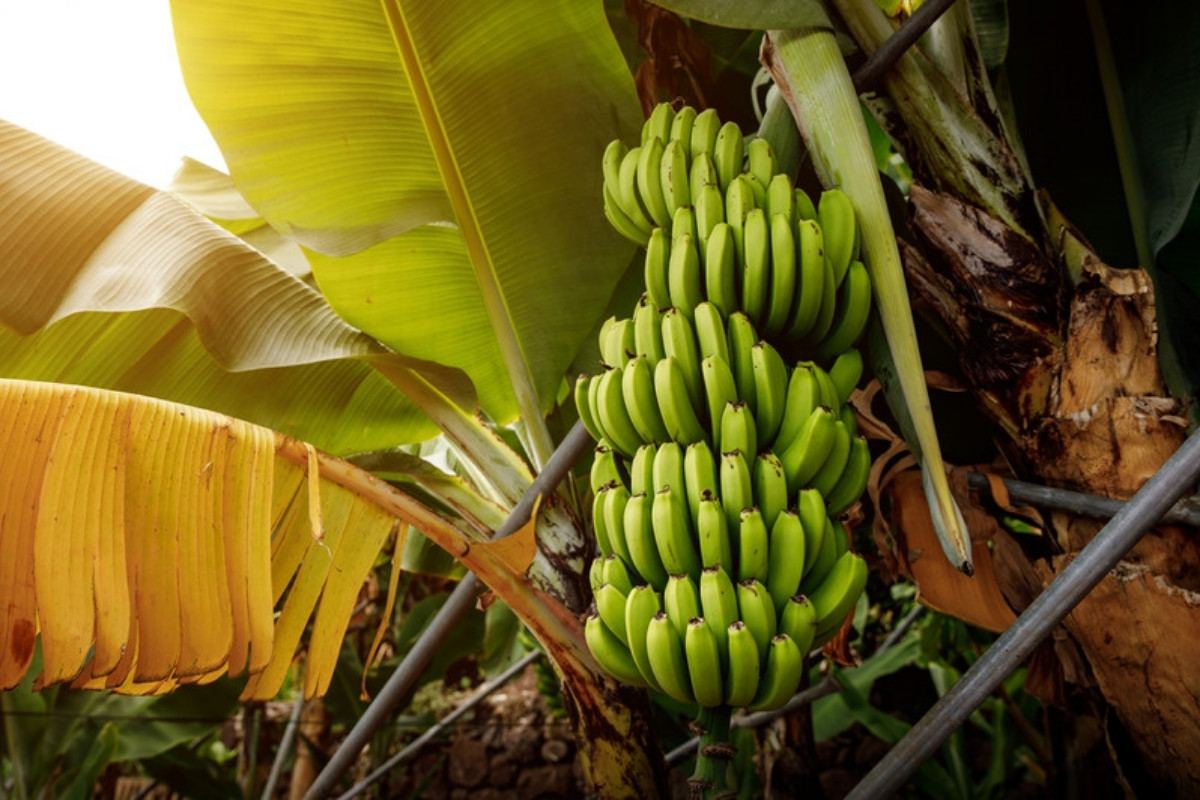
According to MAG's banana situation bulletin, Ecuador produced 7.56 million tonnes of bananas in 2024 on 175,818 hectares. Los Ríos ranked first with 3,011,202 tonnes on 69,007 hectares, Guayas second with 2,410,820 tonnes on 51,968 hectares and El Oro third with 1,336,569 tonnes on 32,161 hectares. Together the three produced 6,758,591 tonnes, 89.4% of national output, on 87.1% of the banana area. The alert for Los Ríos covers the northern part of the province, while the MAG figures cover the whole province. MAG reports that 80.2% of output goes to export and that, with a 25.6% share, Ecuador is the world's largest banana exporter, while it ranks fifth among producers with 5.2% of world output.
SNGR records 9,743 hectares of damaged crops since 29 August
In Situation Report 56, published on the evening of 25 October and covering 29 August to 16:00 on 25 October, SNGR records 648 adverse rain events in 23 provinces, mainly floods (55.25%) and landslides (19.60%), and 32,694 people affected. For crops, the report counts 4,970.75 hectares with partial damage and 4,772.18 hectares with total loss. Guayas has the largest area, with 2,687.24 hectares of partial damage and 4,325.68 hectares of total loss, followed by Los Ríos with 1,302.00 and 332.00 hectares, Esmeraldas with 835.30 and 114.50 hectares and El Oro with 108.76 hectares of partial damage. The report does not say which crops were hit, so these hectares cannot be attributed to bananas or to any other crop. It also closes before 26 and 27 October, the days on which INAMHI forecasts that the most intense events could occur.
Ecuador officially declared El Niño on 28 August
As SNGR states in Situation Report 56, the national ERFEN committee officially declared an El Niño event in Ecuador in Executive Technical Report ERFEN 007-2026 of 28 August, and the next day SNGR placed the country on red alert under resolution SNGR-238-2026. In its bulletin of 25 October, INAMHI lists among the main factors associated with the expected event the passage of equatorial atmospheric waves, upper-level wind divergence, moisture supply and low-level wind convergence, as well as the high sea surface temperatures from the developing warm El Niño event. In its statement 18/2026 of 16 October, Peru's ENFEN commission considers it most likely that sea warming off the Peruvian coast will stay at an extraordinary magnitude until January 2027 and then ease to strong until early southern-hemisphere autumn 2027.
No official estimate exists yet for banana exports
The official sources Wikifarmer examined up to 26 October contain no estimate of how much banana production was lost or of whether Ecuador's exports will fall in the coming weeks. For growers in the three provinces, SNGR data show that floods have been the most frequent adverse event across the country since late August, while INAMHI forecasts moderate to very heavy rain until 28 October. For buyers of Ecuadorian bananas, MAG calculates that 29.3% of 2024 banana export earnings came from the European Union, 18.5% from Russia and 13.5% from the United States, and shipped volumes will show up in the monthly export data. Many factors drive producer, wholesale and retail banana prices, and in the sources Wikifarmer examined no official body has so far linked the October rain to prices.
Frequently asked questions
Which areas of Ecuador have an extreme rain alert?
INAMHI has extreme alerts in force until 23:00 on 28 October 2026 for the provinces of Guayas and El Oro, for northern Los Ríos and for Esmeraldas, together with severe and moderate alerts for other parts of the country. The alerts are updated continuously, so the latest version on INAMHI's website applies.
How many bananas do the provinces under alert produce?
According to MAG, Los Ríos, Guayas and El Oro produced about 6.76 million tonnes in 2024, 89.4% of Ecuador's bananas, on 153,136 hectares. The alert for Los Ríos covers only the northern part of the province.
Has crop damage been recorded?
SNGR records 4,970.75 hectares with partial damage and 4,772.18 hectares with total loss across the country from 29 August to 25 October, most of it in Guayas, without naming the crops. The report covers the period up to 16:00 on 25 October, before 26 and 27 October, the days on which INAMHI forecasts that the most intense events could occur.
Is the rain linked to El Niño?
INAMHI lists high sea temperatures from El Niño as one of the factors associated with the rain of 25 to 28 October, together with atmospheric factors, and Ecuador's national ERFEN committee officially declared El Niño on 28 August 2026.
Will Ecuador's banana exports be affected?
In the sources Wikifarmer examined up to 26 October, no official body has estimated banana losses or the effect on exports, so the picture will emerge from official export data in the coming months.
Important notes
Wikifarmer analysed INAMHI's alerts and bulletin 83, SNGR Situation Report 56, statement 18/2026 of Peru's ENFEN commission and MAG's banana situation bulletin for 2024. The alert for Los Ríos covers the northern part of the province. The alerts and the forecast are INAMHI's and change with each new issue. Situation Report 56 covers the period up to 16:00 on 25 October and does not break hectares down by crop. The three provinces' shares of banana production were calculated by Wikifarmer from MAG's 2024 table. The article does not link crop damage to banana production, because none of the official sources examined links them. Station observations for the event of 25 to 28 October were not available in the sources examined.
Sources
- Instituto Nacional de Meteorología e Hidrología (INAMHI). (2026). Alertas meteorológicas e hidrológicas (in Spanish), retrieved 26 October 2026.
- Instituto Nacional de Meteorología e Hidrología (INAMHI). (2026, 25 October). Boletín Meteorológico Nro. 83, Advertencia (in Spanish). The link always opens the latest issue.
- Secretaría Nacional de Gestión de Riesgos (SNGR). (2026, 25 October). SitRep 56, Lluvias con incidencia del Evento El Niño, del 29 de agosto de 2026 a la fecha (in Spanish).
- Ministerio de Agricultura y Ganadería (MAG). (n.d.). Boletín situacional, cultivo de banano 2024 (in Spanish).
- Comisión Multisectorial ENFEN. (2026, 16 October). Comunicado Oficial ENFEN N°18-2026 (in Spanish).