

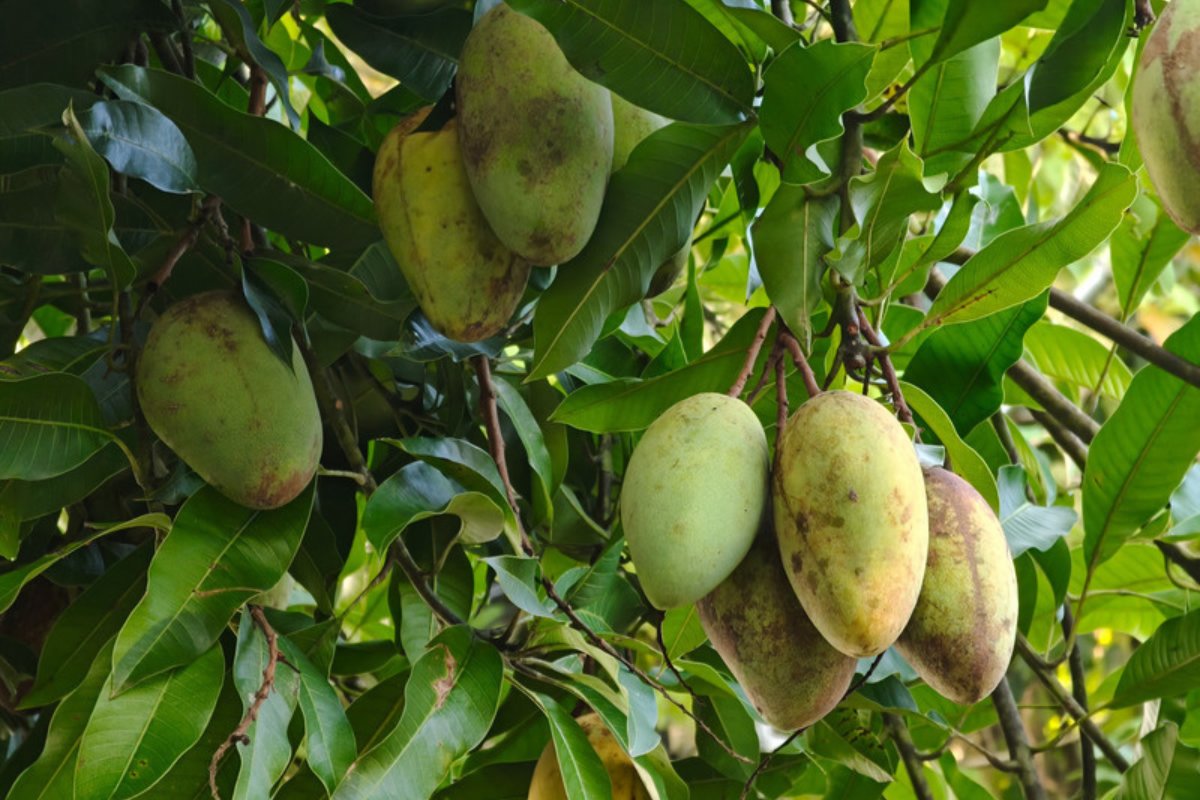
Peru's National Meteorology and Hydrology Service (SENAMHI) has issued three red warnings: one for heavy to extreme rain on the north coast and in the highlands from 24 to 26 November, mainly in Tumbes and the inland coast of Piura, and two for rising daytime and night-time temperatures on the coast and in the highlands from 25 to 28 November, according to a Wikifarmer analysis of the service's warnings and agrometeorological reports. Piura is where SENAMHI was already recording mango harvesting on some plots in October, and the warnings come a few days before December, the month when the main season of European Union mango imports from Peru begins.
SENAMHI has issued three red warnings for 24 to 28 November
Warning 481, issued on 22 November as an extension of red warning 477 for 21 to 23 November, covers rain on the north coast and in the highlands from 24 to 26 November. SENAMHI writes that heavy to extreme rain is expected on the north coast, mainly in Tumbes and parts of the inland coast of Piura, and for 24 November it gave 5 to 70 mm a day of rain on the north coast.
At the same time, two red warnings cover temperature on the coast and in the highlands from 25 to 28 November: 484, for rising daytime temperatures, issued on 23 November, and 485, for rising night-time temperatures, issued on 24 November. A yellow warning, 483, covers stronger winds on the coast from 25 to 27 November.
| SENAMHI warning | Hazard | Area | Valid | Level |
| 481 | Rain | North coast and highlands | 24 to 26 November | Red |
| 484 | Rising daytime temperature | Coast and highlands | 25 to 28 November | Red |
| 485 | Rising night-time temperature | Coast and highlands | 25 to 28 November | Red |
| 483 | Stronger winds | Coast | 25 to 27 November | Yellow |
Four north coast stations broke their record for the highest minimum temperature
In a press note of 23 November, SENAMHI says that five weather stations on the country's coast broke their all-time record for the highest minimum temperature during the southern hemisphere spring, four of them on the north coast. In Piura the Miraflores station recorded 26.8 °C on 18 November, above the 26.6 °C of 21 February 2016, while in Tumbes the Puerto Pizarro station reached 26.8 °C on 14 October, against 26.7 °C on 3 February 1983, and the Papayal station 26.2 °C on 7 October. In La Esperanza, in Piura, the minimum on 18 November was 27.0 °C, 8.5 °C above normal and a new record for the month.
Daytime highs were also high. On 21 November the Mallares station in Sullana recorded 37.2 °C, San Miguel in Catacaos 37 °C and Miraflores 36 °C, according to SENAMHI, which links the heat, among other factors, to sea temperatures off the north coast, where it found positive anomalies of up to 7 °C.
Mango harvesting was already under way in Piura in October
In its weekly agrometeorological impact reports for 6 to 12 and 13 to 19 October, SENAMHI recorded the Edward variety at the Chulucanas station, in Alto Piura, in the fruiting stage and noted that harvesting was taking place on some plots and in parts of El Bigote and Chulucanas. In the week of 13 to 19 October the station measured 6.2 mm of rain and temperatures from 22.6 to 37.4 °C, and the service wrote that the rain together with the warm conditions could increase the risk of anthracnose, a disease that can affect the fruit.
In neighbouring Lambayeque, Kent mangoes at the Pasabar station were flowering on 6 to 12 October, with highs of up to 34.4 °C and lows of up to 22.4 °C, above normal, which SENAMHI linked to the coastal El Niño. The service advised monitoring night-time temperatures and keeping enough water available for flowering. In Piura, as we have reported, Kent mangoes in Piura stayed in vegetative growth until September during a southern hemisphere winter with nights much warmer than normal.
The reports for 3 to 9 and 10 to 16 November include no north coast station, so there is no official record of the mango stage in Piura and Lambayeque for November, and no official damage estimate from the rain or the heat in the sources Wikifarmer examined up to 25 November.
ECMWF gives more than 100 mm in one day near Piura
In the forecast of the European Centre for Medium-Range Weather Forecasts (ECMWF) issued at 00:00 UTC on 25 November, the grid cell that includes Piura gets 110.5 mm of rain on 26 November and 234.4 mm in total over the ten days from 25 November to 4 December. In the Tumbes cell, further north, the forecast's largest daily total is 49.6 mm, on 30 November.
The forecast for the following days changes from run to run. For 28 to 30 November, in the same Piura cell, the 23 November run gave 39.3 mm, the 24 November run 108.4 mm and the 25 November run 62.3 mm, an example of why a rain forecast for one place changes from day to day. The values refer to grid cells of about 28 km and are not station measurements.
EU buyers take most of Peru's mangoes from December to March
In the years 2015/16 to 2024/25, 82.4% of the volume of mangoes Peru shipped to the EU arrived from December to March, according to Eurostat data, with January, February and March each taking about a quarter and November just 1.6%. From October 2025 to March 2026 the EU imported 72,322 tonnes from Peru, 33.6% of its imports, while Brazil supplied 131,770 tonnes, 61.2%.
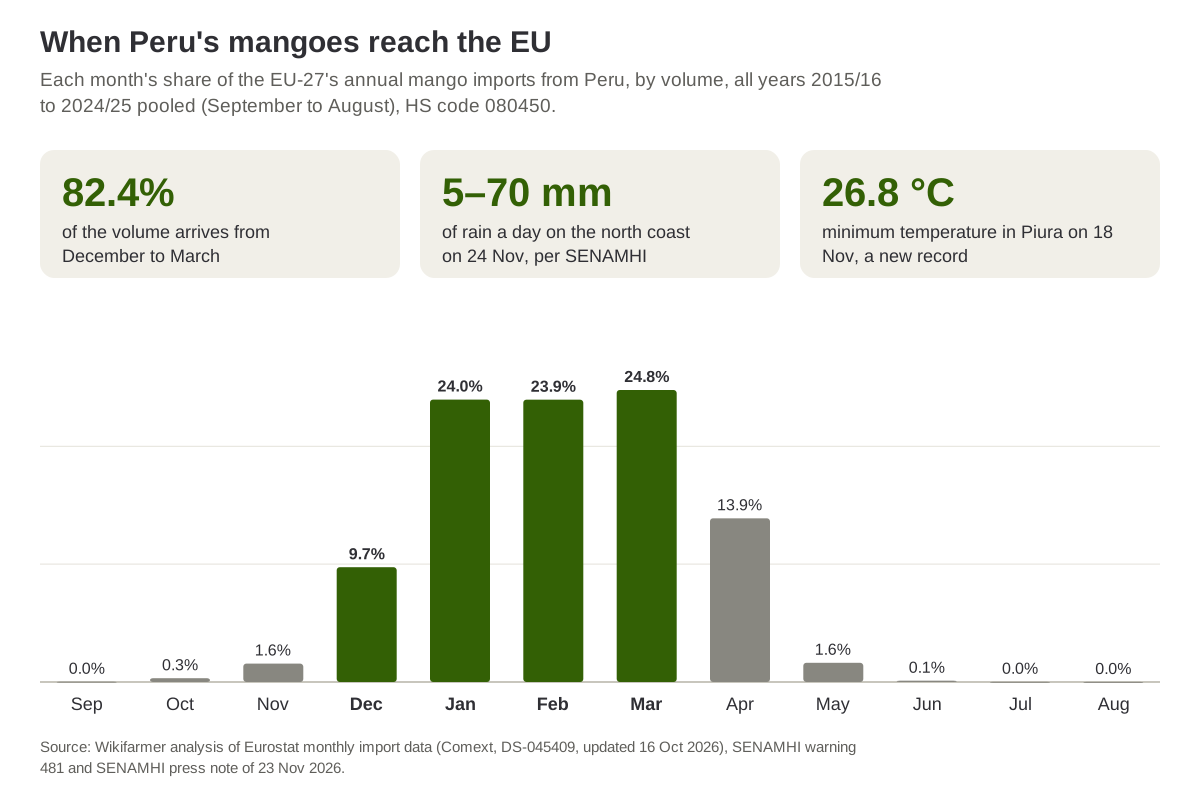
Each month's share of the EU's annual mango imports from Peru, 2015/16 to 2024/25
Anthracnose and water matter for growers and Brazil matters for buyers
For growers on the north coast, the official advice available concerns heat and moisture: SENAMHI has pointed to the risk of anthracnose when rain combines with warm conditions, and to higher water needs of the trees when temperatures are above normal. For importers and retailers in Europe, the warnings fall just before the four months that bring most of Peru's mangoes, while Brazil, the other large origin of the northern hemisphere winter, supplied 61.2% of imports from October 2025 to March 2026. The picture will change with SENAMHI station rainfall for 24 to 26 November, an official estimate of production or damage from Peru's Ministry of Agrarian Development and Irrigation (MIDAGRI), and Eurostat import data for December, which are published with a delay of about two months.
Frequently asked questions
Which areas of Peru does the red rain warning cover?
SENAMHI's warning 481 covers the north coast and the highlands from 24 to 26 November. On the north coast the service expects heavy to extreme rain mainly in Tumbes and parts of the inland coast of Piura.
How warm were the nights in Piura?
The Miraflores station in Piura recorded a minimum temperature of 26.8 °C on 18 November, a new all-time record for the station, and in La Esperanza the minimum reached 27.0 °C, 8.5 °C above normal, according to SENAMHI.
What stage are mangoes at in Piura?
In mid-October SENAMHI recorded the Edward variety in the fruiting stage at Chulucanas and harvesting on some plots in El Bigote and Chulucanas. The November reports include no north coast station.
Are there official damage estimates?
Not as of 25 November, in the sources Wikifarmer examined. SENAMHI's warnings describe the weather expected, not its effects on crops.
When do Peru's mangoes reach Europe?
In the years 2015/16 to 2024/25, 82.4% of the volume Peru shipped to the EU arrived from December to March, according to Eurostat data.
Important notes
The analysis was done by Wikifarmer. The warnings were read in SENAMHI's national warnings table on 25 November 2026, and the description of the areas and rainfall amounts of warning 481 on the warning's page on 23 November. The pages of warnings 484 and 485 listing areas by hazard level were not examined. Station temperatures come from two SENAMHI press notes, of 22 and 23 November, and the mango stages from the weekly agrometeorological impact reports for the coast, for the weeks from 6 October to 16 November 2026. No station rainfall for 24 to 26 November was used, because it had not been published when the article was written. The forecast is ECMWF's (IFS model, open data, 0.25° resolution, 00:00 UTC run), for the cell centred at 5.25°S, 80.5°W for Piura and 3.5°S, 80.5°W for Tumbes, with days counted in UTC, and it is not a Wikifarmer forecast. Imports refer to the EU-27 and HS code 080450, which also includes guavas and mangosteens, with years running from September to August.
Sources
- SENAMHI. (2026). Avisos meteorológicos a nivel nacional, warnings 481, 483, 484 and 485, read on 23 and 25 November 2026.
- SENAMHI. (2026, November 23). SENAMHI: costa peruana registra récords históricos de temperaturas nocturnas elevadas.
- SENAMHI. (2026, November 22). SENAMHI advierte que altas temperaturas persistirán en Piura tras alcanzar los 37,2 °C.
- SENAMHI. (2026). Reporte agrometeorológico de impactos, Región Costa, 06 al 12 de octubre del 2026.
- SENAMHI. (2026). Reporte agrometeorológico de impactos, Región Costa, 13 al 19 de octubre del 2026.
- SENAMHI. (2026). Reporte agrometeorológico de impactos, Región Costa, 03 al 09 de noviembre del 2026.
- SENAMHI. (2026). Reporte agrometeorológico de impactos, Región Costa, 10 al 16 de noviembre del 2026.
- ECMWF. (2026). Open data, IFS, run of 25 November 2026 00:00 UTC, total precipitation, with the 23 and 24 November runs for comparison.
- Eurostat. (2026). EU trade since 1988 by HS2-4-6 and CN8 (DS-045409), EU-27 imports under code 080450, updated 16 October 2026.