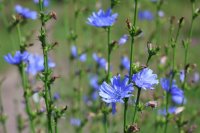

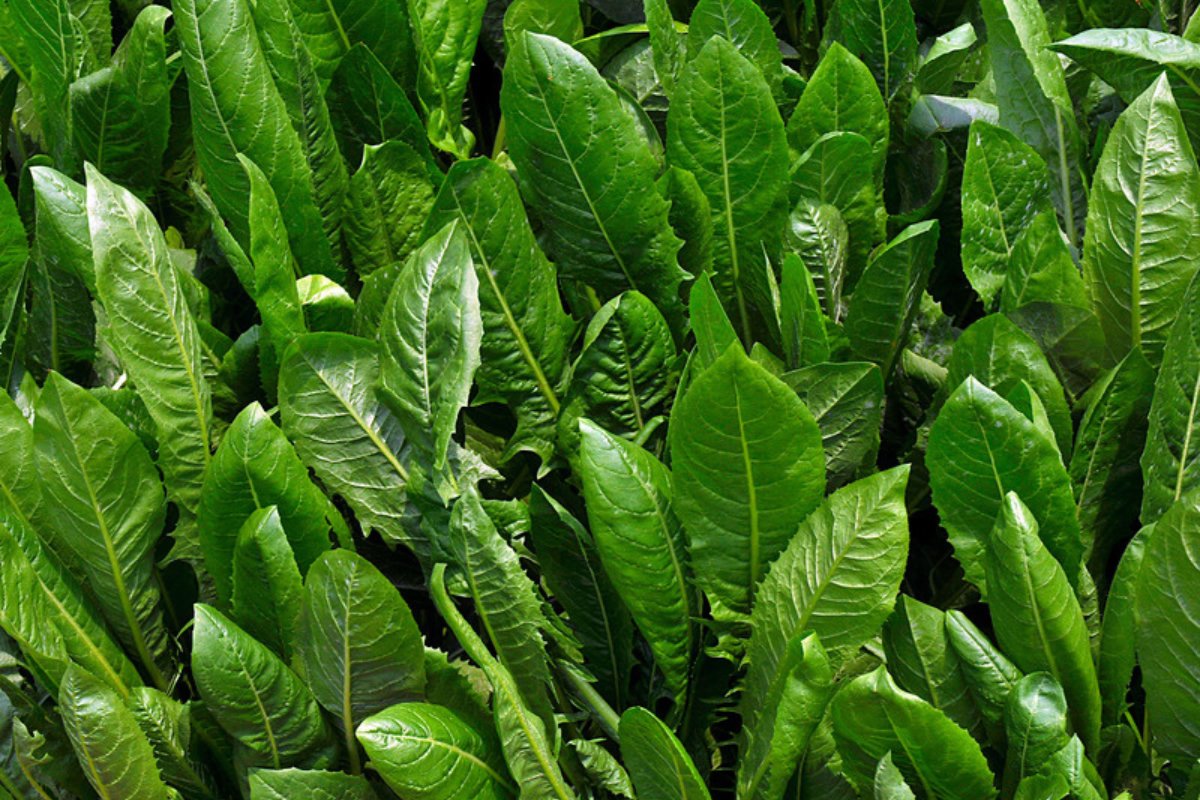
Chicory (Cichorium intybus) is a perennial that in Greece is grown only for its leaves, as an annual or biennial crop. According to the growing guide of the Greek seed company Agrogen, it is sown directly in the field from August to March in the northern hemisphere, at 8 to 10 kg of seed per hectare (0.8 to 1 kg per stremma), and the first harvest comes 70 to 90 days after sowing. The crop gives either 4 or 5 cuts of leaves, each yielding 4 to 5 tonnes per hectare (400 to 500 kg per stremma), or a single harvest of the whole plant at 25 to 30 tonnes per hectare (2,500 to 3,000 kg per stremma). Chicory is a long-day plant, so heat and long days speed up the flower stalk, and this sets the end of each season's production.
Chicory as a commercial crop
In Greece, chicory is sold fresh, as a green for boiling and for salads, and its nutritional value comes with very few calories, 23 kcal per 100 g of raw leaves according to the USDA. The crop is managed in two ways. In the first, the leaves are cut above the crown, which regrows and gives successive cuts. In the second, the whole plant is harvested at once, giving a larger yield that one time and no second crop. The choice depends on the variety, on how long the season lasts before the flower stalk appears and on how the buyer wants the product.
Elsewhere the same species is grown in other forms. Radicchio, with varieties such as Rossa di Treviso and Rossa di Verona, forms a head, while witloof is grown for its root, which is planted in a dark, cool room in winter to produce a tight, white head of leaves, as described by Utah State University. These forms need a different technique, and in Greece chicory is grown for its leaves, in the field as in the home garden.
Climate and sowing season
The best temperatures for chicory are 13 to 24°C, with a minimum of 7°C and a maximum of 30°C, according to Agrogen. The plant tolerates cold and drought well, because its roots reach a good depth, and it does best with mild winters. High temperatures speed up the growth of the flower stalk, with tolerance differing between varieties, and most varieties withstand light frosts. Utah State University reports that the seed germinates best at 18 to 21°C and that germination drops above 27°C, so sowings at the end of summer in warm areas need regular watering until emergence. In the southern hemisphere, the August to March window falls about six months later.
Soil and crop rotation
Chicory is not demanding about soil and adapts to almost any type, but it prefers fertile, neutral, well-drained soils and does poorly in clay, where root growth suffers. Agrogen gives a pH of 5 to 7. Crop rotation keeps most diseases in check, according to Utah State University. The general rule is that chicory should not follow other plants of the same family, such as endive and lettuce.
Sowing rate and plant density
- Method: direct sowing in the field, while raising transplants in a seedbed is now very rare
- Seed rate: 8 to 10 kg per hectare (0.8 to 1 kg per stremma), with 650 to 750 seeds per gram, for 100,000 to 140,000 plants per hectare (10,000 to 14,000 per stremma)
- Spacing: 20 to 30 cm between rows and 20 cm within the row
- Depth: 0.5 to 1 cm, with emergence in about a week
- Mixing with sand: chicory seed is very small and is mixed with sand for even distribution
- Seedbed: when used, it needs 2 to 3 g of seed per square metre, and plants are transplanted at about 8 leaves, 30 to 40 days after sowing
All the figures in the list come from Agrogen. Sowing in rows rather than broadcasting allows hoeing between the rows and makes cutting easier.
Feeding
Fertiliser rates are planned from a soil analysis. According to Agrogen, a yield of 2 tonnes per stremma (20 t/ha) removes about 10 kg of nitrogen, 3 kg of P₂O₅ and 4.5 kg of K₂O per stremma, which is 100, 30 and 45 kg per hectare. Before sowing, 30 to 40 tonnes of well-rotted manure per hectare (3 to 4 tonnes per stremma) are usually worked in, together with the phosphorus and potassium fertilisers, while nitrogen is given as top dressings. Where the crop is cut repeatedly, each cut removes foliage, so a nitrogen top dressing after the cuts supports regrowth. Excess nitrogen is avoided, and for heading types Utah State University advises giving no more nitrogen once the heads start to form.
Irrigation
In a winter crop, rain usually covers the water needs, while in the summer months irrigation is essential, even daily, according to Agrogen. After sowing, frequent light irrigations are given until emergence. Agrogen considers sprinklers the most suitable method, because they spread water evenly across the field. In a five-year trial on radicchio in Italy with mini-sprinklers, Bortolini and Tolomio found that high-frequency irrigation raised marketable yield by 12%, from 23.6 to 26.5 tonnes per hectare, and cut irrigation water by 14%. Lack of water makes the leaves bitter and encourages bolting, as the RHS notes, while wet foliage favours fungal diseases, so irrigation is best done early in the day, letting the leaves dry.
Weed control
Chicory competes poorly with weeds, so control matters most while the crop establishes, according to Utah State University, which also advises shallow hoeing to avoid damaging the roots. Plant Protection, a Greek database of authorised products, lists annual and perennial grasses and annual broadleaf weeds among the weeds of field chicory. In row-sown crops, weeds are controlled by hoeing between the rows, while broadcast crops can only be hand-weeded. Herbicides authorised for chicory exist, and each product must be checked against the national register of the country where it is used, which in Greece is the Ministry of Rural Development and Food database.
Crop protection
Plant Protection lists ten diseases and eleven pests in field chicory, among them the tomato leafminer Tuta absoluta, while the damage from aphids and caterpillars is described by Utah State University.
- Downy mildew, grey mould and Sclerotinia rot: fungal diseases of the foliage favoured by moisture
- Powdery mildew: a white, powdery coating on the leaves
- Septoria, anthracnose and Cladosporium leaf spots: spotting that lowers the market value of the leaves
- Phytophthora and Rhizoctonia: rots of the crown and roots
- Bacterial diseases: rots, mainly at the base of the plant
- Aphids: they feed on the underside of the leaves, which crinkle and curl, and transmit viruses that cause yellowing between the veins and stunted plants
- Caterpillars, such as the cotton bollworm and the Egyptian cotton leafworm: they chew holes in the leaves and hide among them
- Nematodes, whiteflies, thrips, mites, stink bugs and vine weevils: also listed among the pests of the crop
Authorised baits exist for slugs and snails. Prevention relies on crop rotation, correct spacing that lets the foliage breathe, and moderate nitrogen feeding. Every treatment uses only products authorised for chicory, after a diagnosis by an agronomist. Because the crop is cut every few weeks, the pre-harvest interval also shapes the spray schedule.
Harvest and postharvest handling
Chicory is ready to harvest 70 to 90 days after sowing, and harvesting is done by hand, according to Agrogen. For successive cuts, leaves are cut above the crown so the plant can regrow, while for a single harvest the whole plant is lifted. For chicories harvested whole, the University of California, Davis recommends leaving a small stub of root so the leaves stay attached, because bacterial soft rot becomes common when the cut passes through the basal leaves.
Cooling straight after harvest is essential, and at 0°C with 95% relative humidity or higher, radicchio keeps for 16 to 21 days, according to UC Davis, and packing with polymer film liners limits water loss. Ethylene increases browning at the leaf margins and fungal decay, and grey mould is common even with good temperature management. Utah State University also advises against storing chicory with apples or pears, because it develops bitter flavours.
Yields per hectare
| Source | Harvest method | Yield |
| Agrogen | Successive leaf cuts, 4 or 5 | 4 to 5 t/ha per cut (400 to 500 kg per stremma) |
| Agrogen | Single harvest of the whole plant | 25 to 30 t/ha (2,500 to 3,000 kg per stremma) |
| Bortolini and Tolomio, 2019 | Heading radicchio, Italy | 23.6 to 26.5 t/ha |
Sources: Agrogen; Bortolini and Tolomio, 2019
With 4 or 5 cuts of 4 to 5 t/ha, the total for the season comes to roughly 16 to 25 t/ha. The final yield depends mainly on how many cuts the crop fits in before the flower stalk appears, so the sowing date and steady moisture decide the outcome. Quality is also decided in the field, because drought and a late harvest make the leaves bitter and tough, according to Utah State University.
Frequently asked questions
What is the yield of chicory per hectare
According to Agrogen, 4 to 5 t/ha per cut, with 4 or 5 cuts, or 25 to 30 t/ha when the whole plant is harvested at once.
How much chicory seed is needed per hectare
8 to 10 kg for direct sowing, mixed with sand. One gram holds 650 to 750 seeds, and the target is 100,000 to 140,000 plants per hectare.
When is chicory sown for commercial production
In the northern hemisphere, from August to March. Spring sowings give fewer cuts, because heat and long days quickly bring a flower stalk.
How many cuts does chicory give
4 or 5, if the leaves are cut above the crown. The first cut comes 70 to 90 days after sowing.
How is chicory irrigated
In winter rain is usually enough, while in the hot months irrigation may be needed daily. Agrogen recommends sprinklers for even distribution, and in a trial in Italy frequent irrigation raised yield by 12% while using less water.
How long does chicory keep after harvest
At 0°C and 95% humidity or higher, radicchio keeps for 16 to 21 days. It is not stored with apples or pears, because it develops bitter flavours.
Important notes
Spacing, feeding and the number of cuts are adjusted to the variety, the soil and market requirements, and treatment dates follow the official crop advisory bulletins of each region.
Every plant and every growing environment is different. Conditions vary considerably with region, exposure, water quality, soil pH and the overall health of the plant. The guidance above is general and is a starting point.
If you suspect a serious nutrient deficiency or a disease that does not respond to basic practices, contact an agronomist for an accurate diagnosis.
Plant protection products should be used with care and responsibility. Always try non-chemical methods first. When chemical control is needed, use only registered products and follow the label instructions.
References
- Agrogen. Chicory (Cichorium intybus L.). Growing guide, in Greek.
- Bortolini, L. and Tolomio, M. (2019). Influence of irrigation frequency on radicchio (Cichorium intybus L.) yield. Water, 11(12), 2473.
- Suslow, T.V. and Cantwell, M. University of California, Davis, Postharvest Research and Extension Center. Radicchio, produce facts.
- Gibson, R. and Drost, D. (2020). How to grow chicory in your garden. Utah State University Extension.
- Royal Horticultural Society. How to grow chicory.
- Plant Protection. Field chicory, diseases, pests and authorised products. In Greek.
- US Department of Agriculture, FoodData Central. Chicory greens, raw, FDC ID 169992.
- Hellenic Ministry of Rural Development and Food. Plant protection products. In Greek.