

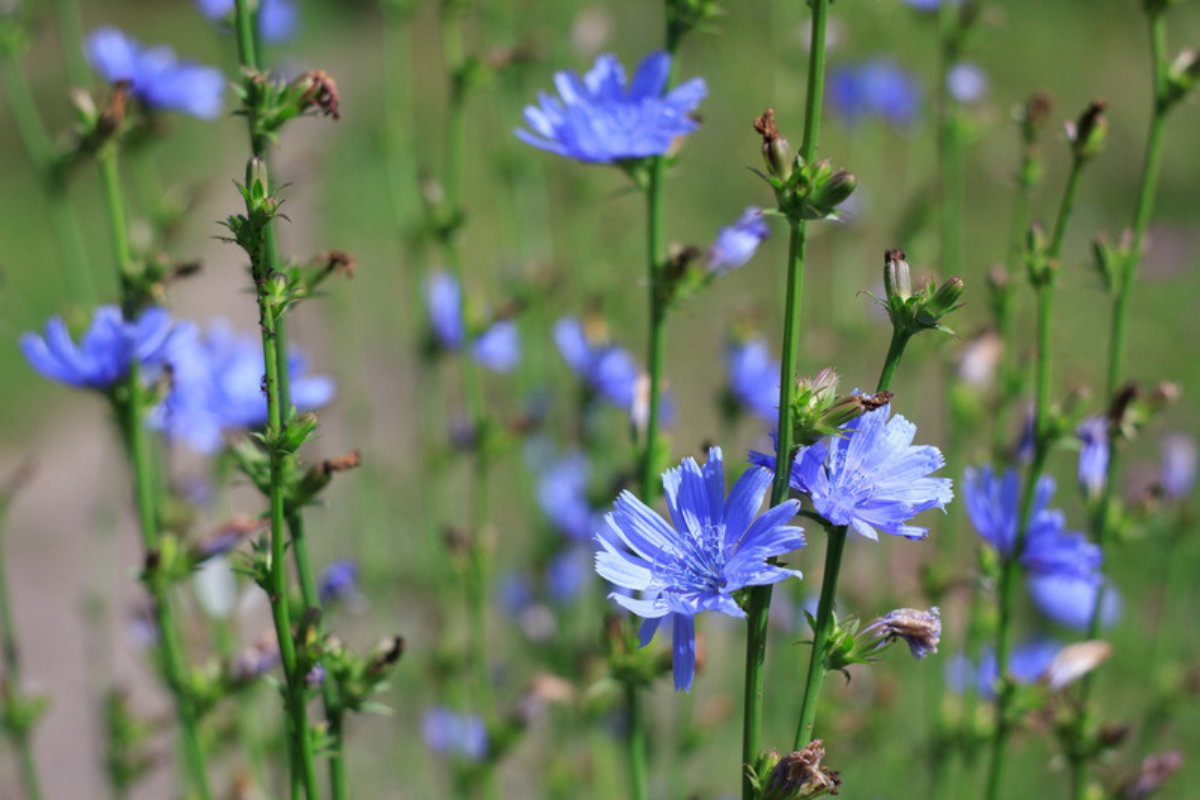
Chicory (Cichorium intybus) is a perennial in the daisy family (Asteraceae). In Greece it is grown only for its leaves, as an annual or biennial, and eaten mostly as a boiled green. According to the growing guide of Agrogen, a Greek seed company, chicory is sown directly in the ground from August to March in the northern hemisphere, germinates in about a week and is ready to cut 70 to 90 days after sowing. The same plant gives 4 or 5 cuts of leaves, or a single harvest in which the whole plant is lifted. Chicory is a long-day plant, so the long days and warmth of spring push it into a flower stalk, while drought makes its leaves more bitter.
What leaf chicory is
All the chicories grown in the garden belong to the same species, Cichorium intybus, and differ in the shape and colour of their leaves. Among the cultivated leaf types is Spadona da taglio, whose Italian name means "for cutting" and which is grown for repeated cuts. Selvatica da campo, "wild of the field", is a wild type. Seed and young plants of Italian chicories with red stems and red veins are also widely sold.
The same species includes types that are grown far more outside Greece. The Royal Horticultural Society (RHS) describes radicchio, which forms a tight head of red leaves, sugarloaf, with a large pale heart, and witloof, whose roots are replanted in the dark in winter to produce the white heads sold as Belgian endive. The root of chicory is also used as a coffee substitute, according to the University of Wisconsin.
How chicory differs from its relatives
- Endive and escarole: Cichorium endivia, a related species of the same genus, which includes curly endive and broad-leaved escarole
- Stamnagathi: Cichorium spinosum, also of the same genus, native to the coasts of Crete and the Aegean, which grows into a spiny bush in summer
- Dandelion: Taraxacum officinale, a different genus of the same family, which in Greece is sometimes sold as seed under a chicory name. According to the University of Wisconsin, dandelion seed has a hairy pappus that is carried by the wind, while chicory seed has none
When to sow chicory
The months in the table refer to the northern hemisphere. In the southern hemisphere the same pattern applies about six months later.
| Sowing | What to expect |
| August to October | Cuts from autumn and through the winter |
| November to March | Cuts from winter into spring, until the long days bring the flower stalk |
| April to July | Not recommended, as heat and long days speed up flowering |
Source: Agrogen, chicory growing guide
The best temperatures for chicory are 13 to 24°C, with a minimum of 7°C and a maximum of 30°C, according to Agrogen. Most varieties tolerate light frosts, while heat makes the flower stalk grow faster, with each variety reacting differently. Utah State University reports that the seed germinates best at 18 to 21°C (65 to 70°F) and that germination drops above 27°C (80°F). This is why in Greece the main sowing goes in with the other autumn sowings of the vegetable garden, once the summer heat breaks.
Position and soil
Chicory likes a sunny spot but copes with some shade. It is not fussy about soil and adapts almost anywhere, yet it does best in fertile, neutral, well-drained soil and poorly in heavy clay, where the root struggles to grow. Agrogen gives a pH of 5 to 7. The RHS advises clearing the bed of weeds and digging in compost or well-rotted manure, ideally a few weeks before sowing. Utah State University suggests growing chicory in a different spot each year, which keeps most diseases in check.
How to sow chicory
Chicory is mostly sown directly in the ground, either broadcast or in rows, and raising it in a seedbed for transplanting is now rare.
- Mixing with sand: the seed is very small, with 650 to 750 seeds per gram, so it is mixed with sand to spread evenly
- Depth: 0.5 to 1 cm
- Spacing: 20 to 30 cm between rows and 20 cm within the row. For small salad leaves, the RHS thins plants to just 5 cm
- Thinning: when seedlings have 3 or 4 true leaves, according to Utah State University
- Transplanting: if raised in a seedbed, plants are moved when they have about 8 leaves, 30 to 40 days after sowing
Until the seed germinates, the soil is watered often and lightly so the surface does not dry out. In normal conditions the seedlings appear in about a week.
Watering and feeding
In a winter crop, rain usually covers the plants' water needs, while in the warm months watering becomes essential, sometimes daily, according to Agrogen. Keep the soil evenly moist, because the RHS and Utah State University agree that lack of water makes the leaves more bitter and encourages bolting. A layer of organic mulch holds moisture and keeps weeds down.
In the garden, chicory rarely needs much feeding, according to the RHS, as long as organic matter was dug in before sowing. For commercial crops, Agrogen describes well-rotted manure worked in before sowing and nitrogen given as top dressings. In the garden this translates into a light feed after thinning or after each cut, with a slow-release organic fertiliser.
When and how to cut chicory
- First cut: 70 to 90 days after sowing, while tender salad leaves can be picked from the first or second month, according to the RHS
- Repeated cuts: leaves are cut with a knife or scissors above the crown, which sprouts again, and Agrogen gives 4 or 5 cuts for chicory grown commercially
- Single harvest: alternatively, the whole plant is lifted in one go
- Timing: delaying the harvest makes the leaves more bitter and tougher, according to Utah State University
Growing chicory in pots
Chicory grows well in a pot or window box on a balcony. The RHS suggests a container at least 30 cm wide filled with multipurpose compost, and since the chicory root goes deep, the pot also needs good depth and drainage holes. A light, free-draining potting mix holds moisture without turning soggy. Compost in pots dries out faster, so watering is more frequent, and the RHS suggests a general-purpose liquid feed every two weeks while the plants are growing.
Why chicory turns bitter and bolts
Bitterness is part of chicory's character, but drought, heat and a late harvest make it stronger. Bolting, the growth of a flower stalk, is triggered by the long days and warmth of spring, and also by a cold snap after a very early sowing, according to the RHS. Once the stalk starts to grow, the leaves become tougher and even more bitter.
Chicory is a perennial, so its root lives on after flowering. According to the University of Wisconsin, in its first year it forms only a rosette of leaves and a fleshy taproot with milky sap, and from the second year it sends up a stiff, branched flower stalk that can reach almost 1.2 m, with flowers that each stay open for a single day. The plant also regrows easily from pieces of root, so chicory left in the garden sprouts new leaves from the root.
Common problems
- Slugs and snails: they eat mainly young seedlings
- Aphids: they feed on the underside of the leaves, which curl, and spread viruses that cause yellowing between the veins and stunted plants
- Caterpillars: they chew holes in the leaves
- Grey mould: caused by Botrytis, it brings a soft rot, especially in wet weather
- Powdery mildew: a white, powdery coating on the leaves
- Root rots: they cause wilting and are reduced by good air movement and crop rotation
Slugs, aphids, grey mould and powdery mildew are listed by the RHS, while caterpillars, root rots and viruses come from Utah State University. Aphids can be knocked off with a strong jet of water or treated with insecticidal soap.
How to clean and cook chicory
Chicory needs a thorough wash, because soil collects at the base of the leaves, and yellowed or tough leaves are removed. Tender leaves are eaten raw in salads and taste quite bitter, while larger leaves are cooked, since cooking softens the bitterness, as the University of Wisconsin notes. In Greece chicory is eaten mostly boiled with olive oil and lemon, on its own or mixed with other greens such as Swiss chard, and it goes into savoury pies. Raw leaves provide 23 kcal per 100 g, according to the US Department of Agriculture's FoodData Central.
Frequently asked questions
When should chicory be sown
In the northern hemisphere, from August to March, with the main sowing in autumn once temperatures drop. Sowing from April to July is not recommended, because long days and heat quickly bring a flower stalk. In the southern hemisphere the same window falls about six months later.
How long does chicory take to germinate
About a week, with the soil kept evenly moist. The seed germinates best at 18 to 21°C, and germination drops above 27°C.
How many times can chicory be cut
The first cut comes 70 to 90 days after sowing, and the same plant gives 4 or 5 cuts in total if the leaves are cut above the crown. If the whole plant is lifted, there is a single harvest.
Does chicory grow back every year
Yes, chicory is a perennial. It flowers in its second year, but the root survives and sends up new leaves, and the plant also spreads from pieces of root.
Why is my chicory bitter
Bitterness is natural in chicory, but it increases with lack of water, heat, a late harvest and bolting. Cooking reduces it.
What is the difference between chicory and dandelion
They are different plants of the same family. Chicory is Cichorium intybus, while dandelion is Taraxacum officinale, and its seed has a hairy pappus that the wind carries away, which chicory seed lacks.
Important notes
Every garden is different, and sowing dates shift with the region, the altitude and each year's weather. For persistent pest or disease problems, an agronomist can help with an accurate diagnosis.
References
- Agrogen. Chicory (Cichorium intybus L.). Growing guide, in Greek.
- Royal Horticultural Society. How to grow chicory.
- Gibson, R. and Drost, D. (2020). How to grow chicory in your garden. Utah State University Extension.
- Mahr, S. (2025). Chicory, Cichorium intybus. Wisconsin Horticulture, University of Wisconsin-Madison, Division of Extension.
- US Department of Agriculture, FoodData Central. Chicory greens, raw, FDC ID 169992.