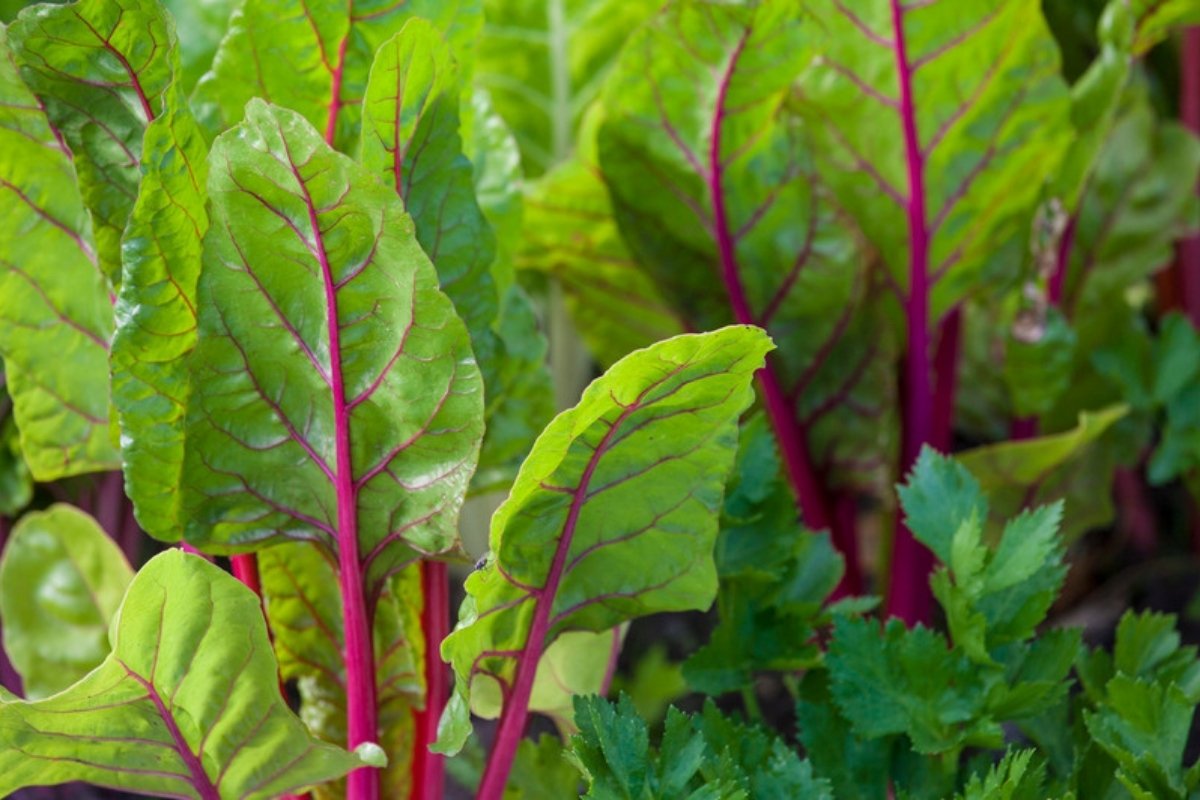
Swiss chard (Beta vulgaris subsp. vulgaris) is the same species as beetroot, selected for its leaves and stalks instead of its root. It is a biennial grown as an annual, and in mild climates it is sown mainly from late summer into autumn and in early spring, directly in the ground or in trays for transplanting. Each chard "seed" is in fact a cluster of several seeds, so two or more seedlings come up from each spot and need thinning. Tender leaves can be picked from about 30 days, full-sized leaves at 50 to 60 days, and harvesting of the outer leaves continues for months. This guide covers how chard relates to beetroot, the main varieties, when and how to sow and thin, watering and feeding, the growth stages, how to harvest so plants keep producing, growing chard in pots, and common problems.
Chard is the same species as beetroot
According to the University of Illinois, chard is a beet selected for leaf production at the expense of storage root formation. It belongs to the family Amaranthaceae, which now includes the former family Chenopodiaceae, together with beetroot, sugar beet and spinach. It most likely originates from the Mediterranean, and its first varieties have been traced to Sicily. The name Swiss chard has nothing to do with Switzerland. The word "Swiss" was added by 19th-century seed catalogue publishers to distinguish the plant from others with similar French names.
Because chard and beetroot are the same species, they share the same cluster-type seeds, the same needs and many of the same pests, and they cross with each other when they flower, which matters for anyone saving their own seed.
Swiss chard varieties
Varieties are usually divided into broad-stemmed types, with wide leaves and broad, fleshy stalks, and narrow-stemmed types with slimmer stalks. They also differ in stalk colour, which can be white, yellow, orange, pink or red. The best-known variety internationally is Fordhook Giant, and there are also red-stalked varieties such as Ruby and Rhubarb, and mixes of multicoloured stalks such as Bright Lights. Colourful varieties are often grown as ornamentals too, in borders and containers.
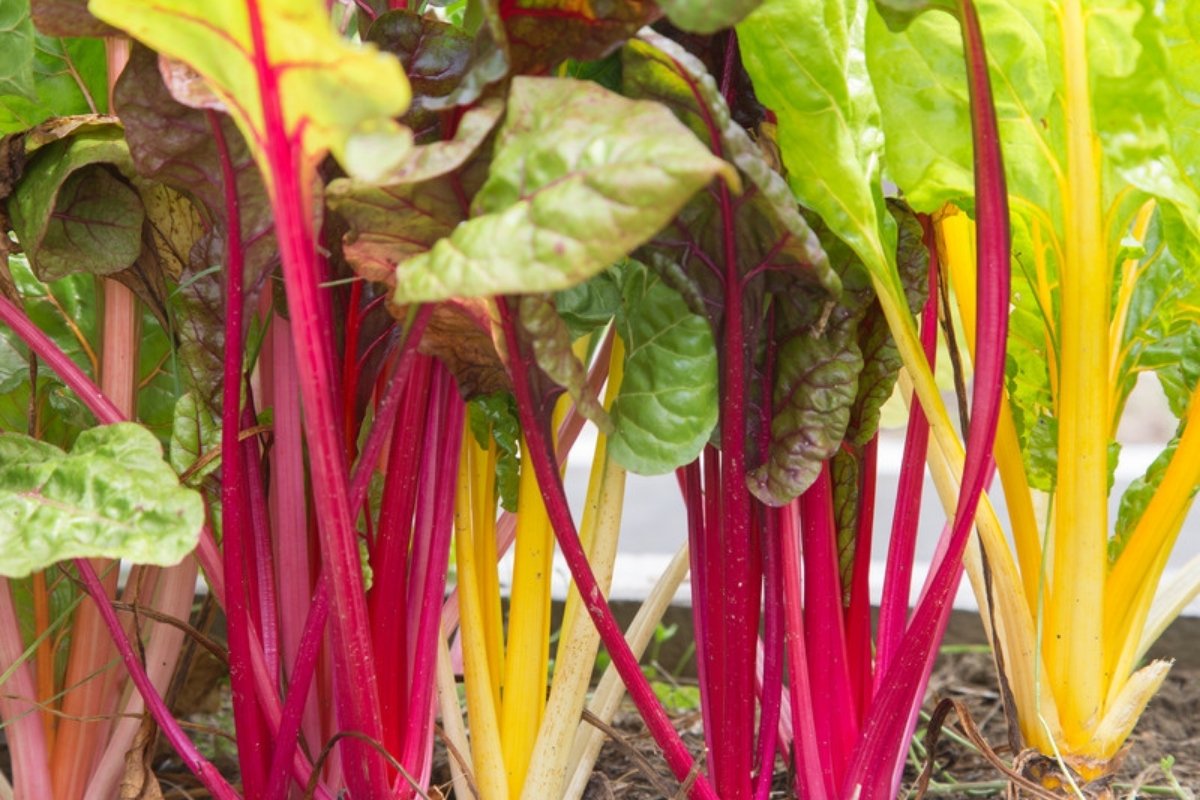
Colourful varieties have stalks in shades of pink, red and yellow and suit both the vegetable garden and ornamental borders.
When to plant Swiss chard
| Sowing | Harvest |
|---|---|
| Late summer to autumn, in mild climates | From autumn, through winter, into spring |
| Early spring | From spring into summer |
Chard is a cool-season crop which, according to UC IPM, grows best at air temperatures of 10 to 18°C, and it tolerates frost and mild freezes. Compared with spinach it copes better with heat, so it keeps producing leaves as the weather warms, at a slower rate. In cold-winter climates, sow in spring a few weeks before the last frost and harvest through summer until hard frosts. Autumn sowing in mild climates goes in alongside the other autumn sowing jobs in the vegetable garden.
Position and soil
Chard grows best in full sun but tolerates partial shade. It performs well in deep, fertile, moist soil rich in organic matter, with good drainage. Before sowing, enrich the soil with compost or rotted manure. According to the University of California, chard should not follow beetroot, spinach or chard from the previous year, because they belong to the same family. It does very well after legumes such as broad beans.
Sowing and thinning
Chard can be direct-sown or started in trays and transplanted once seedlings have a few true leaves.
- Depth: about 1 to 2 cm
- Seed spacing: one seed roughly every 2.5 cm, in rows 30 to 40 cm apart
- First thinning: when seedlings are 2.5 to 5 cm tall, remove the weaker ones from each cluster with scissors, so the roots of those remaining are not disturbed
- Final spacing: 15 to 25 cm between plants
- Two-step thinning: the University of Illinois suggests thinning first to 5 to 8 cm, then harvesting whole plants once they reach 15 to 20 cm, until 23 to 30 cm remain between them
The chard "seed" looks like a small, knobbly lump. It is in fact a small fruit containing several seeds, as in beetroot, so two or more seedlings emerge from each one. That is why thinning is essential, and the thinnings can be eaten in salads.
How long Swiss chard takes to germinate
According to UC IPM, chard seed germinates at soil temperatures of at least 5°C, with an optimum range of 10 to 30°C, and it does not germinate above 35°C. In evenly moist soil within that range, seedlings usually emerge within 1 to 2 weeks. In cold winter soil germination is slower, while in dry soil or under a hard crust it fails.
Growth stages
| Stage | Timing | What to do |
|---|---|---|
| Emergence | 1 to 2 weeks | Keep the soil evenly moist |
| Seedlings at 2.5 to 5 cm | A few weeks after sowing | Thin each cluster |
| Baby leaves | From about 30 days | First picking for salads |
| Full-sized leaves | 50 to 60 days | Pick outer leaves, leave the heart |
| Continuous harvest | For several months | Feed with nitrogen after heavy pickings |
| Bolting | Second spring, or after prolonged cold | Leaves turn bitter, replace the plants |
Watering
Chard needs plenty of moisture to develop well, and the soil is kept evenly moist, especially as the weather warms. Water at the base of the plants rather than over the leaves, because wet foliage favours Cercospora leaf spot. A layer of mulch helps hold moisture and suppresses weeds.
Feeding
Chard has a high nutrient requirement, met either from soil organic matter or from fertiliser. With a good base of compost or rotted manure, a nitrogen feed midway through the season, or after heavy pickings, helps the plant keep producing leaves quickly.
Harvesting cut-and-come-again
- Baby leaves for salads: from about 30 days after sowing
- Full-sized leaves: at 50 to 60 days
- Method: cut the outer, larger leaves near the base and leave the heart of the plant intact, so it keeps producing new ones
- Duration: with regular picking, the same plant gives leaves for several months, until it bolts or leaf diseases take over
Chard leaves are highly perishable, so eat them within a few days of harvest.
Growing Swiss chard in pots
Chard grows easily in pots and window boxes, and colourful varieties brighten a balcony:
- Container: at least 25 to 30 cm deep, with drainage holes
- Growing medium: rich potting compost with added compost
- Sowing: sow about 1 cm deep and thin after germination, leaving one plant per small pot or a few plants in a trough
- Position: sunny, or with some afternoon shade on hot days
- Watering and feeding: more often than in the ground, because pots dry out faster, with a mild liquid feed every few weeks
Does Swiss chard grow back every year
Not exactly. Chard is a biennial. In its first year it produces leaves, and in mild climates it survives winter and keeps going into the following spring. In its second spring, however, it sends up a flower stalk, its leaves turn bitter and tough, and the plant completes its life cycle. It often drops seed that sprouts on its own, giving the impression that the plant returns each year. Prolonged freezing can also make some varieties bolt earlier.
Common problems
- Cercospora leaf spot: small brown or grey spots with reddish margins on the leaves, in damp weather. Rotation, correct spacing, watering at the base and removing infected leaves all help
- Leafminers: larvae tunnel inside the leaves, leaving pale trails or blotches. Remove affected leaves and protect young plants with insect mesh
- Aphids: colonies on the undersides of leaves, controlled by washing off, insecticidal soap and the methods for aphids
- Slugs and snails: eat the leaves, especially of young plants
- Root-knot nematodes: galls on the roots and stunted plants
- Early bolting: in the second spring, or after prolonged cold
How to clean and cook chard
Chard is easy to clean, because it holds little soil. Trim the base of the thick stalks and wash the leaves well. The broad stalks need longer cooking than the leaves, so they are often cut separately and go into the pan first. In Greece, chard is boiled like other greens and served with lemon and olive oil, sautéed, baked into pies, used to wrap stuffed leaves, and added to soups and bean stews. Tender leaves are also eaten raw in salads.
Frequently asked questions
What month is best to plant Swiss chard
In mild climates, from late summer into autumn for harvest through winter into spring, and in early spring for harvest into summer. In cold-winter climates, sow in spring a few weeks before the last frost.
How long does Swiss chard take to germinate
Usually 1 to 2 weeks in moist soil at 10 to 30°C. Germination is slower in cold winter soil, and seed does not germinate above 35°C.
Why do several seedlings come up from one chard seed
Because the chard "seed" is actually a small fruit containing several seeds, as in beetroot. Thin the seedlings with scissors to leave the strongest, and eat the thinnings.
How do you harvest Swiss chard so it keeps growing
Cut the outer leaves near the base and leave the heart of the plant intact. The plant keeps producing new leaves for several months.
Does Swiss chard come back every year
Chard is a biennial. It can survive winter and give leaves into the next spring, but then it bolts and completes its life cycle. It often self-seeds, though.
What spacing does Swiss chard need
Final spacing is 15 to 25 cm between plants, in rows 30 to 40 cm apart. For baby leaves, sowing can be much denser.
Important notes
Every garden differs, and sowing dates shift with region, altitude and each year's weather. For persistent pest or disease problems, a local agronomist can help with an accurate diagnosis.
References
- UC Statewide IPM Program, Cultural tips for growing chard.
- University of Illinois Extension, Chard.
- Penn State PlantVillage, Chard.
- Washington State University Extension, Thinning vegetables in the June garden.
- UC Cooperative Extension Sacramento County, Growing beets.
- Michigan State University Extension, Swiss chard.
- University of Maryland Extension, Growing Swiss chard in a home garden.
- KwaZulu-Natal Department of Agriculture, Swiss chard.