


Spanish olive mills produced 70,530 tonnes of olive oil in October 2026, the first month of the 2026/27 season, the largest October output in the nine seasons since 2018/19 covered by the reports of Spain's Ministry of Agriculture (MAPA), according to a Wikifarmer analysis of the ministry's data. The figures are preliminary and come from the season's first preliminary monthly release (avance), with the situation as of 11 November. They are the first measurement of the new crop in a season expected to bring a bigger Mediterranean crop, with prices that have already halved.
October production was 63% higher than a year earlier
In October 2026, 1,700 mills filed a declaration, and production was 63% higher than in October 2025, when Spain produced 43,294 tonnes. It was also 37% above the previous October high of 51,346 tonnes, reached in 2021. In the eight previous seasons, October output ranged from 7,300 tonnes in 2018 to those 51,346 tonnes, with a median of about 38,500 tonnes, so this year's figure is 83% above a typical October.
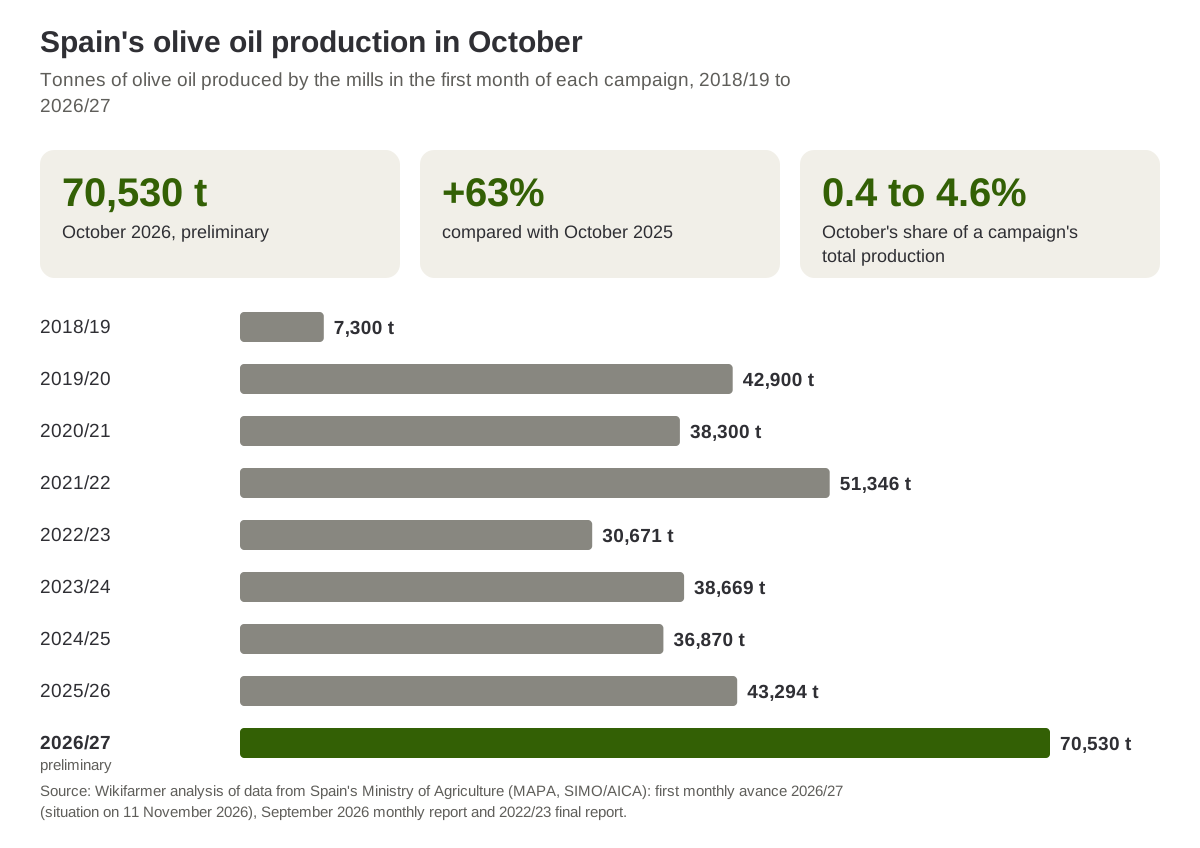
Source: Wikifarmer analysis of MAPA data (SIMO/AICA), first preliminary release (avance) 2026/27, September 2026 monthly report and 2022/23 final report. The 2026/27 value is preliminary.
Values for past seasons come from later ministry reports with consolidated data, while this year's is the first, preliminary record, which limits the comparison. October 2026 would lose first place only if it were revised down by more than 19,184 tonnes, or 27.2%.
Andalusia produced three quarters of the month's olive oil
Andalusian mills produced 52,344 tonnes in October, 74% of Spanish output and 85% more than the 28,301 tonnes of October 2025. Seville was the leading province with 18,765 tonnes, up 72%, while Córdoba, with 11,826 tonnes, and Jaén, with 11,350 tonnes, more than doubled their output of October 2025, which was 5,194 and 5,396 tonnes. In the rest of Spain the increase was much smaller, about 23%.
October is a small part of a season's production
In the eight seasons from 2018/19 to 2025/26, October accounted for between 0.4% and 4.6% of total production, and for 3.3% of the 1,305,807 tonnes of 2025/26. Most of the oil is produced from November to January, so a single month does not show how large the crop will be. The 2018/19 season shows this well: it had the smallest October in the series, 7,300 tonnes, and the largest production of the eight seasons, 1,793,500 tonnes.
For the whole 2026/27 season the ministry's figure is still its first production estimate of 1 October, 1,602,596 tonnes, 23% more than the previous season. October production equals 4.4% of that amount.
Olive oil stocks were about 307,000 tonnes at the end of October
On 31 October Spanish mills held 150,931 tonnes of olive oil. They started the season with 169,645 tonnes, added the 70,530 tonnes of new production and 2,191 tonnes of other inflows, such as oil held for third parties, and shipped out 91,435 tonnes. Packers, traders and refiners held another 154,473 tonnes, of which 121,683 tonnes in bulk and 32,790 tonnes packed. With the 1,563 tonnes declared by the Fundación Patrimonio Comunal Olivarero, total stocks were about 307,000 tonnes, against 357,040 tonnes on 30 September in the September report.
Stocks matter this season because Spain orders its mills to hold back 12% of their monthly production, starting with November production, after its opening stocks and estimated production put supply 6% above the storage rule threshold. The 70,530 tonnes of October were therefore produced before the obligation applies.
The pace of the first crush matters to buyers and sellers of olive oil
The October figures matter to anyone buying or selling new-crop olive oil, because they show how early the crush of the new crop started, at a time when Spain's extra virgin olive oil price is at its lowest since February 2022. The Wikifarmer analysis did not examine what caused the larger October output or whether it affects prices. The data end on 31 October and do not show how the harvest went after the rain of early November in southern Spain, which the November release will show. The picture would change if later reports revise October, or if November and December production moves away from its usual pattern.
The October figure is preliminary and compared with consolidated data
The analysis was carried out by Wikifarmer in November 2026 using the olive oil market information system SIMO, which MAPA runs through the Food Information and Control Agency (AICA) and which is based on the compulsory declarations of Royal Decree 861/2018. October 2026 production comes from the first preliminary release (avance) of the 2026/27 season, with data to 31 October and the situation as of 11 November, and, as the ministry notes, it includes the adjustments declared by the mills. Values for 2018/19 to 2025/26 come from the five-season comparison table of the September 2026 monthly report and the 2022/23 final report, which agree on the seasons they share; the 2025/26 data are consolidated but not yet final. Values for 2018/19 to 2020/21 are rounded to 100 tonnes. Provincial figures for October 2026 include the mills' adjustments, while those for October 2025, from the provincial table of the September report, do not, so provincial and regional changes are approximate, within about one percentage point. Opening mill stocks in the avance are 5,868 tonnes below end-September mill stocks in the September report, a sign that the data may be revised. The analysis did not examine the causes of the larger output or prices. All numbers were recomputed independently from the source files.
Sources
- Ministerio de Agricultura, Pesca y Alimentación (MAPA). (2026). Avance de la situación de mercado del sector del aceite de oliva, aceituna de mesa y aceite de orujo de oliva, campaña 2026/2027, datos octubre 2026. Situation as of 11 November 2026.
- Ministerio de Agricultura, Pesca y Alimentación (MAPA). (2026). Avances e informes de situación de mercado del sector del aceite de oliva y la aceituna de mesa. September 2026 monthly report and season final reports.
- Ministerio de Agricultura, Pesca y Alimentación (MAPA). (2026, 1 October). La producción de aceite de oliva alcanzará 1,6 millones de toneladas en la campaña 2026/27, según las primeras estimaciones del aforo.