

On data published by the Spanish agriculture ministry itself, opening stocks and estimated olive oil production for the 2026/27 campaign reach 1,959,600 tonnes, 6.3% above the threshold set by the ministerial order for mandatory storage, according to a Wikifarmer calculation. Under the same order's formula, mills would have to keep about 189,000 tonnes off the market, close to 12% of Spanish production. Order APA/1145/2026 was published in Spain's official gazette, the BOE, on 30 October and has applied since 31 October, with the same threshold and percentage rules as the draft. The ministry has not yet said whether the threshold is met, and the percentage will be set by a Directorate-General resolution by 15 November.
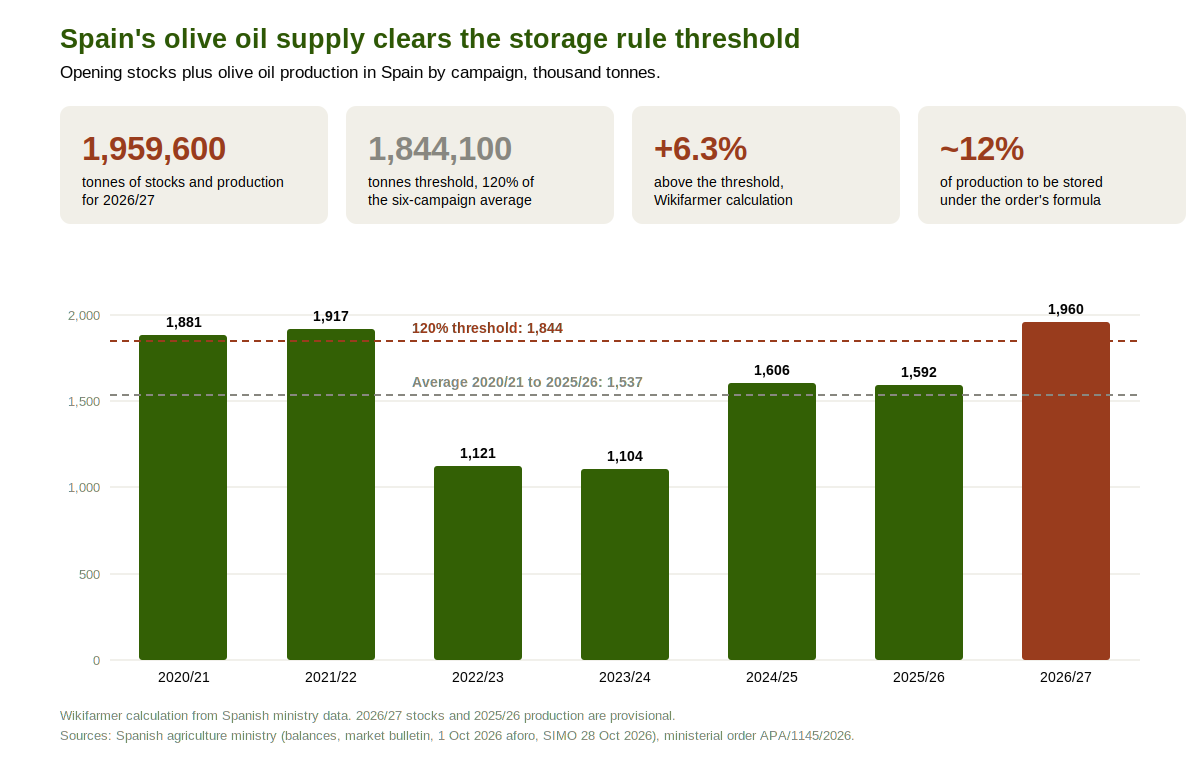
Opening stocks plus production by campaign, the average of the six previous campaigns and the 120% threshold set by the ministerial order. Wikifarmer calculation from Spanish agriculture ministry data.
The rule counts stocks together with the new crop
Article 4 of ministerial order APA/1145/2026 setting the marketing rule for 2026/27, published on 30 October, states that withdrawing olive oil from the market requires opening stocks plus estimated production equal to or above 120% of the average of that same sum over the six previous campaigns. The rule applies Article 167a of Regulation (EU) No 1308/2013 through Spain's Royal Decree 84/2021.
For 2026/27 both figures are now public, since the ministry's first national estimate on 1 October puts production at 1,602,596 tonnes, and stocks at 30 September, which are the opening stocks of the new campaign, stand at 357,040 tonnes, 23.3% more than a year earlier, according to the olive oil market information system (SIMO) data published by the ministry on 28 October, as reported by Agrodiario Huelva. Together they come to 1,959,636 tonnes.
The threshold works out at about 1,844,000 tonnes
For the six previous campaigns, 2020/21 to 2025/26, we used ministry data from its October 2025 market bulletin, its campaign balances and, for 2025/26, opening stocks of 290,500 tonnes and production of 1,301,800 tonnes to the end of August. The average of opening stocks plus production is 1,536,800 tonnes, so the 120% threshold works out at 1,844,100 tonnes.
| Campaign | Opening stocks plus production, thousand tonnes |
| 2020/21 | 1,881.2 |
| 2021/22 | 1,916.6 |
| 2022/23 | 1,120.6 |
| 2023/24 | 1,103.8 |
| 2024/25 | 1,606.2 |
| 2025/26 | 1,592.3 |
| Six-campaign average | 1,536.8 |
| Threshold, 120% of the average | 1,844.1 |
| 2026/27 | 1,959.6 |
Source: Wikifarmer calculation from Spanish agriculture ministry data. For 2020/21 and 2021/22, stocks by campaign are derived from the bulletin's four-campaign average and the 2022/23 and 2023/24 balances. Figures for 2025/26 and 2026/27 are provisional.
The 2026/27 campaign clears the threshold by about 115,000 tonnes, or 6.3%. The margin is wide enough that small revisions to stocks or production do not change the conclusion, since a fall of more than 115,000 tonnes would be needed to bring Spain below the threshold.
Storage could reach about 12% of production
The order also sets out how the quantity is calculated. From the campaign's estimated resources, meaning opening stocks, production and the average imports of the last six campaigns, it subtracts 120% of the average of the two campaigns with the highest marketed volume, where marketed volume is the domestic market plus exports. The difference is expressed as a share of production and cannot exceed 20%.
Average imports over the six campaigns are about 213,200 tonnes, which puts estimated resources for 2026/27 at 2,172,800 tonnes. The two campaigns with the highest marketed volume were 2020/21 and 2021/22, with an average of about 1,653,300 tonnes, and 120% of that average is 1,984,000 tonnes. The difference, about 189,000 tonnes, equals 12% of production of 1,602,596 tonnes, below the 20% ceiling of about 320,500 tonnes.
Under the order, the percentage and the start date of storage are set by the Directorate-General for Agricultural Production and Markets in a resolution published in Spain's official gazette, the BOE, by 15 November. Each mill applies it to its own declared production, chooses which grade of oil to hold back and keeps it until the following campaign.
The farm organisation COAG reached almost the same result on 14 October, calculating a withdrawal of about 188,700 tonnes, or 11.78% of each mill's production, with average imports of 218,000 tonnes (Press Digital).
Spain's competition authority confirms the rule and warns of its effects
Spain's National Markets and Competition Commission (CNMC), in its report on the draft order of 14 September, confirms that the trigger is 120% of the six-campaign average of stocks plus production, and that the average of the two campaigns with the highest marketed volume is used only to calculate the percentage. The point matters because the CNMC's press note, as relayed by Spanish media, described the trigger with the percentage formula, which would give a threshold of about 1,984,000 tonnes, above the 1,959,600 tonnes for 2026/27.
The CNMC warns that such a withdrawal could have very negative effects on competition and consumers, including higher prices and weaker incentives for quality and variety, and asks for the oversupply to be justified with data on demand and trade flows. According to the same report, the ministry's impact assessment puts storage costs, under maximum application of the measure, at EUR 9.24 to 11.68 million in total. The report also confirms last year's precedent, when the order for 2025/26 was published on 28 October 2025 and the Directorate-General found on 11 November 2025 that the threshold had not been reached, so the measure was not activated.
The figures will change with final data
The calculation is ours and may differ from the ministry's, because the 357,040 tonnes of stocks are based on operators' declarations and may be revised, as may 2025/26 production, and for 2025/26 imports we used the ministry's May estimate of 220,000 tonnes. Each change of 10,000 tonnes in stocks or production moves the percentage by about 0.6 points. The ministry may also use marketed volumes from a different source than the one we used.
The final order, adopted in line with the opinion of Spain's Council of State, kept the July draft's rules and provides no compensation for storage costs. The same order lets the ministry reduce the quantity by a new resolution after 31 December 2026, while bottlers and exporters, through the associations ANIERAC and ASOLIVA, oppose activation, which the farm organisations requested on 8 October.
The volume is close to two thirds of the Greek crop
If storage is activated at close to 12%, the roughly 189,000 tonnes kept off the market are about two thirds of Greece's 2026/27 crop, estimated at 280,000 to 300,000 tonnes, and close to two thirds of the increase Spain expects over 2025/26, about 300,000 tonnes. The comparison concerns volumes only and is not a price forecast, as prices will also depend on demand, other countries' crops and how the market reacts to the decision. We follow the wider picture in our olive oil outlook for 2026/27.
Sources
- Spanish Ministry of Agriculture, Fisheries and Food. (2026). Orden APA/1145/2026, por la que se establece la norma de comercialización del aceite de oliva para la campaña 2026/2027. BOE No 270, 30 October 2026.
- Agrodiario Huelva. (2026). Publicada en el BOE la norma de comercialización del aceite de oliva para la campaña 2026-2027. 30 October 2026.
- Spanish Ministry of Agriculture, Fisheries and Food. (2026). Proyecto de orden por la que se establece la norma de comercialización del aceite de oliva para la campaña 2026/2027. Draft for consultation.
- CNMC. (2026). Informe sobre el proyecto de orden ministerial por el que se establece la norma de comercialización del aceite de oliva para la campaña 2026/2027, IPN/CNMC/035/26. 14 September 2026.
- CNMC. (2026). Press note on the report. 5 October 2026.
- Press Digital. (2026). COAG's withdrawal calculation. 14 October 2026.
- Infobae. (2026). Campaña decisiva para el aceite de oliva. 19 October 2026.
- Spanish Ministry of Agriculture, Fisheries and Food. (2026). Primeras estimaciones del aforo de aceite de oliva 2026/27. 1 October 2026.
- Spanish Ministry of Agriculture, Fisheries and Food. (2026). Avances de la situación de mercado del aceite de oliva. Data to 30 September 2026.
- Spanish Ministry of Agriculture, Fisheries and Food. (2025). Boletín del mercado de aceite de oliva, octubre 2025. 2024/25 campaign data.
- Spanish Ministry of Agriculture, Fisheries and Food. (2026). Balance del sector del olivar en España, campaña 2025/2026. May 2026 update.
- Spanish Ministry of Agriculture, Fisheries and Food. (2024). Balance del sector del olivar en España, campaña 2022/2023, definitivo.