Greek olive oil production in 2026/27 is expected to be considerably larger than last season, according to the first country-by-country estimates gathered by the Spanish olive oil magazine Mercacei on 9 October. Italian broker Luigino Mazzei, who specialises in the Greek market, puts production at about 280,000 tonnes, with a margin of 10,000 to 20,000 tonnes depending on yields, while chemist and oleologist Konstantinos Tsoronis gives about 300,000 tonnes, provided weather and plant health remain favourable until the end of the harvest. Greece's National Interprofessional Organisation of Olive Oil also puts production at 300,000 tonnes, against about 232,000 in 2025/26 according to the European Commission.
The larger crop, however, arrives in a market holding unsold oil from the previous season and low prices. Mazzei estimates last season's stocks at at least 40,000 tonnes, at prices of EUR 3.20 to 3.60 a kilo at the mill gate and with no buying interest.
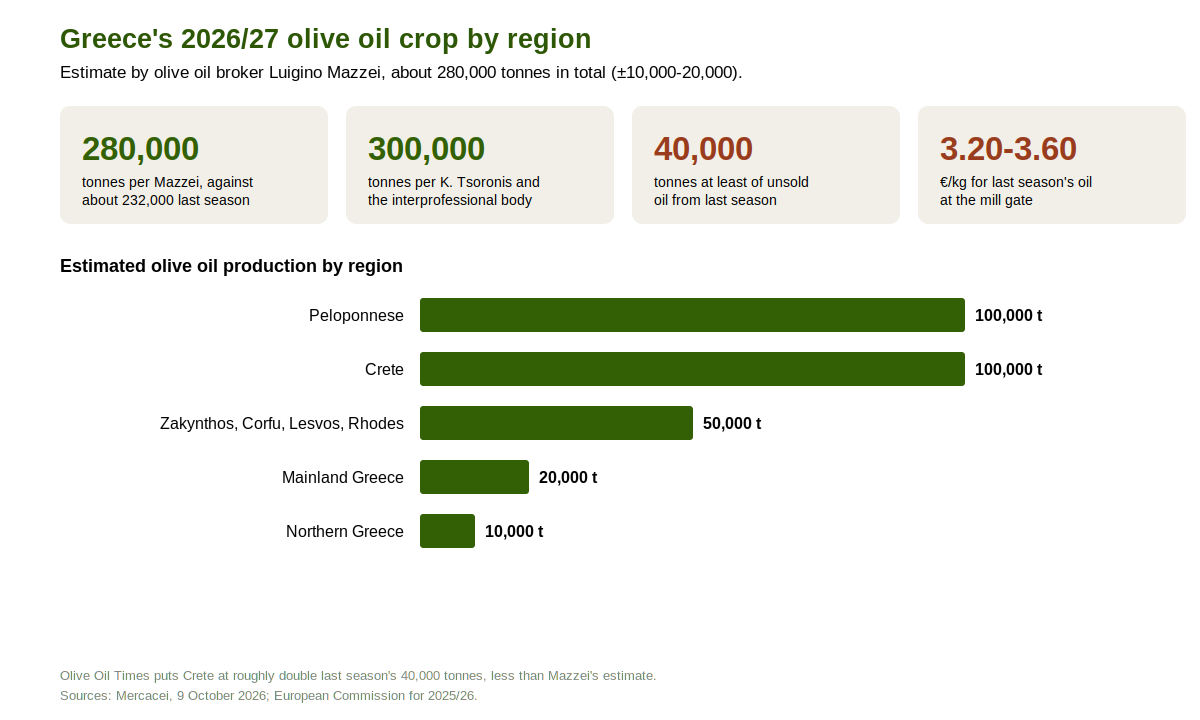
Luigino Mazzei's estimate by region. The Peloponnese and Crete together account for more than two thirds of production. Source: Mercacei, 9 October 2026.
The Peloponnese and Crete supply more than two thirds of the crop
According to Mazzei, the Peloponnese is expected to produce 100,000 tonnes and Crete another 100,000, while Zakynthos, Corfu, Lesvos and Rhodes together produce 50,000 tonnes, mainland Greece 20,000 and northern Greece, mainly Chalkidiki and Macedonia, 10,000 tonnes. He highlights the marked increase in Crete compared with last year.
Estimates for Crete differ. Olive Oil Times, in a report republished by UkrAgroConsult on 6 October, wrote that Crete could roughly double last season's 40,000 tonnes and that Messenia could exceed 60,000 tonnes. Tsoronis, who works in Trifylia, the largest production zone for PDO Kalamata oil, estimates that the area could reach 28,000 tonnes, one of the best crops in recent years.
The weather favoured the season
Mazzei describes the weather so far as ideal, with no olive fly attacks and adequate rainfall. Tsoronis notes that fruit development has generally been very good and that early signs on quality are encouraging, but stresses that production costs, labour availability and growing climate variability continue to put pressure on producers.
The first offers of new oil in the Peloponnese and northern Greece could appear from mid to late October, according to Mazzei.
Last season's stocks weigh on the market
The price of the new oil will be set in a market still holding unsold oil from last season. Market estimates reported by Greek media in late September put the farm-gate price for good-quality extra virgin between EUR 3.80 and 4.20 a kilo, within a wider range of EUR 3.60 to 4.40 depending on region, quality, acidity and available volumes. In Messenia, extra virgin with 0.3 acidity sold at EUR 3.90 a kilo in early September, while deals in Laconia were done at around EUR 4.
Because a litre of olive oil weighs about 0.91 to 0.92 kilos, a price of EUR 3.80 a kilo corresponds to about EUR 3.50 a litre. The distinction matters, because Greek producers who spoke to Olive Oil Times said profitability falls sharply below EUR 5 a litre, above the level the market currently expects. The margin question ultimately depends on the cost of producing olive oil by grove type.
The Mediterranean heads for a larger crop
The Greek increase is part of a wider recovery across the Mediterranean, with large differences between countries.
| Country | 2026/27 estimate | Source |
| Spain | 1,602,596 tonnes | Spanish agriculture ministry |
| Türkiye | 380,000 to 400,000 tonnes | Murat Küçükçakır, agronomist |
| Greece | 280,000 to 300,000 tonnes | Luigino Mazzei, Konstantinos Tsoronis |
| Tunisia | about 300,000 tonnes | Adriano Caramia, broker |
| Italy | 260,000 to 310,000 tonnes | Federolio, Marco Scanu |
| Portugal | 200,000 to 230,000 tonnes | Alberto Serralha, SAOV |
| Morocco | 120,000 to 150,000 tonnes | Noureddine Ouazzani |
Türkiye, at 380,000 to 400,000 tonnes, is expected to become the second-largest producer after Spain, thanks to groves planted with state incentives since the 2000s that are gradually coming into production. Portugal could have a record year, while smaller crops are expected in Italy, in Morocco, down more than 30%, and in Tunisia, where the crop is expected to be about 40% smaller.
Prices are low across the basin. In Spain extra virgin is trading at around EUR 3.30 a kilo, and according to the cost study of the Spanish Association of Olive Municipalities, cited by its director José María Penco, more than 80% of Spanish groves do not cover their production costs at these prices. In Tunisia producer prices are also around EUR 3.30, while in Italy, according to a document from the Italian government to the EU Agriculture Council, prices in the main producing areas have fallen by more than 50%. We follow the wider price picture and Spain's withdrawal mechanism in our olive oil outlook for 2026/27.
Important notes
The production figures are first estimates by brokers, consultants and industry bodies, not official data, and they will be revised as the harvest progresses. Regional estimates differ from source to source, especially for Crete. Prices for the new oil are market estimates rather than confirmed deals, except where stated otherwise. The comparison with 2025/26 is based on the European Commission’s estimate.
Sources
- Mercacei. (2026). Campaña oleícola 2026/27, primeras estimaciones en los principales países productores. 9 October 2026.
- UkrAgroConsult. (2026). Greece eyes its biggest olive oil crop in four years but prices remain under pressure. Based on Olive Oil Times, 6 October 2026.
- Zarpa News. (2026). Olive oil, where the new-crop producer price will open. September 2026.
- Creta24. (2026). Olive oil, the new crop brings price stabilisation and easing. September 2026.
- Eleftheros Typos. (2026). Olive oil, forecasts for production at 300,000 tonnes. September 2026.