
Producing one kilo of olive oil costs EUR 5.31 in a traditional rainfed grove that cannot be mechanised and EUR 3.08 in an irrigated super-intensive one, according to the 2026 production cost study published by AEMO, the Spanish Association of Olive Municipalities. Over the same period, the weighted-average producer price in Spain across all grades was about EUR 3.26 per kilo in July. Set those two numbers side by side, and AEMO's conclusion follows: that more than 75% of Spanish olive growing is currently operating at a loss or at the edge of economic viability.
The study has been running since 2010 and is updated regularly, with the 2026 edition adding the rainfed super-intensive grove for the first time. Its headline finding is that average production cost rose by 57% between 2020 and 2026, with no single cause, since labour, machinery, energy, fuel and fertiliser all became more expensive at once.
Slope decides the cost more than planting density does
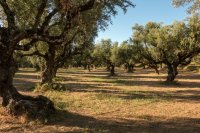
AEMO distinguishes grove types by planting density. A traditional grove typically carries 8 to 12 trees per 1,000 square metres, an intensive grove 20 to 60, and a super-intensive or hedgerow grove reaches 60 to 200.
The split between mechanisable and non-mechanisable traditional groves turns on the slope of the ground, since both carry similar tree densities. On steep slopes, machinery use is limited or impossible, and manual labour requirements rise sharply, particularly at harvest. That is why harvesting remains the highest single cost in traditional groves, while super-intensive groves are picked by straddle harvesters running over the tree rows, which cuts the cost per kilo substantially.
Cost per kilo by grove type
| Grove type | Cost per kilo of olive oil |
| Traditional rainfed, not mechanisable | EUR 5.31 |
| Traditional rainfed, mechanisable | EUR 4.67 |
| Traditional irrigated, mechanisable | EUR 4.18 |
| Intensive rainfed | EUR 3.52 |
| Intensive irrigated | EUR 3.20 |
| Super-intensive rainfed | EUR 3.17 |
| Super-intensive irrigated | EUR 3.08 |
These figures go beyond annual cultivation expenses, as they include the amortisation of establishing modern groves and the cost of using the land, which makes them a real economic cost rather than a cash cost. At a producer price of EUR 3.26, only the super-intensive grove covers its own costs, whereas the traditional non-mechanisable grove incurs a loss of more than EUR 2 per kilo produced.
Why the Greek picture tracks the traditional grove
Greek olive growing is dominated by small family holdings, with thousands of hectares of traditional groves on sloping ground, which places most Greek production on the two most expensive rows of that table. Greek growers face the same increases in labour, energy, fertiliser and input costs, so the Spanish study describes much of their situation as well. No equivalent official cost study exists for Greece.
Greek producer prices are at levels similar to those in Spain. From EUR 7.85 per kilo at the opening of the 2025/26 season, they fell to between EUR 4 and 5.50 in January and are now around EUR 4. For the new crop, growers on Lesvos expect industrial lampante-grade oil to trade near EUR 2.50 per kilo and good extra-virgin near EUR 4 at trader prices, figures that, when set against daily harvest wages and fuel costs, raise the question of whether picking the crop pays at all.
As indicative origin prices, the Oleista platform recorded Greek extra-virgin at EUR 3.74 per kilo, up 2.07% on the week, and Spanish at EUR 3.40 per kilo, down 2.65%, in the week starting 21 September, a gap of EUR 0.34. Those figures are the midpoints between the minimum and maximum quotations, rather than volume-weighted market prices.
Where the sources disagree on the Spanish costs
Greek press reports citing sector estimates put Spanish production cost at EUR 1.70 to 2 per kilo, roughly half the Greek figure. AEMO's study gives a Spanish range of EUR 3.08 to 5.31, depending on grove type, and concludes that three-quarters of Spanish olive growing is at a loss or marginal.
The gap probably comes down to what each figure includes: AEMO counts establishment amortisation and the cost of using the land, whereas the operating cost of a super-intensive grove without those components is far lower. This article uses AEMO's figures because they come from a methodologically documented study that has been repeated since 2010.
The traditional grove holds soil and communities in place
When a crop ceases to be viable, it is eventually abandoned, and a traditional olive grove offers more than just production. In many mountain areas, it holds soil against erosion, contributes to fire prevention through cultivation itself, and keeps communities alive that would otherwise empty out. AEMO warns that continued economic pressure puts at risk a production model with considerable environmental, social and territorial value.
The same process is already visible in the numbers elsewhere in the Mediterranean, with Italian olive oil production down 37.6% over twenty years. In Greece, where exports of packaged olive oil total around 50,000 tonnes, SEVITEL president Kostas Koutsioumpis points to the absence of organised promotion for the Greek product abroad, contrasting this with Turkey's markedly stronger presence at international trade fairs.
Sources
- AEMO, Asociación Española de Municipios del Olivo. (2026). Olive oil production cost study, 2026 edition, via Ελαίας Καρπός, 12 August 2026.
- Capital. (2026). Olive oil, what the new crop brings. Statements by K. Koutsioumpis, SEVITEL, 20 September 2026.
- Dnews. (2026). Lesvos, olive oil prices dive. September 2026.
- Eleftheros Typos. (2026). Higher olive oil production, cheaper on the shelf. September 2026.
- Ελαίας Καρπός. (2026). Italian olive oil production down 37.6% over the last twenty years. 4 September 2026.