For the first time, the European Commission's Special Eurobarometer 577 asked citizens what prevents them from eating more plant-based protein products, such as pulses, tofu and other processed plant-based products. In Greece, 20% said they find them difficult to digest, the highest share in the EU, where the average is 9%. The next countries, Finland, Czechia and Austria, reach 14%.
The most common answer, however, both in Greece and across the EU, is that respondents already eat enough. That was the answer of 47% of Greeks, against 38% in the EU, while difficulty finding or preparing such products barely registers among Greeks. The survey was based on 26,456 interviews across the EU between 26 May and 24 June 2026, including 1,007 in Greece, and each respondent could give up to two answers.
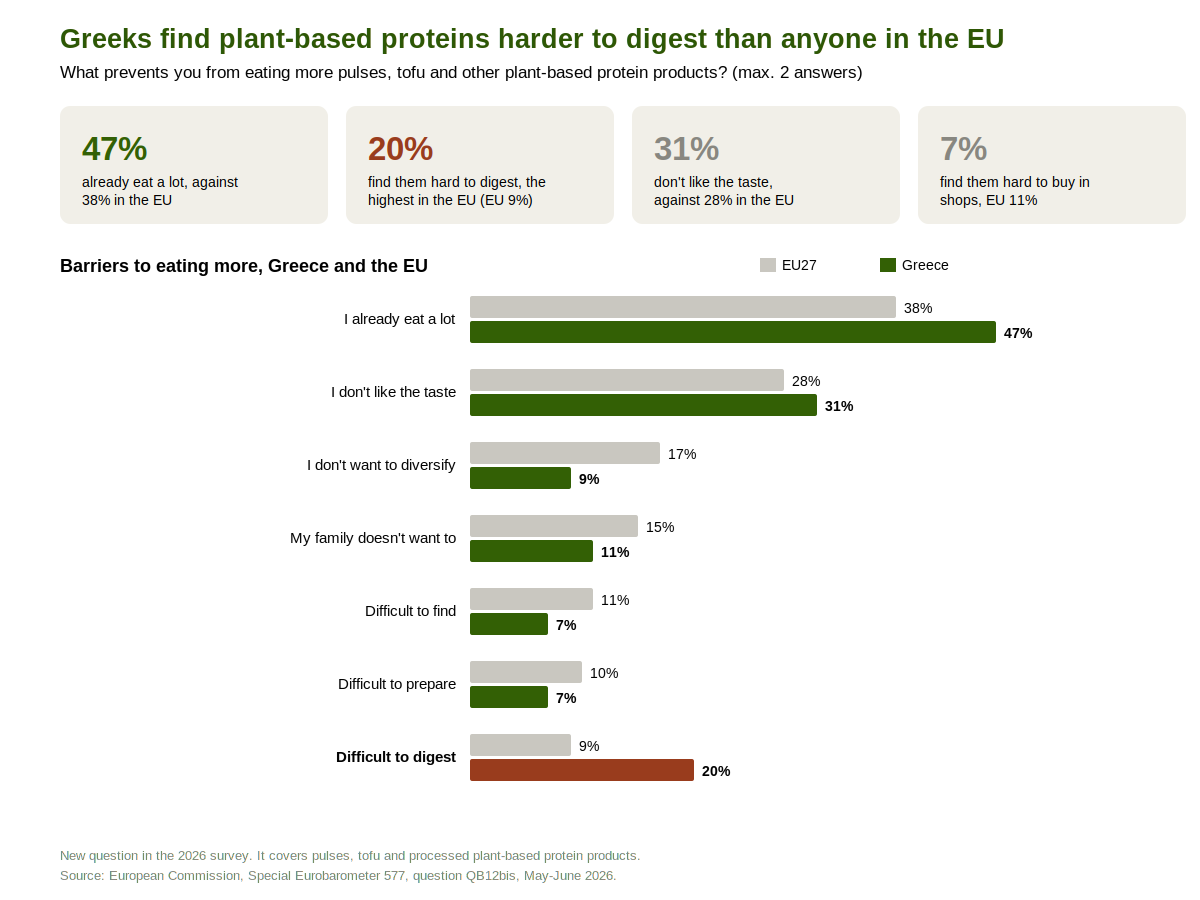
The barriers Greeks and Europeans cite to eating more pulses and plant-based protein products. Source: European Commission, Special Eurobarometer 577.
Almost half of Greeks say they already eat enough
The 47% of Greeks who say they already eat a lot of plant-based protein products places Greece seventh in the EU. Latvia leads at 61%, followed by Slovenia at 57%, Spain at 51%, Sweden and the Netherlands at 50% and Cyprus at 48%. Among Mediterranean countries the picture varies widely, with 42% in Portugal, 35% in Italy and only 28% in France.
Greeks are also among the most open to diversifying the protein in their diet. Only 9% say they do not want to diversify it, against 17% in the EU, 20% in Italy and 22% in France, and only 11% say their family or partner does not want to eat more of these products, against 15% in the EU.
Digestibility sets Greece apart from the rest of Europe
Finding plant-based protein products difficult to digest is the least common answer at EU level, at 9%, but in Greece it reaches 20%, more than double. In the other Mediterranean countries the share is much lower, at 12% in Italy, 7% in France, 5% in Spain and 4% in Portugal. The survey records citizens' perceptions and does not explain why Greeks give this answer more often than other Europeans.
Taste is the second barrier in Greece, at 31%, slightly above the EU's 28% and level with Italy. At EU level taste is the largest barrier after already eating enough, with the highest shares in Ireland at 38%, Austria at 36%, and Croatia and Czechia at 35%.
Greeks find plant-based protein products easy to buy
Only 7% of Greeks say they find it difficult to get plant-based protein products in shops and restaurants, against 11% in the EU, and another 7% that they find them difficult to prepare, against 10% in the EU. Greece is therefore among the countries where access to these products concerns consumers least, together with Latvia, Finland, Luxembourg and Czechia.
Education and financial comfort shape the answers
At EU level, the report records differences between social groups. Those who finished their education at 20 or later more often say they already eat enough plant-based protein products, at 44%, than those who finished by 15, at 34%. The same applies to those who never have difficulty paying their bills, at 40%, against 31% for those who struggle most of the time.
Women more often than men say they already eat enough, at 40% against 35%, while men more often cite taste as a barrier, at 31% against 26%. Differences between age groups are small.
For producers and processors of pulses, the findings show that in Greece the barriers relate more to taste and perceptions of digestion than to availability or preparation. The Wikifarmer Library has already covered the nutritional value of pulse-enhanced foods and the role of plant proteins in a more sustainable food system.
Important notes
The results reflect citizens’ answers, not measurements of consumption or scientific evidence on the digestibility of pulses. The question covers pulses, tofu and processed plant-based protein products together, so the answers are not about pulses alone. Each respondent could give up to two answers, so the percentages do not add up to 100%. The figures for social groups refer to the EU as a whole and not specifically to Greece. The sample for Greece is 1,007 people.
Sources
- European Commission. (2026). Special Eurobarometer 577, Europeans, agriculture and the CAP. Report, section V.4, and data annexes, question QB12bis, 22 September 2026.