
In its run of 00:00 UTC on 5 November 2026, the European Centre for Medium-Range Weather Forecasts (ECMWF) shows 100.7 mm of rain for the three days from 9 to 11 November near Évora, in Portugal's Alentejo, 54.1 mm near Seville and 44.7 mm near Córdoba, while near Jaén, the Spanish province with the largest olive oil output, it shows only 10 mm, according to a Wikifarmer analysis of the centre's open data. If it falls, the rain will reach Andalusia's olive groves after an October that Spain's state meteorological agency (AEMET) rates as very dry, with 41% of average rainfall for the month, and will come during the harvest season: according to the regional government of Andalusia, with data from Spain's Food Information and Control Agency (AICA), in recent seasons the harvest of olives for oil has started as early as October, and the share picked in November and December has grown.
ECMWF shows the most rain near Évora and in western Andalusia
In the 5 November run, rain for the three days from 9 to 11 November reaches 100.7 mm at the grid point near Évora, 54.1 mm near Seville, 48.0 mm near Huelva and 44.7 mm near Córdoba, while the total drops to 25.9 mm near Beja, in the southern Alentejo, and to 10.0 mm near Jaén. Across the four 00:00 UTC runs from 2 to 5 November, the forecast for Évora rose from 43.7 mm to 75.4 and 109.1 mm and was 100.7 mm in the 5 November run, while for Jaén it stayed low, between 10.0 and 18.6 mm. For Seville the forecast swung from 87.9 mm in the 2 November run to 43.2 mm, then to 146.0 mm and finally to 54.1 mm, so the amount for western Andalusia remains uncertain even though the rain appears in every run.
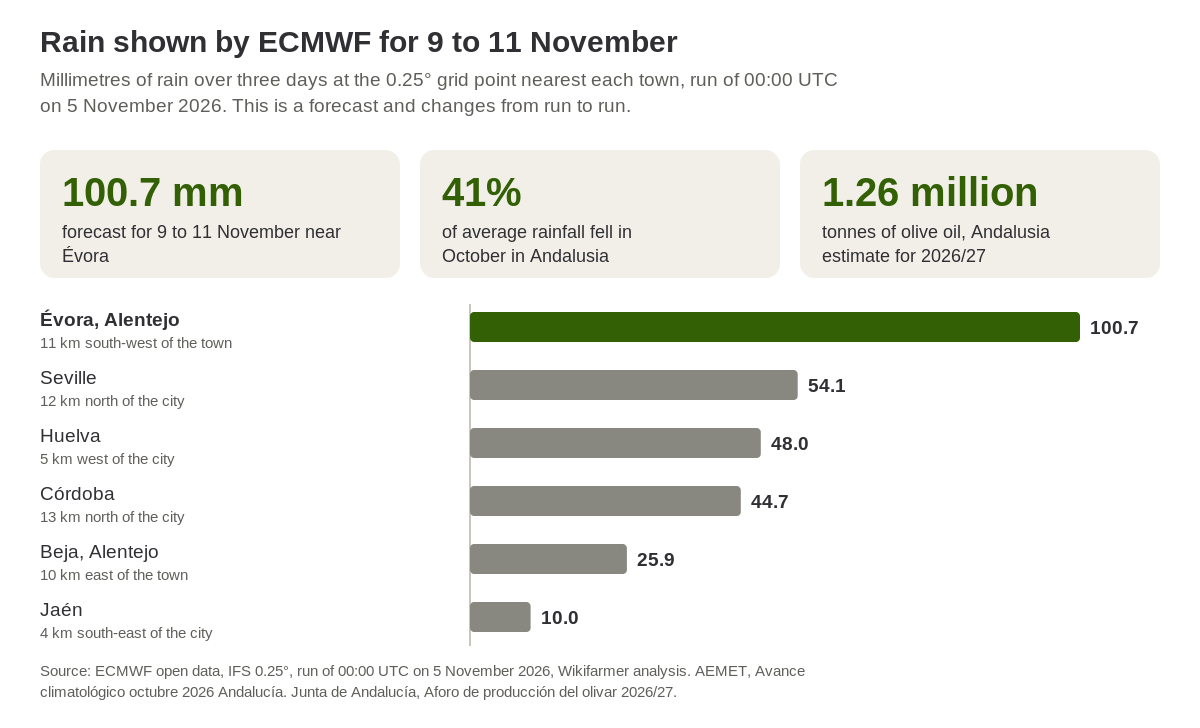
Source: ECMWF open data, IFS 0.25°, run of 00:00 UTC on 5 November 2026, Wikifarmer analysis. AEMET for October rainfall and the regional government of Andalusia for the production estimate.
The forecast covers the fifth to seventh day of the run and may change before 9 November, so for the amounts in each area the information to act on will be the forecasts and warnings of AEMET in Spain and of Portugal's Institute for the Sea and Atmosphere (IPMA) for the Alentejo as the three days approach.
October was very dry and very warm in Andalusia according to AEMET
In its monthly climate summary for Andalusia, signed in Seville on 3 November, AEMET gives 29.4 mm of rain for October across the region, 41% of the average, and ranks the month as the 17th driest October since 1961, while the mean temperature reached 19.3 °C, 1.8 °C above average, and the month was the 9th warmest October since 1961. According to AEMET, cut-off lows at the beginning and in the middle of the month brought storms and heavy showers, with flooding in many parts of Andalusia in mid-month, followed by days of stable weather and clear skies until the end of October.
For Portugal, IPMA writes in its latest update of the PDSI drought index, for the end of September, that meteorological drought worsened very significantly compared with the end of August, both in extent and in intensity, and that it intensified in the south, with a larger share in the moderate and severe drought classes, particularly inland, while across mainland Portugal 16.5% was in severe drought and 44.2% in moderate drought. At the Alentejo point, NASA POWER data give 18.4 mm of rain for the 30 days to 1 November, 24.5% of the 1991 to 2020 average, and 32.1% for the 90 days. In its Weekly Weather and Crop Bulletin of 3 November, the US Department of Agriculture (USDA) writes that "the drier-than-normal start to the 2026-27 Water Year persisted on the Iberian Peninsula, raising concerns about drought development."
Rainfed olive groves in Andalusia showed water stress at the end of September
In its production estimate for 2026/27, presented on 29 September, Andalusia's regional ministry of agriculture writes that the rains of the 2025/26 northern hemisphere winter favoured the development of the crop and that, despite local problems with rain and wind at flowering, fruit set was generally good. Rainfed groves, however, were already feeling the drought of the previous months, with symptoms of water stress in many trees and fruits, which according to the ministry could affect both production and oil yield if no rain fell in the following weeks. Spain's Ministry of Agriculture, Fisheries and Food (MAPA) makes the same point in its 1 October announcement of the first national estimate, where it writes that the weather of the coming weeks, together with the development of the fruit after the high temperatures of the northern hemisphere summer, which mainly affected rainfed groves, will set the oil yield.
For table olives, the Andalusian estimate reports that harvesting had begun in all the main commercial varieties and that efforts were being made to speed it up as far as possible, starting with irrigated plots and with those carrying a lighter crop, while the weather remained adverse, with no rain and successive heatwaves. According to the ministry, possible rain in the northern hemisphere autumn could increase the volume of the crop with a suitable fruit size in the Hojiblanca variety destined for the table, and in its conclusions on table olives it writes that the harvest of rainfed groves will be strongly affected by autumn rain.
Andalusia estimates 1.26 million tonnes of olive oil for 2026/27
The regional government of Andalusia estimates 1,261,200 tonnes of olive oil for 2026/27, 29.3% more than the final production of the previous season and 44% above the average of the last five, from 6,849,200 tonnes of olives for milling. Jaén comes first with 575,000 tonnes, 45.6% of Andalusia, followed by Córdoba with 339,700 tonnes and Seville with 142,000 tonnes, while the estimate for table olives is about 466,000 tonnes, of which 320,000 in Seville. The regional agriculture minister, Ramón Fernández-Pacheco, attributed the picture to a very wet northern hemisphere winter, which favoured the crop, and to temperatures well above average, which limited its productive potential. For Spain as a whole, MAPA's first national estimate gives 1,602,596 tonnes of olive oil, 23% more than the previous season, of which Andalusia would supply 79%.
In the same document, Andalusia records, with data from AICA, that in recent seasons the harvest has been starting earlier, already in October, and that the quantities picked in November and December have been growing at the expense of the last months of the season. It links this shift with the decline in the oil yield of the olives, which last season averaged 18.5% in Andalusia and about 20.1% in Jaén, as harvesting moves earlier to improve quality.
The Spanish price of extra virgin olive oil fell in October
In European Commission data, the average national price of extra virgin olive oil in Spain was €343.19 per 100 kg in the week of 28 September to 4 October, the first of the 2026/27 marketing year, and fell to €316.51 in the week of 26 October to 1 November, that is from €3.43 to €3.17 per kg and 7.8% lower. In Portugal, the equivalent price moved from €344.86 to €347.00 per 100 kg over the same weeks. Prices in the coming weeks will be compared against these, and for those who follow the Greek market, a Wikifarmer analysis found that Greek prices usually follow Spain's within three weeks.
Up to 39 mm of rain fell in Murcia on 4 November
AEMET had an orange warning in force for 30 mm of rain in one hour in Murcia's Campo de Cartagena y Mazarrón on the night of 3 to 4 November, from 21:00 to 01:59 local time, and issued a new orange warning with the same threshold for the afternoon and night of 4 November, for the Levante almeriense in Almería from 16:00 to 23:59 and for the Valle del Guadalentín, Lorca y Águilas and the Campo de Cartagena y Mazarrón from 19:00 until the early hours of 5 November, with possible thunderstorms. In AEMET's daily data for 4 November, the highest rainfall in Murcia was 39.0 mm at the Cartagena/Salinas Cabo Palos station, of which 24.8 mm fell before 06:00, while in the evening, from 18:00 to midnight, the highest values were 24.9 mm at San Javier airport and 18.0 mm at Torre-Pacheco. The Lorca station recorded 0.0 mm, and among the stations in Almería province with data the highest value for 4 November was 5.2 mm at Roquetas de Mar, while for 5 November, in AEMET's table of 11:44 local time, Adra had 18.2 mm and El Ejido 9.6 mm.
Rain during the harvest affects oil yield according to the Spanish estimates
For olive growers in Andalusia, the Spanish estimates of late September and 1 October link the rain of the coming weeks with the oil yield of rainfed groves, and the Andalusian estimate also writes that, for table olives, the harvest of rainfed groves will be strongly affected by rain in the northern hemisphere autumn. For olive oil buyers, MAPA's first estimate of 1,602,596 tonnes was made before the rain ECMWF now shows, and Andalusia would account for 79% of the estimated Spanish output, while for the point near the city of Jaén, in the province estimated to supply 45.6% of Andalusia, the forecast shows the least rain of the six points. How much rain actually falls in each area, in Spain and in the Alentejo, will show in AEMET and IPMA measurements after 11 November.
Frequently asked questions
How much rain does ECMWF show for olive groves in Andalusia and the Alentejo?
In the run of 00:00 UTC on 5 November 2026, ECMWF shows for 9 to 11 November 100.7 mm near Évora, 54.1 mm near Seville, 48.0 mm near Huelva, 44.7 mm near Córdoba, 25.9 mm near Beja and 10.0 mm near Jaén. The forecast changes from run to run.
How dry was October in Andalusia?
According to AEMET, 29.4 mm fell, 41% of the average, and October 2026 was the 17th driest since 1961, with a mean temperature 1.8 °C above average.
When are olives for oil harvested in Andalusia?
According to the regional government of Andalusia, with data from AICA, in recent seasons the harvest has started as early as October and the share picked in November and December has grown, at the expense of the last months of the season.
How much olive oil is estimated for Andalusia and Spain in 2026/27?
Andalusia estimates 1,261,200 tonnes, 29.3% more than the previous season, and MAPA 1,602,596 tonnes for all of Spain, 23% more.
How does drought affect oil yield?
According to Andalusia's regional ministry of agriculture, water stress in rainfed groves could affect both production and oil yield if no rain fell in the weeks after the end of September.
Important notes
The rainfall values for 9 to 11 November are an ECMWF forecast, from the open data of the IFS model on a 0.25° grid, and correspond to the rain accumulated from 00:00 UTC on 9 November to 00:00 UTC on 12 November at the grid point nearest each town, which lies 4 to 13 km from the town centre. The analysis and the comparison of the four runs were done by Wikifarmer, and this is a single deterministic run, which often changes this far ahead of the day of the rain. NASA POWER data are estimates on a grid of about 0.5° for the point at 38.4° N 7.9° W in the Alentejo, for the 30 and 90 days to 1 November, with the same periods of 1991 to 2020 as the average. AEMET's October data are provisional according to the agency, the daily station data for 4 and 5 November have passed only real-time quality checks, and the 5 November data come from the 11:44 local time table and cover only part of the day. IPMA's monthly climate bulletin for October had not been published by 11:00 UTC on 5 November, so for Portugal the end-of-September PDSI is used. The Andalusian and MAPA production estimates are the first of the season, and according to MAPA they may be revised. Prices are the weekly average national prices published by the European Commission. The article does not estimate effects on production or prices.
Sources
- AEMET, Delegación Territorial en Andalucía, Ceuta y Melilla. (2026, 3 November). Avance climatológico mensual, octubre de 2026 en Andalucía, Ceuta y Melilla (Monthly climate summary, October 2026).
- AEMET. (2026). Hoy y últimos días, datos diarios (Daily station data), accessed 5 November 2026.
- AEMET. (2026). Warnings for Spain, via the Meteoalarm feed, accessed 4 November 2026.
- European Centre for Medium-Range Weather Forecasts (ECMWF). (2026). Open data, IFS 0.25°, runs of 00:00 UTC, 2 to 5 November 2026.
- Instituto Português do Mar e da Atmosfera (IPMA). (2026). Monitorização da seca meteorológica, índice PDSI, setembro de 2026 (Meteorological drought monitoring, PDSI, September 2026), accessed 5 November 2026.
- NASA. POWER Data Access, daily point data, accessed 4 November 2026.
- USDA. (2026, 3 November). Weekly Weather and Crop Bulletin.
- Junta de Andalucía, Consejería de Agricultura, Pesca, Agua y Desarrollo Rural. (2026). Aforo de producción del olivar en Andalucía, campaña 2026/27 (Olive production estimate for Andalusia, 2026/27).
- Junta de Andalucía. (2026, 29 September). El aforo del olivar estima para la campaña 2026/27 una producción de 1.261.200 toneladas de aceite de oliva en Andalucía.
- Ministerio de Agricultura, Pesca y Alimentación. (2026, 1 October). La producción de aceite de oliva alcanzará 1,6 millones de toneladas en la campaña 2026/27.
- European Commission. Agri-food data portal, olive oil prices, accessed 5 November 2026.