No other EU country places as much weight on reasonable food prices as Greece, and in no other country are citizens as unconvinced that the Common Agricultural Policy delivers them. In Special Eurobarometer 577 on Europeans, agriculture and the CAP, published by the European Commission on 22 September, 77% of Greeks named ensuring reasonable food prices for consumers as a main objective of EU agricultural policy, the highest share in the Union. In the same survey, only 35% agree that the CAP is fulfilling its role on that objective, against 64% who disagree, the lowest level of agreement among the 27 member states.
The survey was based on 26,456 interviews across the EU between 26 May and 24 June 2026, including 1,007 in Greece, and compares its results with the previous edition from summer 2024. Greek views have improved on many points since then, but the gap between what Greeks ask of the CAP and what they believe it delivers remains the widest in Europe.
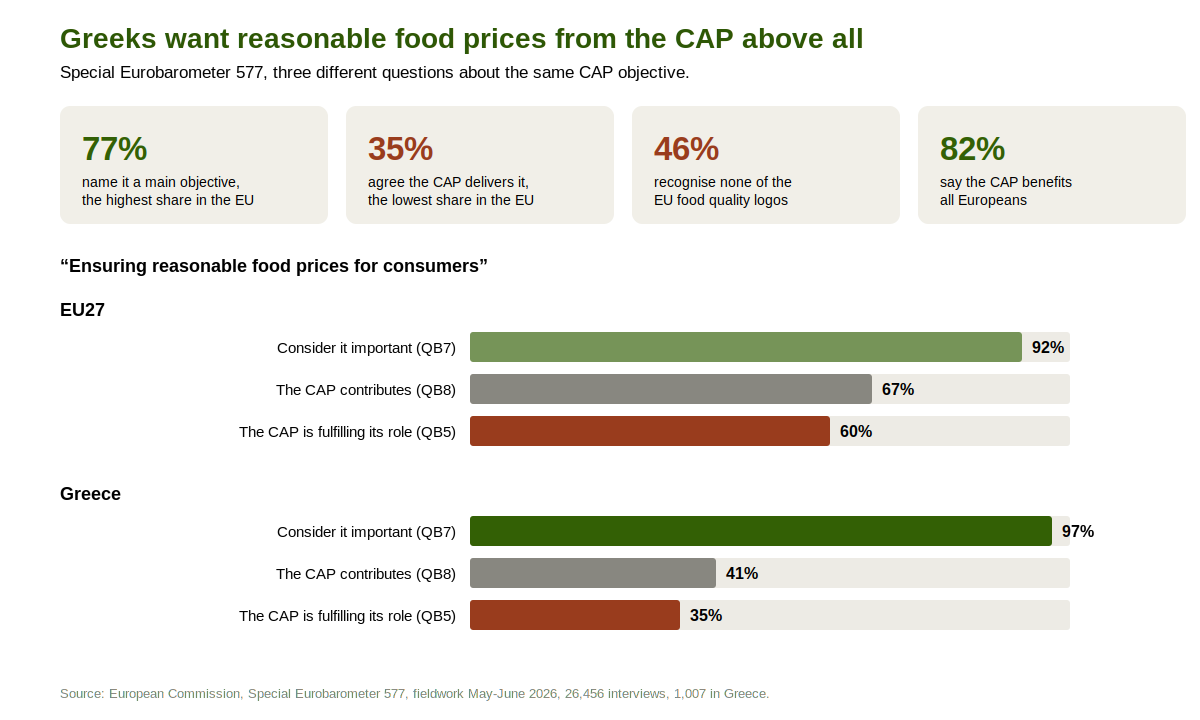
Three different questions about the same objective. Almost everyone considers reasonable prices important, far fewer believe the CAP secures them, and in Greece the gap is much wider. Source: European Commission, Special Eurobarometer 577.
Three questions give three different numbers
Several reports on the survey presented figures such as 92% for reasonable prices as if they measured the CAP's success. The survey in fact measures the same objective through three separate questions, and the numbers mean very different things. The first asks how important the objective is, and 92% of Europeans and 97% of Greeks say reasonable prices are important. The second asks whether the CAP contributes to the objective, and 67% of Europeans agree against only 41% of Greeks. The third asks whether the EU, through the CAP, is fulfilling its role on the objective, and 60% of Europeans agree against 35% of Greeks.
The distinction changes what the figures say. The 92% shows what citizens want, while the 60% and the 35% show what they believe they are getting, and the distance between the two is the survey's most telling finding for Greece.
Food prices are the top priority for Greeks
When respondents choose the main objectives of agricultural policy, ensuring reasonable prices for consumers comes first in only three countries, Bulgaria, Latvia and Greece, where 77% select it. Some 71% of Greeks consider it a very important CAP priority, against 55% across the EU. The second objective for Greeks, at 74%, is providing safe, healthy and sustainable food of high quality, a share Greece shares with Slovenia as the highest in the EU.
Concern over cost appears elsewhere in the results. Among the risks to EU food security, 36% of Greeks cite economic downturns and poverty, almost double the EU average of 19%.
Only 35% believe the CAP keeps prices reasonable
On whether the CAP is fulfilling its role in ensuring reasonable prices, only a minority agrees in three countries, Greece at 35%, Cyprus at 43% and Latvia at 45%. At the other end of the scale, agreement reaches 78% in Hungary and 77% in Italy. The Greek figure has nevertheless risen by 11 points since 2024, one of the three largest increases in the EU.
Greeks view the CAP more critically on other objectives too. Some 52% agree it ensures a fair standard of living for farmers, against 60% in the EU, and 66% that it provides safe, high-quality food, against 74%. The smallest gap with the average is on securing a stable food supply, where 74% of Greeks agree against 78% of Europeans.
Greeks value agriculture more than the average European
Criticism of how the CAP performs sits alongside very strong support for farming. 74% of Greeks consider agriculture and rural areas very important for the future, against 61% across the EU, and 82% agree that the CAP benefits all citizens and not only farmers, against 70%, with those who totally agree up 8 points. Some 77% have heard of the EU's support to farmers through the CAP, against 71% in the EU.
One of the largest changes since 2024 concerns the level of support. The share of Greeks who consider the EU's financial support to farmers too low fell from 47% to 34% in two years, while those who find it about right rose by 16 points to 59%. Looking ahead, Greece still differs from the rest of Europe, with 67% of Greeks wanting financial support to farmers to increase over the next decade, against 48% in the EU.
Rural life in Greece is rated poorly
Greeks rate services in their country's rural areas far more negatively than the average European. Only 25% rate rural health services as good, against 46% in the EU, 31% rate job opportunities as good, against 40%, and 36% rate educational facilities as good, against 55%. The environment and landscape are the only area where a large majority of Greeks gives a positive rating, at 82%.
Greeks value tradition and origin but do not recognise the logos
When buying food, Greeks give far more weight than the average European to factors linked to origin and quality. Respect for local tradition and know-how is very important for 62%, against 39% in the EU, coming from a geographical area they know for 59%, against 38%, and carrying a specific label guaranteeing quality for 59%, against 41%. A short supply chain from producer to consumer and higher environmental and animal welfare standards follow at 60% each.
The logos that certify those characteristics, however, are little known in Greece. 46% of Greeks recognise none of the five logos they were shown, against 19% in the EU, a share up 12 points since 2024. The Protected Designation of Origin logo is known by only 11%, against 20% in the EU, and the Protected Geographical Indication logo by 16%, against 25%, while the organic farming logo, the best known in Europe at 58%, is recognised by 32% of Greeks, 13 points fewer than in 2024. For producers of PDO and PGI products, the finding suggests that the value Greek consumers place on origin is not yet linked to the logo that certifies it.
Greeks are more cautious about trade
Greeks are among the most cautious Europeans about EU trade agreements. Some 57% consider them positive for themselves as food consumers, against 70% in the EU, and 55% positive for EU agriculture, against 64%. Three quarters, 75%, agree that the EU should have trade barriers on agricultural imports except from developing countries, against 59% in the EU and up 9 points since 2024, while 86% want imports to comply with EU environmental, animal welfare and labour standards.
Extreme weather is seen as the biggest risk
Some 54% of Greeks cite extreme weather events and climate change as a leading risk to food security, against 46% in the EU, and Greeks are also above the EU average in citing animal and plant health events, at 40% against 30%, the declining number of farms, at 33% against 28%, and dependency on imports, at 31% against 21%. Some 95% agree that extreme weather can affect food supply, and 76% that farmers need to change the way they produce to fight climate change even if that makes EU agriculture less competitive.
Despite these concerns, Greeks see food security in their country as better than ten years ago. Those who think it has increased rose by 14 points to 42%, and those who think it has decreased fell by 15 points to 17%, making Greece the only EU country with a change of that scale in both answers.
The survey was published a few weeks before the Agriculture Council of 26 and 27 October, where the Presidency aims for a partial general approach on the CAP after 2027, at a time when world food prices stand at their highest level since November 2022.
Sources
- European Commission. (2026). Special Eurobarometer 577, Europeans, agriculture and the CAP. Report, data annexes and country factsheet for Greece, 22 September 2026.
- European Commission. (2026). Special Eurobarometer 577, infographic. DOI 10.2762/6925600.