
The FAO Food Price Index averaged 133.3 points in August 2026, up 1.9% from July and 2.5% from a year earlier, and every one of its five commodity groups moved higher in the same month. FAO's own data series shows the index has not stood this high since November 2022, when it read 136.0 on the way down from the record set after Russia's invasion of Ukraine. It remains 16.8% below that March 2022 peak, but the direction has turned.
FAO Chief Economist Maximo Torero framed the August reading as a warning. Climate shocks, geopolitical tension and disrupted trade logistics are converging to tighten supply expectations, he said, and the risk premium is returning to food markets. The three drivers he named each show up in a different commodity group below.
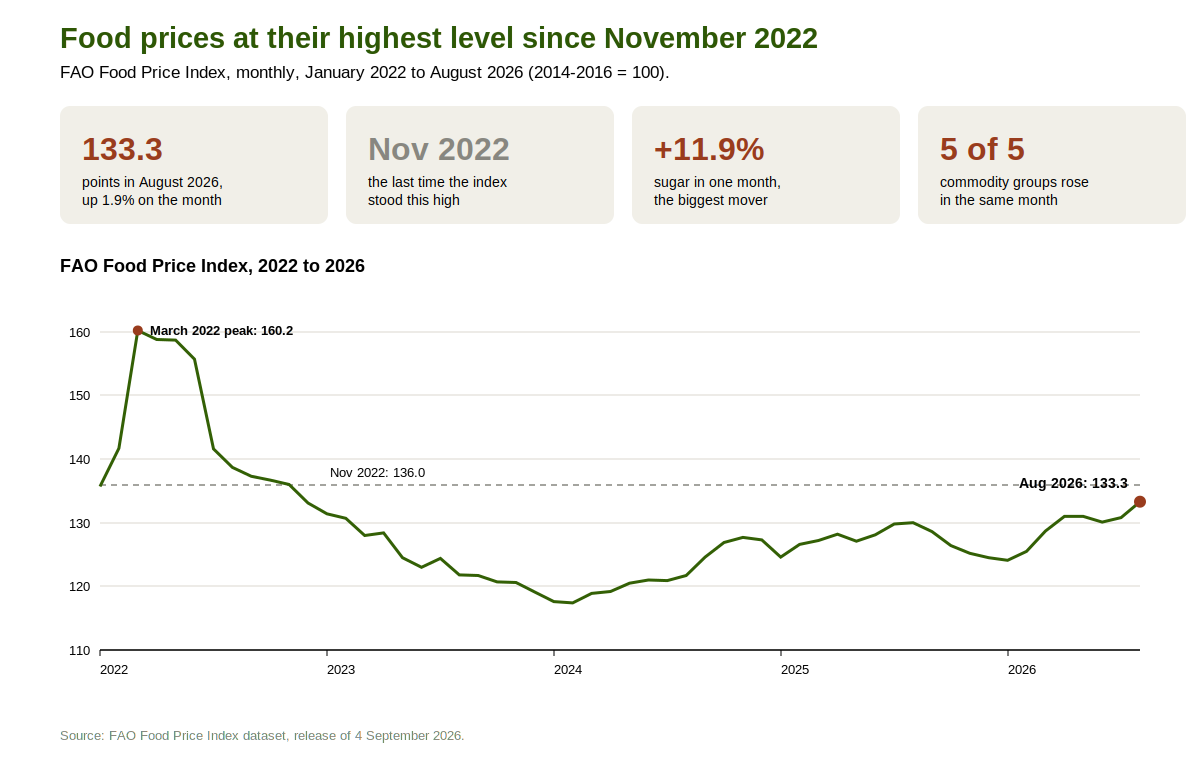
The index has risen every month but one since January 2026 and now sits above every reading since November 2022. Source: FAO Food Price Index, release of 4 September 2026.
Sugar led the rise with an 11.9% jump
The FAO Sugar Price Index climbed to 106.4 points, up 11.9% in a single month and its highest since June 2025 by FAO's account. Four factors converged. Persistent heat and dryness forced a downward revision of sugar beet yield forecasts in the European Union, where the planted area was already expected to shrink from last season. El Niño conditions continued to weigh on production prospects in Asia's main producing countries. Output in Brazil's Center-South region fell. India then announced duty-free imports of raw sugar, adding demand to a market already short of supply.
The sugar sub-index has risen from 86.2 points in February to 106.4 in August, a gain of more than 23% in six months, after two years of steady decline that had left European processors under pressure.
Cereals reach their highest level since May 2024
The FAO Cereal Price Index rose 2.2% to 116.3 points, with every major grain higher. Wheat gained 2.6% on the month and stands 15.0% above a year earlier, driven by persistent disruption to Black Sea export logistics, lower production prospects across much of Europe after the hot and dry summer, and a weaker US dollar that improved the competitiveness of dollar-priced supplies. The concentration of world exports in a handful of origins, examined in how weather and trade turbulence move global cereal markets, is why trouble in one corridor moves prices everywhere.
Maize rose 2.5% on concerns over yields in parts of the US Corn Belt, deteriorating prospects in the EU, strong demand from the ethanol and feed sectors, disruption to Ukrainian exports, and worries over input supplies following the closure of the Strait of Hormuz. Sorghum and barley gained 3.9% and 2.6% on firmer feed grain conditions. Rice rose a modest 0.5% on sustained purchases by Asian and African buyers and prospects of tighter supply.
Vegetable oils hit a four-year high
The FAO Vegetable Oil Price Index reached 196.9 points, up 0.6% for a third consecutive monthly increase and its highest level since June 2022. Palm and soy oil drove the gain. Palm oil rose on strong import demand and concern over El Niño's effect on Southeast Asian production, the same weather pattern tracked in what El Niño means for crops and food prices this year. South American soy oil stayed firm on export demand, while US quotations slipped on uncertainty over biofuel policy. Sunflower and rapeseed oil fell slightly on expectations of ample 2026/27 supply.
Dairy rose for the first time in four months
The FAO Dairy Price Index gained 2.3% to 119.2 points, its first increase since April, though it remains 21.7% below its level a year ago after a long slide from the 2025 highs. Skim milk powder rose 3.0% and whole milk powder 2.4%, as firmer European quotations outweighed seasonal declines in Oceania. Cheese gained 2.7%, extending a recovery that began in July. Butter held steady.
FAO attributes the European firmness to tightening milk supplies, compounded by hot and dry weather across several major producing regions, with sustained import demand adding pressure. Meat prices rose 1.0% to 127.9 points, close to their level a year earlier. Poultry, pig and ovine meat all climbed, with pig meat lifted by high temperatures in the EU that slowed animal growth and limited the supply of slaughter-ready animals. Bovine prices fell as Brazil and Australia, having exhausted Chinese quota allocations, competed for alternative markets.
Production is falling from record levels
FAO's Cereal Supply and Demand Brief, published the same day, forecasts 2026 world cereal production at 2,980 million tonnes, down 2.0% from 2025 but still the second largest harvest on record. The maize forecast was cut to 1,309 million tonnes as worsening prospects in France and Poland outweighed better-than-expected yields in Argentina and Brazil, a pattern consistent with the heat and drought damage already measured across EU summer crops. Wheat was raised to 810.7 million tonnes, 3.8% below 2025, and rice is expected to fall 1.9% to 553.1 million tonnes on reduced margins and El Niño-related weather.
World cereal stocks are forecast at 947.2 million tonnes at the close of the 2027 seasons, slightly above opening levels, partly because wheat reserves are building in Russia and Ukraine behind restricted export routes. The stocks-to-use ratio slips to 31.6% from 31.9%, a level FAO still describes as relatively comfortable by historical standards. Cereal trade is expected to decline from record levels to 509.3 million tonnes.
What a returning risk premium means
The August index is not high by the standards of 2022, when it peaked at 160.2. What has changed is that the sources of pressure are now structural rather than seasonal. Heat is cutting European yields across maize, sugar beet and dairy at once. The Strait of Hormuz closure has raised the cost of fertiliser and fuel that feed into next season's planting. Black Sea shipping remains disrupted, leaving importers paying for security of supply rather than for grain alone. When those three drivers act together, as they did in August, the mechanism by which compound heat and drought events cut crop yields runs faster and further.
For producers, the reading cuts two ways. Higher international prices support farm-gate values for those with product to sell, particularly in regions that escaped the summer damage. For livestock farmers and anyone buying inputs, the same numbers describe a cost base that has been rising since February and has not yet turned.
Sources
- FAO. (2026). Supply concerns drive FAO Food Price Index higher in August. 4 September 2026.
- FAO. (2026). FAO Food Price Index, release of 4 September 2026.
- FAO. (2026). Cereal Supply and Demand Brief. 4 September 2026.