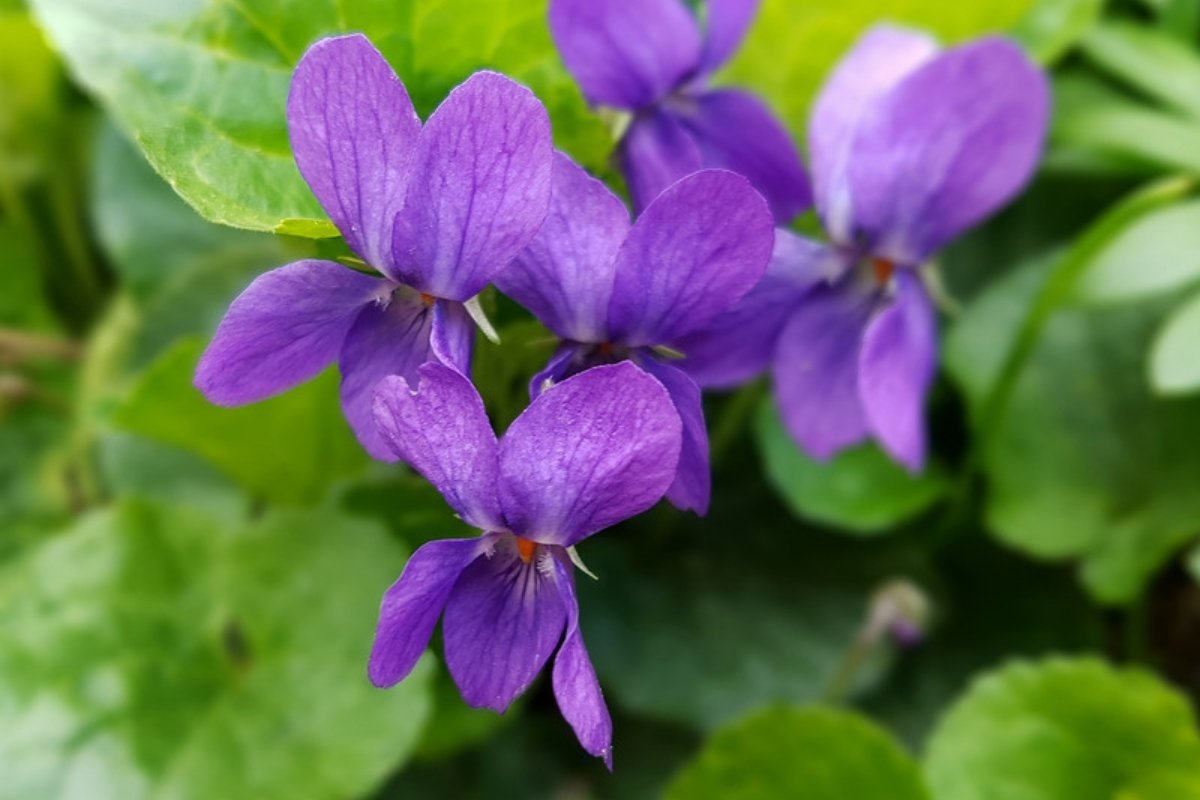
Sweet violet, Viola odorata, is a low perennial with heart-shaped leaves and small, intensely fragrant flowers that bloom from late winter into spring and spreads by creeping runners, forming dense carpets under trees and shrubs. It wants part shade and moist soil, propagates most easily by division, and its seed needs cold to germinate. It is one of the commonest violets in Greece and Europe and grows wild on Mount Parnitha near Athens, while both its flowers and leaves are edible.
Sweet violet is the violet of antiquity
In Greek, the names violeta, menexes and ion refer to species of Viola, and the ancient ion was the sweet violet. Violas were grown in Greece as early as the fourth century BC, mainly for medicinal use. Today, however, Greek nurseries sell a different plant as "violeta", usually Matthiola incana, with grey-green leaves and flowers on an upright spike, and growing stock flowers has little in common with growing sweet violets.
Greece has many wild Viola species
The "wild violet" is not a single plant. Violas are among the best-studied genera of the Greek flora, with species such as Viola alba, V. graeca, V. fragrans, V. macedonica, V. euboea and V. hymettia, named after Mount Hymettus where it was first described. The checklist of the Greek flora also includes dozens more species and subspecies, from the Cretan V. alba subsp. cretica to V. delphinantha of the high mountains.
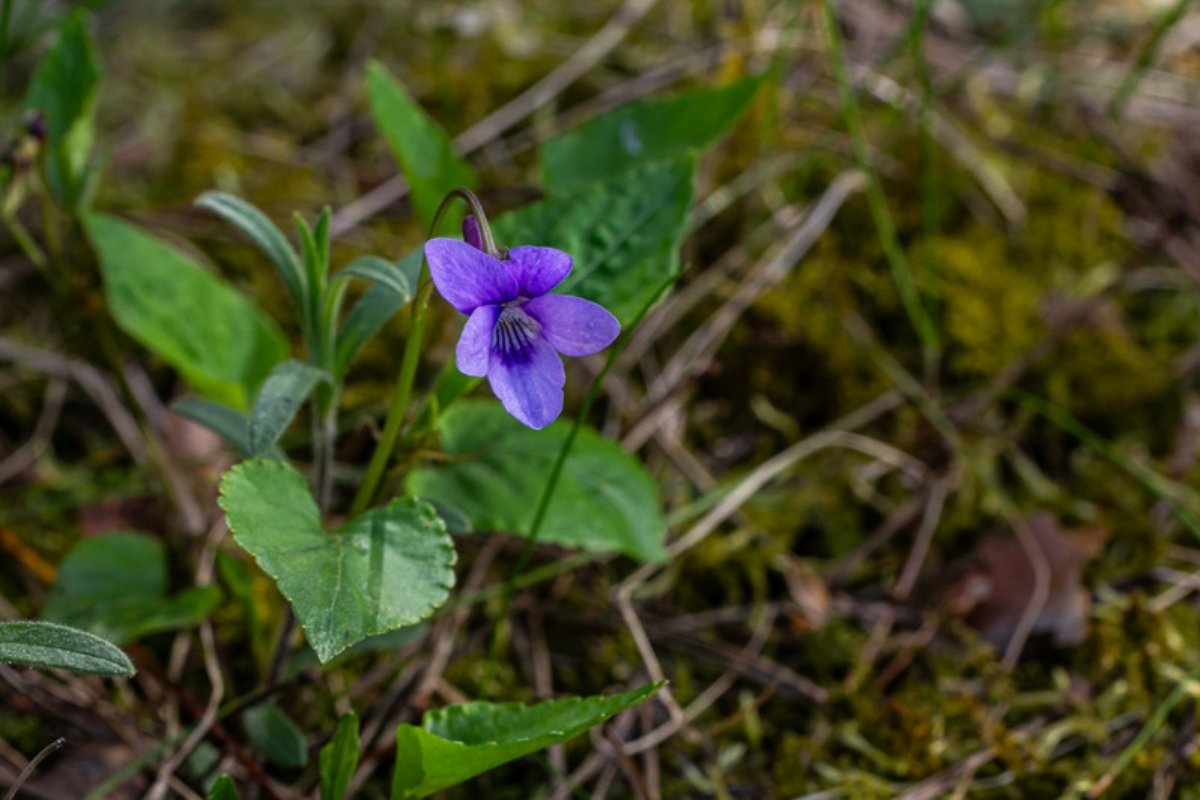
A wild violet among moss. Wild plants are left in place, and in protected areas collecting them is forbidden.
Wild plants should not be dug up, and in protected areas collecting them is forbidden. Garden sweet violets are easy to find in nurseries, as plants or as seed.
Sweet violet wants part shade and moist soil
Sweet violet grows in partial shade to dappled sun and dislikes full sun. It is not fussy about soil texture or pH but prefers moist, well-drained soil, and in the wild it is found most often on fertile, base-rich, calcareous, neutral to alkaline, moist soils. It reaches about 15 to 25 cm in height and spreads 30 to 45 cm, which makes it good ground cover under trees, shrubs and roses.
In hot summers, shade and soil moisture are what keep sweet violets alive. In a window box or pot it wants a north- or east-facing spot, compost rich in organic matter and watering that never lets the soil dry out.
It flowers in late winter and sets seed without opening
Sweet violet is among the first violets to bloom, with flowers often from February, usually deep violet, white or shades in between. In late spring and summer it produces extra small flowers that never open and self-pollinate inside the closed bud, known as cleistogamous flowers, setting still more seed.
Each seed carries a nutritious oily appendage, the elaiosome, which attracts ants. The ants carry the seeds to their nests, which explains why sweet violets suddenly appear in parts of the garden where nobody planted them.
Division is the easiest way to propagate
Sweet violets are most easily propagated by division in autumn or just after flowering. Large clumps go straight into their permanent position, while small divisions are first potted up and kept in a shady spot until they are growing well. Runners root by themselves in the soil and can also be cut and planted as new plants.
For a showy spring display, NC State Extension recommends pruning away runners and weak growth in late autumn, so the plant puts its energy into flowers rather than spreading.
Seed needs cold to germinate
Sweet violet seed needs a period of moist cold, known as stratification, and is best sown in autumn so it goes through winter in the seed tray, while stored seed germinates erratically. In recent work, stratification for 8 and 12 weeks at 4°C improved germination in a sweet violet cultivar.
In practice, seed is sown in autumn in a tray of moist compost that stays outdoors through winter, or kept for 8 weeks in the fridge in a moist medium before sowing in spring. Because germination is slow, anyone who wants quick results buys plants or propagates by division.
The scent of violets fades and returns
Anyone who smells violets for a while notices that the scent disappears and then comes back. The reason is ionone, the main fragrance compound of the flower, which temporarily desensitises the smell receptors, so the flower keeps smelling but we briefly stop perceiving it.
Flowers and leaves are edible
The leaves and flowers of sweet violet are edible, with the flowers used in salads, candied or in syrups, and no toxic effects have been reported for the plant. Traditional uses of the plant also mention an emetic action, however, so only the flowers and young leaves are used as food, in small amounts. Plants bought from florists and garden centres have often been sprayed with products not meant for food, so for eating, unsprayed plants from your own garden are best.
The flowers of violas and pansies are also edible and used the same way, to decorate desserts and salads.
Violas and pansies differ in how their petals are arranged
All Viola flowers have five petals, two upper, two side petals and one lower petal that ends in a spur. In pansies the two side petals tilt upwards, so the flower shows four petals pointing up and one pointing down, and the flowers are larger. In violas the side petals tilt downwards, which sources usually describe as two petals up and three down, with smaller but more numerous flowers.
In University of Georgia trials, violas performed better than pansies overall, filling space faster, showing more colour and tolerating more cold.
| Trait | Sweet violet | Viola | Pansy |
| Life cycle | Perennial | Grown as an annual | Grown as an annual |
| Flowers | Small, very fragrant | Small, many | Large, with a "face" |
| Position | Part shade | Sun or part shade | Sun or part shade |
| Flowering | Late winter to spring | Autumn to spring | Autumn to spring |
| Edible flowers | Yes, and the leaves | Yes | Yes |
Sources: NC State Extension, BSBI, University of Missouri Extension and the sources in the text.
Sweet violets have few pests
Sweet violet is a tough plant, with aphids and red spider mites as its main pests, the mites mostly in hot, dry conditions. Its leaves also feed the caterpillars of some butterflies, which in a butterfly-friendly garden is an advantage rather than a problem.
Frequently asked questions
Is sweet violet a perennial?
Yes. Sweet violet is a perennial, evergreen or semi-evergreen, and spreads by runners and seed from year to year.
When does sweet violet flower?
From late winter, often from February, into spring. In summer it produces small flowers that never open and set seed.
How do I plant sweet violets?
By dividing clumps in autumn or after flowering, in part shade and moist, well-drained soil. From seed, sow in autumn so the seed goes through winter cold.
Are sweet violets edible?
The flowers and leaves are edible, in salads, desserts and syrups. Only flowers and young leaves are used as food, and unsprayed plants are best.
What is the difference between violas and pansies?
Pansies have larger flowers with the side petals tilting up, while violas have smaller, more numerous flowers with the side petals tilting down. In trials, violas tolerated cold better.
Why does the scent of violets disappear when I smell them?
Because the flower's ionone temporarily desensitises the smell receptors. The scent returns after a short while.
Important notes
Every plant and every environment is unique. Conditions vary considerably with region, exposure, water quality, soil pH and the overall health of the plant. The guidance above is general and a starting point.
If you suspect a serious nutrient deficiency or a disease that basic practices do not resolve, contact an agronomist for an accurate diagnosis.
Plant protection products should be used carefully and responsibly. Always try non-chemical methods first (cultural practices, soft soap, summer oil). When chemical intervention is needed, use only approved products and follow the label instructions.
Sources
- Greek Wikipedia. Violeta (in Greek).
- Topoguide. Flora of Greece, the genus Viola (in Greek).
- Votaniki. (in Greek).
- Botanical Society of Britain and Ireland. Viola odorata L., sweet violet.
- NC State Extension. Viola odorata, plant toolbox.
- Plants For A Future. Viola odorata.
- bioRxiv (2025). A simple method of mechanical scarification to break seed dormancy in Viola odorata.
- Gardenia. Viola odorata, sweet violet.
- BBC Gardeners' World (2023). Sweet violet, Viola odorata.
- Cosmetics Business (2006). Fragrance, the sweetness of violets.
- University of Missouri Extension. Pansy, the smiley face flower.
- University of Missouri Extension. Pansies bring bright colors to fall.
- The Columbia Star. Pansies and violas, what's the difference?.
- Plant Care Today (2022). Viola odorata, sweet violet growing and care.