


Spain exported 195,482 tonnes of persimmons worth €274.6 million in the 2025/26 season, from September 2025 to August 2026, the highest value since 2012/13, the first complete season since persimmons got their own code in EU foreign trade statistics, according to a Wikifarmer analysis of Eurostat data. The average export price was €1.404 per kilo, 45.0% above the median of the 2012/13 to 2021/22 seasons, and the new season is now entering the months that carry most of the exports: October, November and December together accounted for 84.1% of the tonnage across all complete seasons since 2012/13, and January for another 11.1%.
Since 2022/23 the average export price has ranged from €1.29 to €1.54 per kilo
In the ten seasons from 2012/13 to 2021/22 Spain sold its persimmons abroad at an average of between €0.902 per kilo, in 2017/18, and €1.084, in 2021/22, with a median of €0.969, according to Eurostat's Comext foreign trade database. From 2022/23 the average ranged from €1.290 per kilo in 2023/24 to €1.537 in 2022/23. Prices are in euros and are not adjusted for inflation.
The 2022/23 season had the smallest tonnage since 2012/13, 92,175 tonnes, less than half the median season of 2012/13 to 2021/22, which was 198,852 tonnes, and the highest average export price in the series. In the three following seasons volumes came back to between 169,437 and 195,482 tonnes, while the average price stayed above every season before 2022/23. In 2025/26 the average price was 6.8% lower than in 2024/25, when it was €1.507, but tonnage rose 15.4% from 169,437 tonnes, so the value rose 7.5% from €255.4 million mainly because more was exported. By volume, 2025/26 stayed below 2012/13, with 262,738 tonnes, and 2019/20, with 221,684 tonnes.
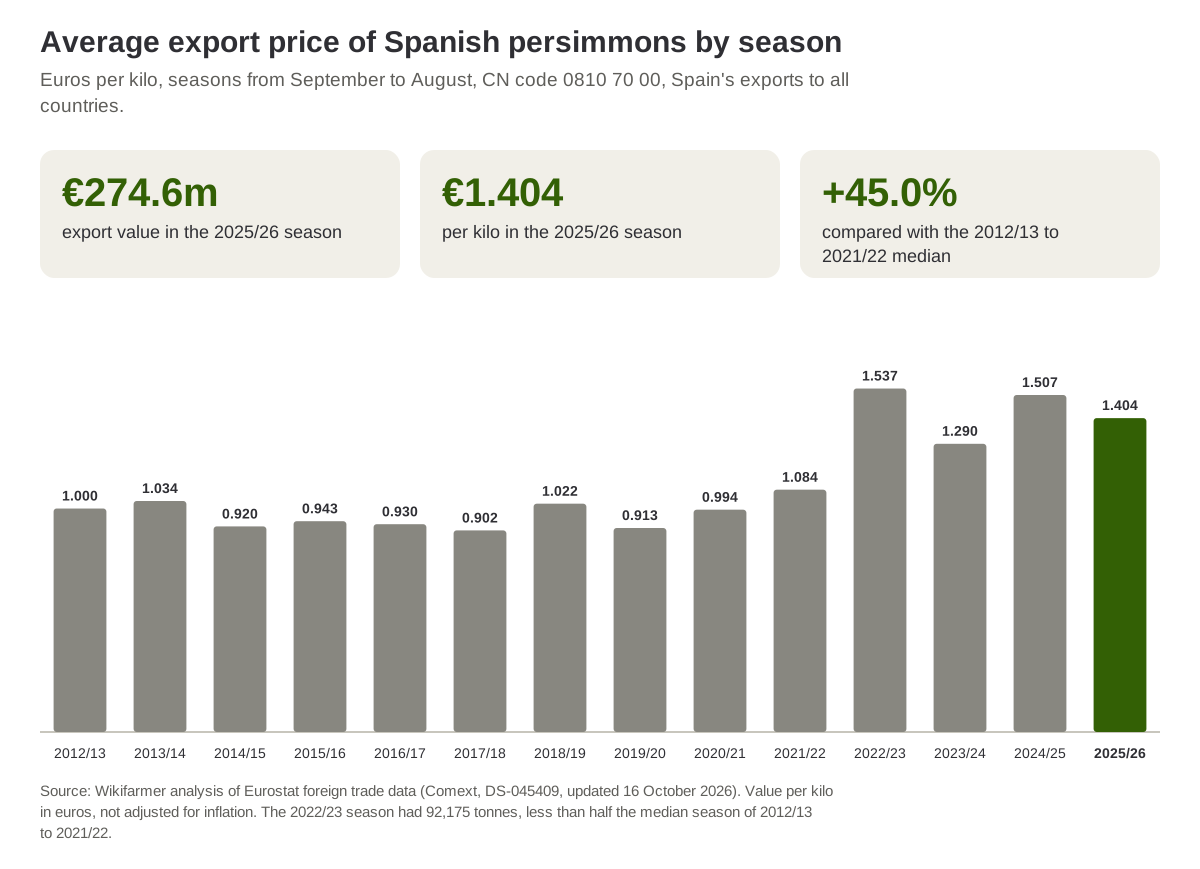
Source: Wikifarmer analysis of Eurostat foreign trade data (Comext, DS-045409, updated 16 October 2026), CN code 0810 70 00. Seasons run from September to August.
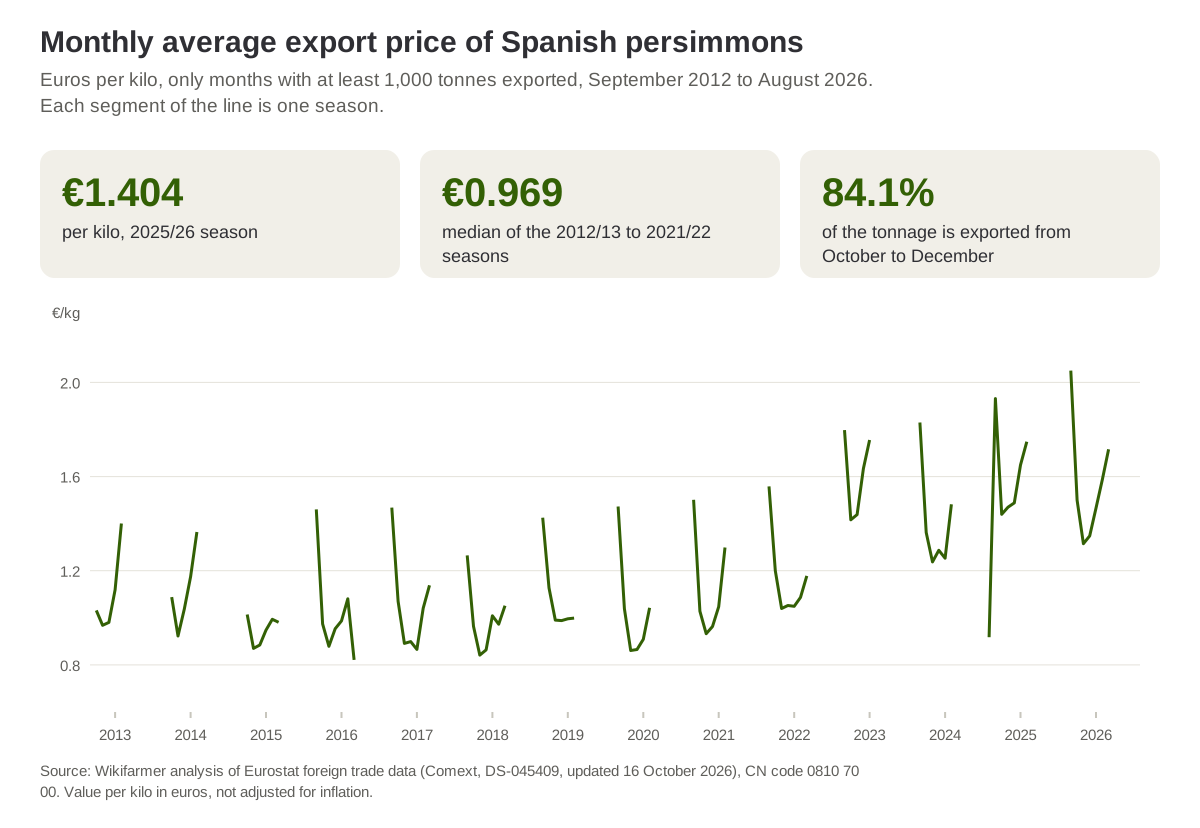
Source: Wikifarmer analysis of Eurostat data (Comext, DS-045409). The line shows the average export price of every month with at least 1,000 tonnes, and each segment is one season.
Germany bought more than a quarter of Spain's persimmons
In 2025/26 Germany bought 51,642 tonnes of Spanish persimmons, 26.4% of exports, followed by France with 26,657 tonnes (13.6%), Italy with 22,373 tonnes (11.4%), Poland with 11,513 tonnes (5.9%) and the Netherlands with 8,954 tonnes (4.6%). Destinations outside the EU took 19.6% of the tonnage, led by Morocco with 8,175 tonnes (4.2%) and the United Kingdom with 6,983 tonnes (3.6%). Average prices varied widely by destination: persimmons shipped to the United Kingdom sold for an average of €1.66 per kilo and those shipped to Morocco for €0.61 per kilo.
In Madrid persimmons sold wholesale above €1.9 per kilo in 2024 and 2025
At Madrid's central wholesale market, Mercamadrid, the average price of persimmons from October to December, weighted by the quantities sold, was €1.06 per kilo in 2019, €1.11 in 2020 and €1.24 in 2021, rose to €1.80 in 2022 and reached €1.95 in 2024 and €1.94 in 2025, according to the City of Madrid's open data. In the same months the market handled 7,995 tonnes of persimmons in 2019, 9,369 tonnes in 2020, 9,249 tonnes in 2021, 4,630 tonnes in 2022, 8,968 tonnes in 2023, 9,511 tonnes in 2024 and 6,771 tonnes in 2025, so in Madrid too 2022 was the year with the smallest quantity. From September 2025 to July 2026, 75.7% of the persimmons sold at Mercamadrid came from Valencia, 12.6% from Murcia and 4.7% each from Castellón and Alicante.
The prices matter to Spanish growers and northern European buyers
The average export price and the Madrid wholesale price moved the same way, with the big change showing in both from 2022, so the rise matters both to persimmon growers and exporters in Valencia and the neighbouring regions and to importers and retailers in Germany, France, Italy and the other countries that buy Spanish persimmons, in a global market with its own quality standards for persimmons.
The picture for 2026/27 will show in Eurostat's data for September and October, which are published about six weeks after the end of each month, and in Mercamadrid's prices for the last quarter of 2026. For another fruit of the same period, EU packing-station prices of kiwifruit usually change little from the start of the season.
The comparisons start in 2012/13 because persimmons have had their own trade code since 2012
The analysis is by Wikifarmer, based on Spain's exports under CN code 0810 70 00 (fresh persimmons) from Eurostat's Comext database (dataset DS-045409, updated 16 October 2026, data to August 2026) and on Mercamadrid's monthly volume and price data from the City of Madrid's open data portal (2019 to September 2026). The persimmon code appears in the data from January 2012, so the comparisons start with the 2012/13 season. Seasons run from September to August, the average export price is declared value divided by declared quantity, and prices are not adjusted for inflation. At Mercamadrid the price is the most frequent selling price of each variety from each origin, weighted by quantity, and three records are added together: Rojo Brillante, Sharon and persimmons with no variety. In 2021 most of the volume was recorded with no variety, which appears to reflect a change in how it was recorded, and with Rojo Brillante alone the price path is the same. The 2020 file repeats December three times, and it was counted once. The analysis does not examine the causes of the price change, and Eurostat's figures for the latest months may be revised. All figures were recomputed independently from the original files. They describe what prices did and are not a forecast.
Sources
- Eurostat. (2026). International trade in goods, Comext database (DS-045409), updated 16 October 2026.
- Ayuntamiento de Madrid. (2026). Mercamadrid, volumen y precio de productos comercializados. City of Madrid open data portal.