
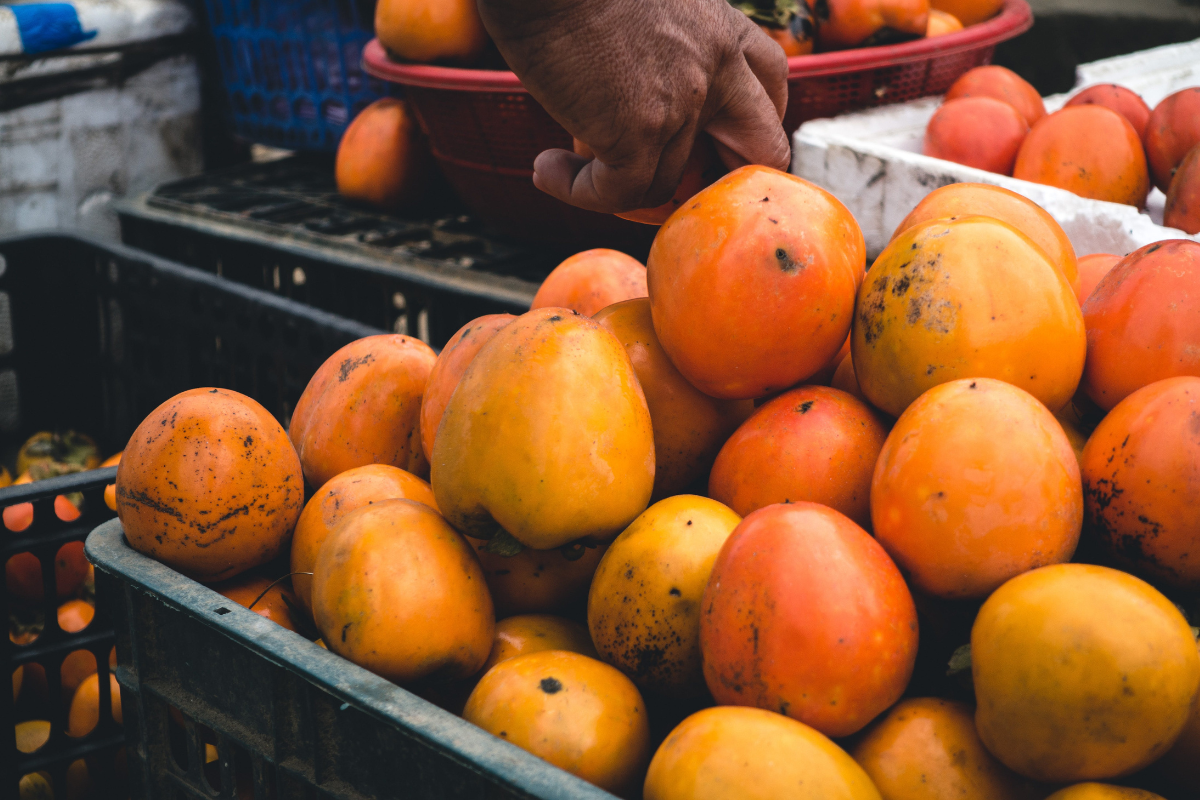
Persimmon types and uses
Persimmons are bright orange, sweet fruits enjoyed around the world. Often called kaki fruit, they originate from East Asia and are mainly from the Diospyros kaki species. There are two broad types of persimmons: astringent and non-astringent. Astringent varieties (like the heart-shaped Hachiya) are high in tannins and must fully soften (or be treated) before eating, whereas non-astringent types (like the squat Fuyu) can be eaten while firm and crisp. Persimmons are often enjoyed fresh as a dessert fruit, sliced or eaten whole like an apple. They can also be dried (a traditional delicacy in many cultures), used in baking, or processed into jams and other products. Their honey-like flavour and versatility have helped persimmons gain global popularity in recent years.
Global persimmon production
Global persimmon production has grown steadily over the past decades, reaching around 5.07 million metric tons in 2023. China alone accounts for about 75–77% of the world’s persimmon output. In 2022, China produced approximately 3.85 million tonnes of persimmons, by far the largest share of any country. South Korea (~240 thousand tonnes) and Azerbaijan (~192 thousand tonnes) were the next leading producers.
Outside of Asia, the most significant persimmon producer is Spain. Over the last decade, Spain has rapidly expanded persimmon cultivation, and at its peak, harvested around 400,000–430,000 tonnes annually, becoming one of the world's leading producers. The predominant Spanish variety is the deep-orange Rojo Brillante, often marketed as Kaki.
Global trade trends: Exports, imports, and market value
The persimmon trade has grown alongside production, connecting surplus producers with persimmon-hungry markets. In 2021, global exports of fresh persimmons were valued at about $620 million, and although export revenues dipped to ~$525.5 million in 2022, they rebounded to $564 million in 2023. This indicates a generally rising trend as persimmons gain popularity.
On the export side, a few countries dominate supply. Spain is the world’s top persimmon exporter by value in 2022, Spain alone accounted for about 31% of global export value (US$164 million). Thanks to its high-quality Rojo Brillante persimmons, Spain has built a strong export industry that mainly serves European markets. Azerbaijan is the second-largest exporter (21.6% of global export value), leveraging its substantial production and proximity to big buyers like Russia. China, despite consuming most of its huge crop domestically, is the third-largest exporter, with about 18% of export value, shipping surplus fruit to neighbours in Asia and beyond.
In contrast, demand for persimmons is spread across many countries, with Europe and parts of Asia being key markets. The top importers in 2022 were Russia (the #1 buyer, importing about $150.9 million worth – roughly 27% of global imports), Vietnam (~$67 million, 12.2%), Germany (~$57 million, 10.4%), France (~$29 million, 5.2%), and Italy (~$28 million, 5.1%). In the European Union, consumer demand for persimmons has surged, and countries like Germany, France, and Italy import large volumes, mostly supplied by Spain during the European season and by external partners in the off-season. Europe as a whole represented over 68% of global persimmon import value.
As the new persimmon season begins, growers and buyers alike are preparing for an active trade period. On the Wikifarmer Marketplace, fresh Spanish Rojo Brillante persimmons (Category I) are already available. If you want to source high-quality fruit for export or connect with reliable buyers, now is the ideal time to explore the available offers and update your supply plans.
Quality standards for persimmons in the EU market
Producers and traders must ensure the fruit meets strict quality standards to sell persimmons internationally, especially in the European Union. The EU bases its fresh fruit quality requirements on the United Nations Economic Commission for Europe standard for persimmons. This standard defines what is considered an acceptable persimmon in trade in terms of freshness, appearance, and condition. In simple terms, it lays out the minimum quality requirements and classification (grading) for persimmons that are to be sold fresh to consumers.
Minimum requirements
Regardless of grade, all persimmons on the market must meet certain basic quality criteria:
- Intact fruit: must be whole, not cut or seriously damaged, with the green calyx (cap) still attached. The stem may be removed, but the calyx should remain.
- Sound condition: fruit showing rot, mold, frost damage, or serious deterioration that affects edibility is excluded.
- Clean appearance: should be practically free from visible foreign matter such as dirt, dust, or pesticide residues.
- Free from pests and pest damage: no insect presence or feeding marks affecting the flesh.
- No abnormal moisture or odours: the fruit must be dry (no free water inside the packaging) and free from foreign smells or chemical taints.
- Sufficient maturity: persimmons must be properly developed to continue ripening after harvest. Fruit picked too early (completely green and hard) does not meet the standard.
These requirements ensure that traded persimmons are safe, clean, and of acceptable eating quality for consumers.
Quality classes: Beyond the minimum criteria, UNECE FFV-63 defines three quality classes – "Extra" Class, Class I, and Class II – which categorise persimmons based on the degree of perfection or presence of minor defects:
- "Extra" Class: This is the top grade. Persimmons in Extra Class must be "of superior quality", meaning they are characteristic of the variety, with excellent shape, colour, and appearance. The flesh must be sound and free of any defect. The calyx must be intact. In Extra Class, fruit is practically free of defects – only very slight superficial flaws are permitted, and only if they do not affect the fruit's overall appearance or storage quality. In fact, Extra Class persimmons in a package should be fairly uniform in size and colour as well, presenting a visually consistent product. This grade is typically intended for premium persimmons destined for high-end retail markets where appearance is critical.
- Class I: This grade is still of high quality, but it allows for small defects, provided the fruit overall is good. Persimmons in Class I must be of "good quality" and true to type, with the flesh sound (no internal breakdown). Allowed defects in Class I are slight and cosmetic – e.g. a slight defect in shape, a minor colour unevenness or sunspot on the skin (not more than 1/8 of the surface), or a few small healed skin blemishes. Very slight bruising is acceptable in Class I if it's tiny (e.g. a couple of cm²) and not deep. The key is that any defects do not affect the fruit's general appearance or keeping quality. Class I fruit still look attractive and is free from any severe defects – to the untrained eye, they appear perfectly fine, with just the occasional minor quirk. This is the most common grade for good commercial persimmons; although they may not be absolute perfection, they are close.
- Class II: This is the marketable class for fruit of reasonable quality. Persimmons in Class II may not qualify for higher classes, but they meet all the minimum requirements. They must still be sound and fit to eat, but can show more noticeable defects in shape, skin, or colour. For example, a Class II persimmon might be more irregular in shape, have a larger area of skin blemish or sunburn, or other visual defects – but nothing that makes it inedible. Some bruising or internal discolouration is tolerated in this class as long as the fruit's flesh is not seriously affected. Essentially, Class II fruit is perfectly good to consume, but looks less than ideal. This category allows producers to sell a portion of fruit with cosmetic imperfections (within limits) instead of discarding it, which helps reduce waste while still protecting consumers from low-quality or spoiled fruit. It's important to note that even in Class II, fruit with decay or damage beyond edible condition is not allowed; all fruit must be of at least minimum acceptable quality.
These quality standards, used in the EU and internationally, ensure that buyers get persimmons that meet their expectations, and that traders have a common language to describe quality. For instance, an importer can specify they want Class I persimmons, and the exporter knows exactly what that entails. The standard also covers other aspects like sizing (for Extra Class and Class I, fruit must be fairly uniform in size) and proper packing/marking, to further facilitate fair trading.
Sources
Data: Statista and World’s Top Exports