An avocado (Persea americana) can be grown readily from the pit of a ripe fruit, which is why it is one of the most popular home kitchen gardening projects. The resulting plant grows quickly and produces handsome foliage in a container or a warm garden. Fruit is a different matter, because a seedling does not reproduce the parent variety and takes many years to flower. What follows covers how an avocado seed germinates, how to look after the young plant, and why orchard trees are always grafted.
Where avocados grow well
Avocado is a subtropical tree that thrives in mild climates without hard frost. It needs deep, fertile, well-drained soil and is highly sensitive to high lime levels, salts, and waterlogging, which can cause root rot. In Greece, it is grown commercially mainly in Crete, with the Chania area as the main centre, and in other warm coastal districts. In cooler regions, the plant is kept in a container and protected through winter.
How the seed germinates
Take the pit from a ripe fruit, wash it well so that no flesh remains and cause mould, and set it with the pointed end facing up. Roots emerge first from the broad base, and the shoot follows from the tip. Two simple methods work.
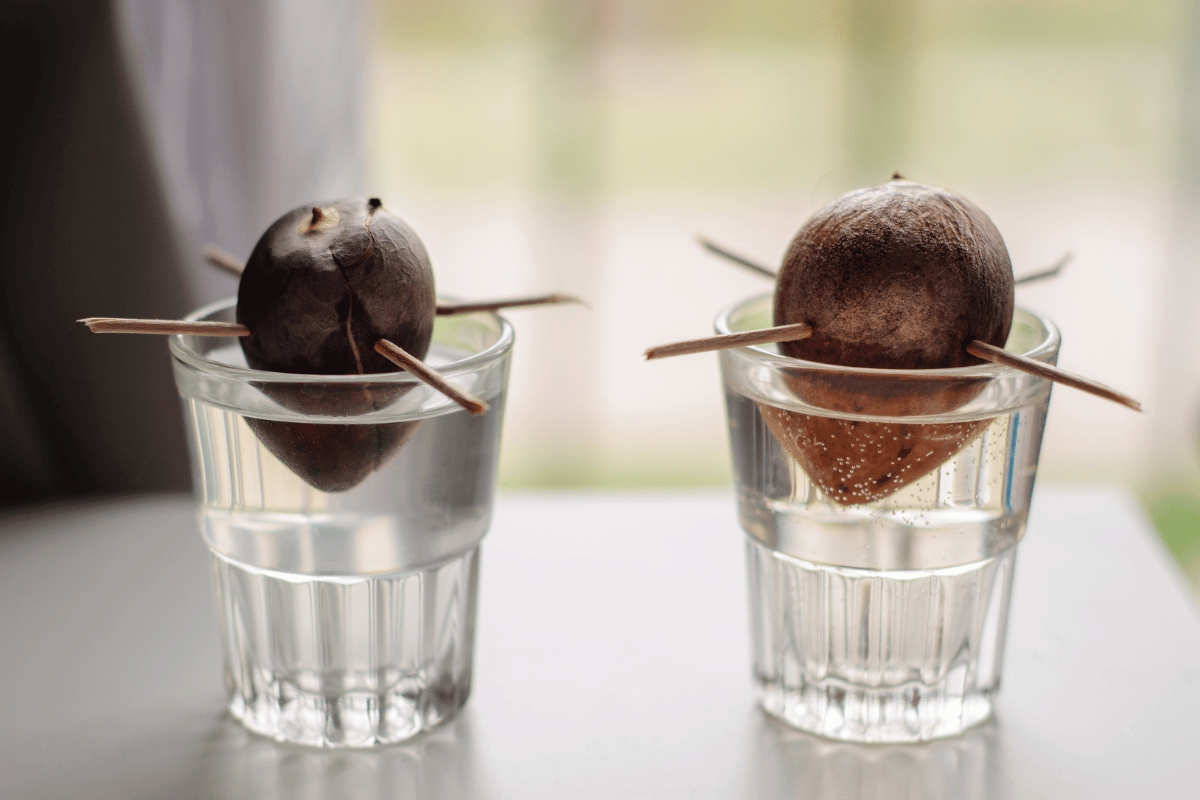
In the water method, push three or four toothpicks around the middle of the pit so that they hang over a glass of water with only the bottom third submerged. Change the water every 3 to 5 days and keep the glass in a warm, bright place, out of direct sunlight. In the soil method, plant the pit in a light, moist growing medium with the top half left exposed. Either way, germination takes two to six weeks, and since not every pit sprouts, it pays to start two or three at once.
Potting up and caring for the young plant
Pot up once the roots reach 5-10 cm and the shoot is about 15 cm tall. Choose a container at least 30 cm across with drainage holes, and a light, medium-rich organic soil with perlite added for drainage. Set the pit so that its top half stays above the soil surface.
Place the plant in a bright spot sheltered from strong wind and water regularly once the surface of the medium dries, without overdoing it. Overwatering is the most common reason young plants are lost. Because avocado is sensitive to salts, avoid very hard water. A young seedling grows as a single stem and stays low down, so pinching the tip at about 15 cm, and again at a greater height, encourages branching and a bushier plant.
Why does a seedling not give the same fruit
Avocado is cross pollinated, so every seed carries genetic material from two different trees and produces a new, unique plant. For that reason, seedlings usually do not bear fruit true to the parent variety in flavour, size or quality. Some commercial varieties are hybrids, in which case the seeds may not germinate or may produce a sterile seedling. On top of that, there is a long juvenile period during which the tree grows without flowering.
What rootstocks and grafting do
A seedling is far from useless, since it is the foundation of every orchard. It serves as the rootstock, the root system onto which the chosen variety is grafted. The rootstock governs tree vigour, adaptation to the soil, and resistance to soil-borne pathogens, with phytophthora root rot the most serious threat to the crop. In commercial production, every tree is grafted at the seedling stage, so it keeps the characteristics of the variety and carries its first fruit at around three years of age, reaching a full crop at four to five. A home grower can also graft a scion from a known variety onto a home-raised seedling later on.
| Feature | Seedling from a pit | Grafted young tree |
|---|---|---|
| Fruit quality | Unpredictable, differs from the parent | Consistent, true to the grafted variety |
| First fruit | 5 to 10 years or more | Around 3 years |
| Best suited to | Foliage, containers, rootstock | Fruit production in a garden or orchard |
Type A and type B flowering
An avocado flower opens twice, working first as a female and then as a male, at different times of day. Depending on that sequence, varieties fall into type A and type B flowering groups. The mechanism limits self pollination, since many varieties are not sufficiently self fertile. In practice, planting varieties of both types near each other, with bees present, raises fruit set considerably. This is why a single tree, even a grafted one, may carry only a few fruit.
What to expect in practice
An avocado grown from seed gives a good-looking, vigorous plant within a few months and makes an excellent project for a container, a balcony or a warm garden. Fruit, by contrast, takes years, is never guaranteed, and rarely resembles the original, while in a container it is very unlikely indeed. Anyone aiming for a crop should buy grafted young trees of a certified variety from a reputable nursery and, where space allows, plant both flowering types. A home-raised seedling still earns its place, both as an ornamental plant and as a rootstock for grafting later.
Sources
- University of California Cooperative Extension Ventura County, Growing avocado from seed.
- The Old Farmer's Almanac, How to grow an avocado tree from seed.