

In the same season that French maize has fallen to a record low, Bulgaria is producing 5.52 tonnes per hectare, 29% above its five-year average. Romania reaches 4.46 tonnes per hectare for an 11% gain, and both countries expect record or near-record winter cereal yields, according to the August bulletin from the European Commission's Joint Research Centre.
That eastward shift is the clearest structural feature of the season, and it determines where Europe's shortfall will be covered from, with the EU maize average falling to 6.61 tonnes per hectare, 7% below the five-year mark.
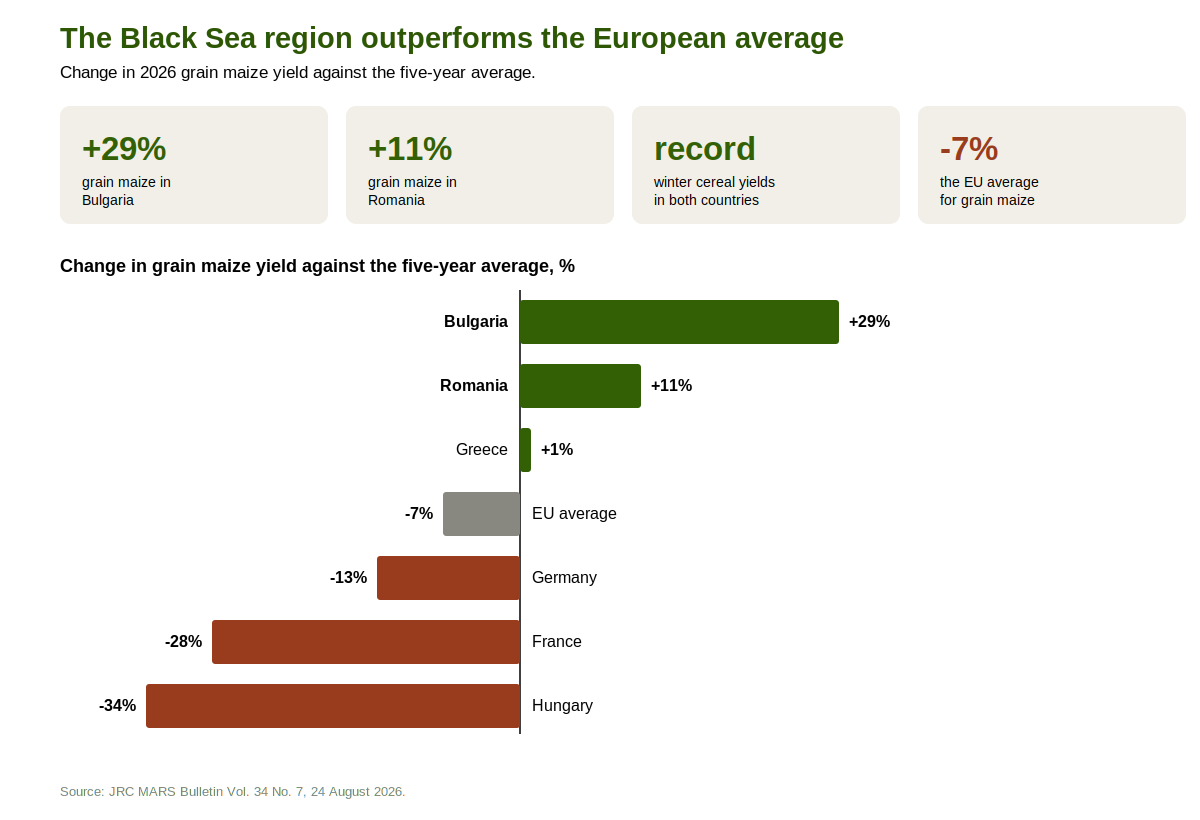
Bulgaria and Romania are above their five-year averages, while France and Hungary are far below.
Bulgaria got through flowering without heat stress.
Seasonal temperatures in Bulgaria stayed close to average, and the absence of heat stress provided adequate thermal conditions for yield formation, while July rainfall was near normal and exceeded the long-term average in the north-east. Soil moisture, therefore, remained close to average levels and adequately supplied maize and sunflower, apart from the north-west, where the Severozapaden region remained drier than usual for the entire review period.
Satellite measurements confirm the positive picture, with photosynthetic activity at or above average until the end of July, though some deterioration began to appear during August as rainfall declined. Sunflower finishes at 2.27 tonnes per hectare, 13% above average, and in winter cereals, the July rain caused a moderate harvest delay without preventing the record yields now forecast.
Romania revised upwards despite drought in the west
Eastern and central Romania received beneficial rainfall and near-average July temperatures, creating favourable conditions for summer crop development, while the first half of August turned drier and warmer than usual in the same regions. Western Romania went the other way, suffering a severe rainfall deficit. At the same time, a late-July heatwave with daily maxima up to 41°C intensified water stress, shortened the grain-filling period and worsened crop conditions.
Satellite imagery clearly captures the differences in development and biomass accumulation between the west and the rest of the country. Despite that split, national forecasts for grain maize and sunflower were revised upwards to 10% above the five-year average, on the strength of crop development in the east and centre. Winter crop harvesting progressed and finished well, with forecasts remaining near record-high levels.
Ukraine and Türkiye also close positively
The weather across most of Ukraine was cooler and drier than average, conditions that favoured winter crop maturation and harvesting. Maize reached grain filling under favourable conditions in the north, south and east, while soybean, grown mainly in the west, was more exposed to dry soils following an already dry spring.
Winter crop harvesting was completed in July, with wheat and rapeseed forecasts unchanged and barley revised slightly upwards, as conditions were favourable during the final grain-filling stage of spring barley. The grain maize forecast also increased, supported by crop conditions in the centre and north, while soybean remains close to average.
In Türkiye, the winter cereal harvest ended in most regions in early July with very satisfactory results. Summer crops are delayed in development due to late sowing, with the second crop cycle in Şanlıurfa significantly delayed and crops not yet emerged. At the same time, remote sensing data indicate a reduced sown area for the summer cycle, in line with the larger area allocated to winter crops this year. In the remaining regions, including Adana, Hatay and Samsun, biomass accumulation is favourable, and crops are around flowering with average temperatures and sufficient irrigation water, putting summer crop expectations 5% above the five-year average.
Hungary turns from exporter to importer
This season also exposes a deeper shift in Central Europe that goes beyond a single bad year. According to Reuters reporting that cites a late-August European Commission estimate, the EU maize harvest is forecast at 50.1 million tonnes, a near two-decade low and roughly a fifth below the average of the past three years. Hungary, once a regular exporter, will have to import maize this year, the government said, with the harvest estimated at 2.5 million tonnes, less than a third of its output in 2018 and 2019.
Romania's good season also needs context. Its crop of around 8 million tonnes is 11% above the five-year average, yet still less than half the levels of 2018 and 2019, as the planted area has shrunk sharply. Romanian maize exports fell to between 2.2 and 4.7 million tonnes over 2023 to 2025 from more than 7 million tonnes at the turn of the decade, according to Commission figures. The Black Sea surplus is therefore real relative to the recent five years and far smaller than it was only a few years ago.
Temperature explains much of the contraction. Over the past decade, Hungary's June and July highs have run 3.1°C above the 1961 to 1990 average, with Romania close behind at 3°C, according to data cited by Reuters. An Expana analyst quoted in the same report projects an 8% to 9% rise in EU maize imports in 2026/27.
What the shift means for feed costs
Livestock production across the Mediterranean depends substantially on imported raw materials for rations, so the geography of supply matters directly to cost. With western and central Europe in deficit and the Black Sea zone in surplus, trade flows run from east to west, which limits price pressure compared with a year when both regions had poor harvests.
That balance stays fragile. Both Bulgaria and Romania contain regions with severe rainfall deficits, in the north-west and west respectively, and Bulgarian satellite measurements showed deterioration through August. Final yields will be settled at harvest, and a year with simultaneous drought in both east and west would change the cost picture entirely.
Sources
- Reuters. (2026). Climate shocks hit EU maize heartland in Hungary and Romania. 2 September 2026.
- European Commission Joint Research Centre. (2026). JRC MARS Bulletin, Crop monitoring in Europe, August 2026, Vol. 34 No. 7. Publications Office of the European Union, Luxembourg.