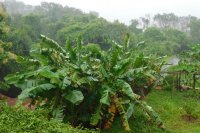

AEMET, Spain's state meteorological agency, recorded a 117 km/h gust at its La Palma airport station at 06:50 Canary time on 11 November 2026, while an AEMET red warning for gusts of up to 130 km/h was in force across the island and the Canary Islands government had put the island on maximum alert for wind from Storm Charles. La Palma shipped 36.6% of the bananas sent out of the Canary Islands in 2024, almost all of them to the rest of Spain, according to estimates by the Canary Islands statistics office (ISTAC). The Canary Islands government's announcements up to midday on 11 November dealt with the alerts and forecasts and contained no assessment of the banana farms.
AEMET had a red warning for gusts of up to 130 km/h across La Palma
From 03:00 to 11:59 on 11 November, in both Canary time and UTC, AEMET had a red warning in force for gusts of up to 130 km/h over the summits and the eastern and western sides of La Palma, with a south-westerly wind expected to affect mainly the summits, the north-western slope and the slope facing east and south-east. This followed an orange warning for gusts of up to 110 km/h that had been in force since 18:00 the previous day. The Canary Islands government's emergencies department declared a maximum alert for wind on La Palma and the summits of Tenerife from 00:00 on 11 November because of Storm Charles, with gusts forecast at up to 140 km/h in the east and north of La Palma and up to 120 km/h on the western side. The rest of Tenerife and the other islands had been on alert since 18:00 on 10 November, with gusts that could reach or exceed 110 km/h on Tenerife, 100 km/h on El Hierro and La Gomera and 90 km/h on Gran Canaria, Lanzarote and Fuerteventura.
The strongest gust on the island was recorded at the airport
At AEMET's stations on La Palma the strongest gust on 11 November was 117 km/h at the airport on the east coast, followed by 110 km/h at 00:50 at Roque de los Muchachos, in the island's summit area at 2,223 m, 89 km/h at Puntagorda, 72 km/h at Fuencaliente and 65 km/h at Tijarafe. At San Andrés y Sauces, on the north-eastern side of the island at 362 m, gusts did not exceed 36 km/h. No AEMET station on the island that reported a gust reached the 130 km/h forecast in the red warning. On the other islands the strongest gusts were recorded at stations above 1,000 m, with 148 km/h at Izaña on Tenerife, 130 km/h at Alto Igualero on La Gomera, 122 km/h at Cruz de Tejeda on Gran Canaria and 116 km/h at San Andrés on El Hierro.
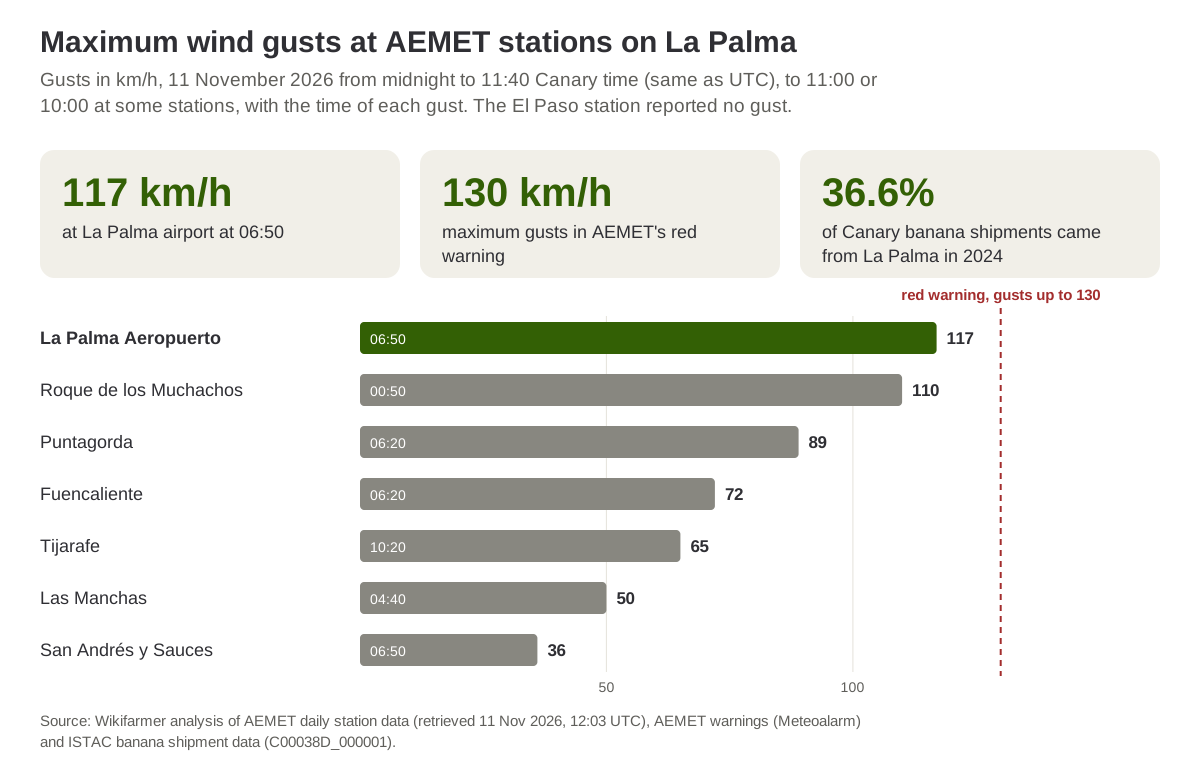
Source: Wikifarmer analysis of AEMET daily station data (retrieved 11 Nov 2026, 12:03 UTC), AEMET warnings (Meteoalarm) and ISTAC banana shipment data.
La Palma remains on rain alert
By 11:40 the airport station had measured 43.1 mm of rain, and by 11:00 San Andrés y Sauces had 22.4 mm and Puntagorda 12.8 mm. In its update effective from 11:30, the Canary Islands government kept La Palma on rain alert. It forecast up to 100 mm in 12 hours in the east and on the summits until 18:00, especially in Breña Baja, Breña Alta, Santa Cruz de La Palma and the northern part of the Caldera de Taburiente, and up to 30 mm an hour across the island until midnight. From 18:00 the forecast was up to 60 mm in 12 hours in the east, on the summits and in the west. The other islands were placed on pre-alert (prealerta), the level below alert. AEMET has an orange warning for La Palma for 30 mm of rain in one hour until 23:59.
La Palma ships bananas every month and sends almost all of them to the rest of Spain
ISTAC puts Canary banana shipments out of the archipelago in 2024 at 322,441 tonnes and estimates that 118,022 tonnes of them, or 36.6%, came from La Palma, while Tenerife supplied 42.6% and Gran Canaria 19.0%. In all, 98.9% of the shipments went to the rest of Spain, and 99.1% of La Palma's did. According to Eurostat, the EU imported 2,672,914 tonnes of bananas from non-EU countries in the first half of 2026 alone, 40.2% from Ecuador, 19.7% from Colombia and 19.2% from Costa Rica, its three largest suppliers on the global banana market.
La Palma ships bananas in every month of the year, and in 2024 the monthly figure ranged from 7,797 tonnes in June to 11,772 tonnes in April. From 2003 to 2024 its share of Canary shipments ranged between 32.5% and 40.5% every year except 2022, when it fell to 24.5% after the volcanic eruption of autumn 2021. Canary bananas have been registered since 2013 as the Protected Geographical Indication "Plátano de Canarias" under Commission Implementing Regulation (EU) No 1084/2013.
Banana insurance in Spain covers windstorm damage
In Spain, Agroseguro manages agricultural insurance, and under the 2026 plan its line 305 for bananas covers windstorm, which the policy calls viento huracanado, among other risks. Production cover starts when the insurance takes effect, never before 1 July, and ends at harvest, when the bunches have filled enough to be cut, or at the latest on 30 June of the following year. The special conditions for the same line in 2022 define windstorm damage as snapped, leaning or fallen plants, physical damage to the hands of the bunch and visible wind damage to the greenhouse. A broken bunch stalk or leaf blade also counts when the leaves then dry out or are lost and leaf area falls by more than 50% on more than 3 of the 8 youngest leaves. Leaf shredding by wind is excluded unless it falls within that definition.
After the strong winds of 23 February 2020, Alicia Vanoostende, then the Canary Islands regional minister for agriculture, livestock and fisheries, visited banana and avocado farms in Los Llanos de Aridane and Tijarafe on La Palma. She said that many banana farms had been hit and had lost production and that the damage would be assessed together with technicians from the Cabildos, the island councils, and from Agroseguro. For Storm Charles, the next announcements from the Canary Islands government and the Cabildo of La Palma will show whether and where the farms were affected.
Frequently asked questions
How strong was the wind on La Palma?
The strongest gust at an AEMET station on the island on 11 November was 117 km/h at the airport, at 06:50 Canary time, followed by 110 km/h at Roque de los Muchachos. AEMET's red warning forecast gusts of up to 130 km/h, and no station on the island that reported data reached that speed.
Has there been damage to the banana farms?
The Canary Islands government's announcements up to midday on 11 November dealt with the wind and rain alerts and contained no assessment of the farms. After the winds of February 2020, the Canary Islands government said the damage would be assessed together with technicians from the Cabildos and Agroseguro.
How many bananas does La Palma ship?
ISTAC estimates that La Palma shipped 118,022 tonnes of bananas in 2024, 36.6% of Canary shipments, and that 99.1% of them went to the rest of Spain. Shipments go out every month, and in 2024 they ranged from 7,797 to 11,772 tonnes a month.
Does insurance cover wind damage?
For insured farms, Agroseguro's line 305 for bananas covers windstorm in the 2026 plan, along with hail, heat damage and other risks. The 2022 special conditions for the same line define windstorm damage as including fallen plants and physical damage to the hands of the bunch.
Important notes
The analysis was carried out by Wikifarmer. The gusts and rain are provisional AEMET station measurements from the agency's daily tables. At the time of retrieval, the tables for 11 November ran to 11:40 Canary time at three stations, to 11:00 at most others and to 10:00 at Fuencaliente, and gave neither a gust nor rain for the El Paso station. Canary time is the same as UTC in November, and station altitudes are AEMET's. Shipments come from ISTAC series C00038D_000001, based on data from the organisations that ship bananas, and cover shipments abroad as well as to the rest of Spain, which here includes the Balearic Islands, Ceuta and Melilla. The figures by island are ISTAC estimates and are used mainly for the islands' shares. The 2025 and 2026 figures are provisional and are not used, because the 2025 total is about half of the 374.6 million kg of production that ASPROCAN, the association of Canary banana producer organisations, reported for that year. The insurance terms come from the product information document for the 2026 plan and the 2022 special conditions for line 305. The article does not assess damage to the farms.
Sources
- AEMET. (2026). Observación, últimos datos, tablas diarias por estación, retrieved 11 November 2026, 12:03 UTC.
- AEMET via Meteoalarm. (2026, 11 November). Warnings for Spain, retrieved 11 November 2026, 10:08 UTC.
- Gobierno de Canarias. (2026, 10 November). El Gobierno de Canarias actualiza hasta alerta máxima por viento en La Palma y Tenerife.
- Gobierno de Canarias. (2026, 11 November). El Gobierno de Canarias actualiza la situación permaneciendo La Palma en Alerta por lluvias.
- Instituto Canario de Estadística (ISTAC). (2026). Plátanos según destinos de exportación, series mensuales por islas (C00038D_000001), retrieved 11 November 2026.
- Eurostat. (2026). EU trade since 1988 by HS2-4-6 and CN8 (DS-045409), EU-27 imports under code 080390, updated 16 October 2026.
- Agroseguro. (2026). Seguro agrario combinado, Plan 2026, Plátano, Línea 305, documento de información sobre el producto.
- ENESA, Ministerio de Agricultura, Pesca y Alimentación. (2022). Seguro de explotaciones de plátanos, condiciones especiales, línea 305, Plan 2022.
- Gobierno de Canarias. (2020, 24 February). Alicia Vanoostende visita en La Palma fincas de plátanos y aguacates afectadas por las fuertes rachas de viento.
- FyH Revista. (2026, 5 February). Canarias produjo 374 millones de kilos de plátano en 2025, el 12 % menos anual, with ASPROCAN data.
- WIPO. (2023, 16 March). Plátano de Canarias, certificate of registration, Protected Geographical Indication, hosted by the Ministerio de Agricultura, Pesca y Alimentación.