
Vietnam's Central Highlands, home to the country's main coffee provinces, are likely to have a rain deficit combined with high temperatures from February to April 2027, according to the seasonal bulletin of the country's National Center for Hydro-Meteorological Forecasting (NCHMF), which gives a 96% chance that El Niño stays very strong through January. Vietnam is the world's largest robusta producer, with 31.4 million 60-kilo bags out of 83.8 million bags of robusta forecast worldwide for 2026/27 by the US Department of Agriculture (USDA), and its Ministry of Agriculture and Environment has asked the provincial agriculture departments of the Highlands to protect coffee from drought in the coming months. After four of the five previous dry seasons with a strong El Niño, the World Bank's average robusta price was higher in the following marketing year, compared with 14 of the 38 other years, while Vietnam's production fell in only two, according to a Wikifarmer analysis.
Vietnam's forecasting centre gives a 96% chance that El Niño stays very strong through January
The Oceanic Niño Index (ONI) of the US National Oceanic and Atmospheric Administration (NOAA), which measures how much warmer than normal the sea surface is in the central and eastern equatorial Pacific, reached 2.46 °C for August to October 2026, up from 2.16 for July to September. That puts the 2026 El Niño already well above the 1.5 threshold the analysis uses for strong episodes, and it is the same episode that is affecting mango flowering in Peru this year. In its seasonal bulletin for November 2026 to April 2027, the NCHMF gives a 96% chance that El Niño stays very strong through January, and says that from February it will start to weaken, most likely to a moderate to strong intensity, and persist into the first half of summer 2027 before gradually returning to neutral conditions.
For the Central Highlands the bulletin forecasts average temperatures 1.0 to 2.0 °C above normal in December and January, December rain 10 to 20 mm below normal and generally little rain in January. For February to April it says that the Highlands and the south of the country are likely to have a rain deficit with high temperatures, which could have a large impact on water resources and harm daily life and production. The NCHMF's next seasonal bulletin is due by 15 November.
Vietnam's Ministry of Agriculture and Environment calls for water storage for coffee
In document 2504/TTTV-TTBVTV of 19 June 2026 to the agriculture and environment departments of the southern provinces, the Ministry of Agriculture and Environment's Department of Crop Production and Plant Protection asked for the crops of the Central Highlands that use a lot of water, such as coffee, black pepper and fruit trees, to be protected from drought. The document calls for water to be stored in reservoirs, dams and ponds for dry-season irrigation, for drip or sprinkler irrigation, for mulch of plant residues or plastic film around the base of the trees to hold soil moisture, for less herbicide use and for more organic fertiliser.
On 5 November the newspaper Nhân Dân reported that, because the strong El Niño of the 2026/27 dry season raises the risk of drought and of shortages of irrigation water, the same department had sent the provinces of the South Central Coast and the Central Highlands a new document on the 2026/27 winter-spring crop, mostly rice. According to the newspaper, the department's deputy director, Nguyễn Quốc Mạnh, called for post-harvest care of perennial industrial crops and fruit trees, water-saving irrigation and farm ponds and, if drought sets in, thinning of branches and removal of small and misshapen fruit. The department advises against any new planting in water-short areas while the heat and drought last, and among the pests and diseases to be controlled it names anthracnose and coffee leaf rust.
The 2027 dry season comes after a harvest forecast to be a record
For the 2026/27 marketing year, which for Vietnam begins in October, the USDA's July 2026 report forecasts a record coffee crop of 32.5 million bags, about 1.95 million tonnes, 800,000 bags more than the 31.7 million of 2025/26, on a larger area and higher yields. In its May annual report, the USDA office in Ho Chi Minh City wrote that prices had fallen from their 2024 and 2025 peaks because of oversupply on the world market, and the World Bank put the robusta price at $3.63 per kilo in October 2026, against an average of $4.98 from October 2024 to September 2025.
The analysis matches each dry season to the marketing year that begins in October of the same year, so the harvest that corresponds to the 2027 dry season is 2027/28, while harvesting of the 2026/27 crop began in October 2026. The USDA's next report on the world coffee market is due on 16 December 2026.
After four of the five past strong El Niño dry seasons the average robusta price was higher
The analysis defines dry seasons with a strong El Niño as the months of January to April that followed an ONI of 1.5 or more for November to January, which leaves five since 1981, in 1983, 1998, 2010, 2016 and 2024. NASA's POWER estimates, averaged over four grid cells in the Highlands, put normal January to April rain at 66.1 mm, and in those five dry seasons it was 13%, 32%, 100%, 50% and 22% of normal. It stayed below half of normal in three of the five, but also in 15 of the 41 other years from 1981 to 2026, so the Highlands' dry season is often very dry even without El Niño. NOAA's daily station records show 0.3 mm of rain at Buôn Ma Thuột and none at Pleiku from January to April 2024, over the 115 of the 121 days with data, and 36.8 and 60.5 mm over the same months of 2016.
Vietnam's coffee production, according to USDA data, fell in the following marketing year in two of the five cases, by 16.9% in 1983/84, when Vietnam still produced only 69,000 bags, and by 7.7% in 2016/17, while it rose by 7.1% in 1998/99, 4.9% in 2010/11 and 5.3% in 2024/25. Production also fell in 9 of the 39 other years from 1983/84 to the 2026/27 forecast, so the data do not show a strong El Niño regularly cutting the harvest. The World Bank's average robusta price, by contrast, was higher than in the previous year in four of the five cases, by 12.7% in 1983/84, 45.3% in 2010/11, 24.7% in 2016/17 and 29.4% in 2024/25, when coffee prices hit record highs led by arabica, and lower by 11.6% in 1998/99. In the other years from 1983/84 to 2025/26 the price was higher in 14 of 38, but five cases are too few to establish a pattern, and the robusta price also depends on Brazil's harvest and on the dollar exchange rate.
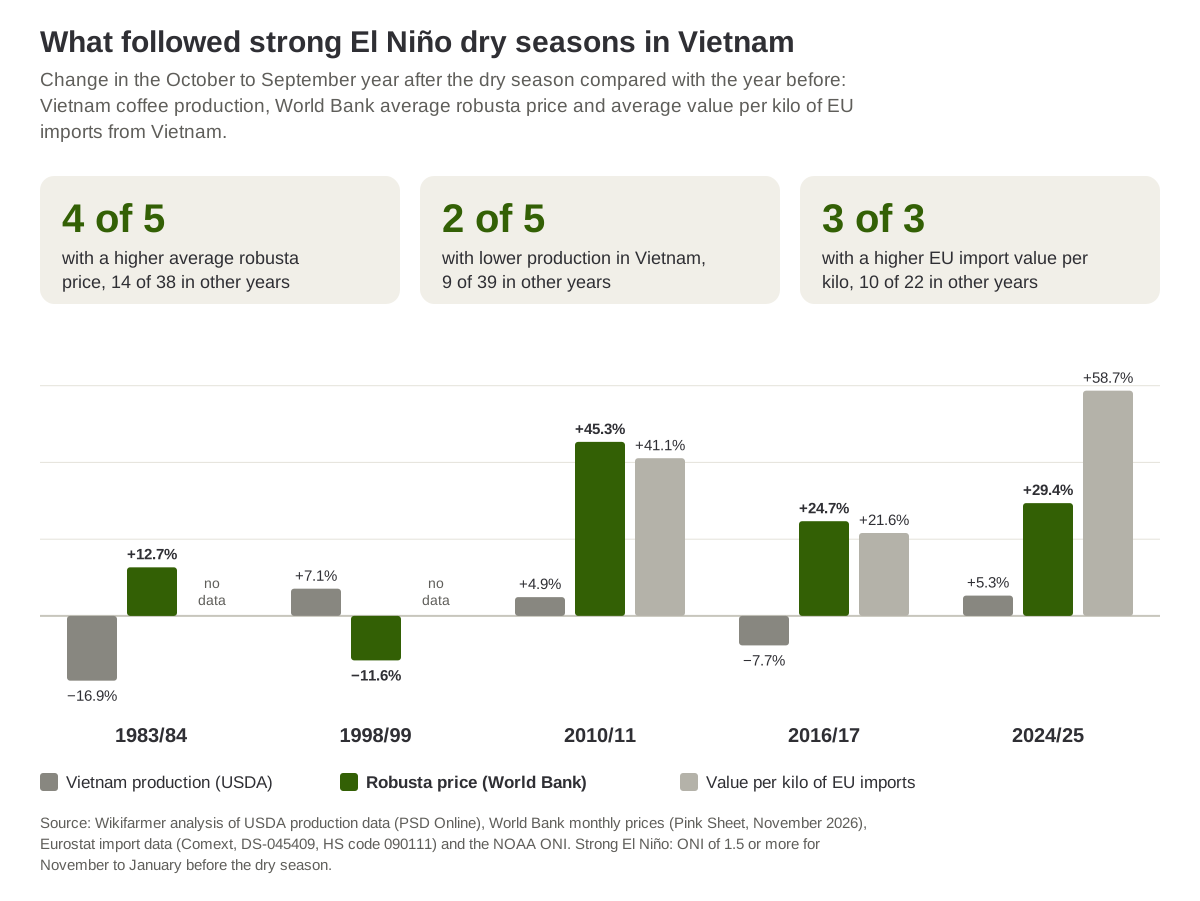
Source: Wikifarmer analysis of USDA production data (PSD Online), World Bank monthly prices (Pink Sheet, November 2026), Eurostat import data (Comext, DS-045409, HS code 090111) and the NOAA ONI.
After the three most recent episodes the EU imported almost the same volume from Vietnam at a higher value per kilo
For EU-27 imports of green (unroasted) coffee from Vietnam under HS code 090111, the volume in the October to September year after a strong El Niño dry season rose by 0.2% in 2010/11 and fell by 1.3% in 2016/17 and by 4.3% in 2024/25, while the average value per kilo rose by 41.1% in 2010/11, 21.6% in 2016/17 and 58.7% in 2024/25, from €3.17 to €5.04 per kilo, according to a Wikifarmer analysis of Eurostat data. The value per kilo rose in all three years, against 10 of the 22 other years from 2000/01 to 2024/25. In the three years after a strong El Niño, the rise coincided with a rise in the World Bank's average robusta price. There are no complete EU-27 import data for 1983/84 and 1998/99.
Vietnam supplies almost a quarter of the green coffee the EU imports
From October 2025 to August 2026 the EU imported 639,125 tonnes of green coffee from Vietnam, 24.4% of its imports from outside the EU, behind Brazil with 32.4% and ahead of Uganda with 8.7%, at an average of €4.02 per kilo. Over the same October to August period, Vietnam's share was 21.1% in 2023/24 and 18.8% in 2024/25, the first year after the 2024 dry season, and Brazil's was 41.3% and 37.8%.
In the three episodes with data, EU imports from Vietnam kept almost the same volume at a higher value per kilo, and the country now supplies a larger share of EU imports than in 2024/25. In the analysis, a rain deficit in the 2027 dry season would be matched with the 2027/28 crop, while the USDA forecasts a record for the 2026/27 crop. The next data due are the NCHMF's seasonal bulletin by 15 November, the USDA report on 16 December and Eurostat's monthly import data for autumn 2026.
Frequently asked questions
What does Vietnam forecast for the 2027 dry season?
The NCHMF says that from February to April 2027 the Central Highlands and the south are likely to have a rain deficit with high temperatures, and gives a 96% chance that El Niño stays very strong through January. The Ministry of Agriculture and Environment calls for water storage in the Central Highlands and for water-saving irrigation in coffee and the other crops that use a lot of water.
Will Vietnam's coffee production fall?
For the 2026/27 crop the USDA forecasts a record 32.5 million bags, while the 2027 dry season corresponds to the 2027/28 harvest, for which there is no forecast yet. After the five previous dry seasons with a strong El Niño, production fell in two, 1983/84 and 2016/17, and rose in three.
What happened to the robusta price after previous strong El Niños?
The World Bank's average robusta price was higher in the following marketing year in four of the five cases, by 12.7% to 45.3%, and lower by 11.6% in 1998/99, while in the other years since 1983/84 it was higher in 14 of 38. Five cases are too few to establish a pattern, and the price also depends on Brazil's harvest and the dollar.
How much coffee does the EU buy from Vietnam?
From October 2025 to August 2026 the EU imported 639,125 tonnes of green coffee from Vietnam, 24.4% of its imports from outside the EU, according to Eurostat. Only Brazil had a larger share, with 32.4%.
When are the next data due?
The NCHMF's next seasonal bulletin is due by 15 November 2026 and the USDA's next report on the world coffee market on 16 December 2026. Eurostat's monthly import data show the volume and value per kilo of imports from Vietnam.
Important notes
The analysis was carried out by Wikifarmer. A strong El Niño is defined as a NOAA ONI of 1.5 or more for November to January before the dry season, a threshold chosen for the analysis, and the 2009/10 winter had exactly 1.50. January to April rain comes from the daily estimates of NASA's POWER service on a grid of about half a degree, as an average of four cells around Buôn Ma Thuột, Pleiku, Đắk Nông and Bảo Lộc, compared with the 1991 to 2020 average, and these are not station measurements. The station totals for Buôn Ma Thuột and Pleiku come from NOAA's Global Summary of the Day, which for these stations runs to August 2025. The POWER estimates for the 1980s are much drier than for later years, and without that decade the very dry years without a strong El Niño are 8 of 32 and the strong El Niño dry seasons below half of normal are 2 of 4. Production figures are the USDA's, in 60-kilo bags, and each dry season is matched to the USDA marketing year that begins in October of the same year. World Bank prices are October to September averages in US dollars, not adjusted for inflation. Imports refer to the EU-27 and HS code 090111, which also includes arabica, the value per kilo is the import value in euros divided by the volume, and the data run to August 2026. Under Fisher's exact test, the difference in the robusta price, 4 of 5 cases against 14 of 38, is not statistically significant (p = 0.14), and neither is the one in EU value per kilo (p = 0.22). The NCHMF forecast of rain 10 to 20 mm below normal in February and March and 20 to 40 mm below in April covers the centre and south of the country as a whole and does not name the Highlands separately. The comparisons show coincidence, not cause.
Sources
- National Center for Hydro-Meteorological Forecasting (NCHMF). (2026). Bản tin dự báo, cảnh báo khí hậu thời hạn mùa trên phạm vi toàn quốc (từ tháng 11/2026 đến 4/2027).
- Department of Crop Production and Plant Protection, Ministry of Agriculture and Environment. (2026, 19 June). Công văn 2504/TTTV-TTBVTV, chủ động chỉ đạo sản xuất trồng trọt thích ứng với hiện tượng El Niño năm 2026 ở các tỉnh, thành phía Nam.
- Nhân Dân. (2026, 5 November). Duyên hải Nam Trung Bộ và Tây Nguyên chủ động ứng phó với hiện tượng El Nino cường độ mạnh.
- USDA Foreign Agricultural Service. (2026, July). Coffee: World Markets and Trade.
- USDA Foreign Agricultural Service. (2026, 20 May). Vietnam: Coffee Annual, VM2026-0016.
- USDA Foreign Agricultural Service. (2026). PSD Online, coffee data, retrieved 10 November 2026.
- NOAA Climate Prediction Center. (2026). Oceanic Niño Index (ONI).
- World Bank. (2026, 3 November). Commodity Markets, Pink Sheet monthly prices.
- Eurostat. (2026). EU trade since 1988 by HS2-4-6 and CN8 (DS-045409), EU-27 imports under code 090111, retrieved 10 November 2026.
- NASA Langley Research Center. (2026). POWER daily point data, PRECTOTCORR, 1981 to 2026, retrieved 10 November 2026.
- NOAA National Centers for Environmental Information. (2026). Global Summary of the Day (GSOD), stations 48875 Buôn Ma Thuột and 48866 Pleiku.