

In every weekly report from late June to early September 2026 that mentions the variety, Peru's National Service of Meteorology and Hydrology (SENAMHI) recorded Kent mango in Alto Piura in vegetative growth rather than flowering, with temperatures above normal, while the average minimum temperature from July to September reached about 21.9 °C in NASA's data for the area, against 17.8 °C on average in 1991 to 2020, according to a Wikifarmer analysis. In 2023, the last year before this one with an average minimum above 20 °C in the same three months, EU mango imports from Peru in the northern hemisphere winter that followed fell by 59.7% in volume, Eurostat data show, and their average value per kilo more than doubled. The main season for EU imports from Peru starts in December, at a time when Peru's multisectoral ENFEN commission expects more rain than normal on the country's northern coast under coastal El Niño conditions.
SENAMHI recorded Kent in Alto Piura in vegetative growth from June to early September
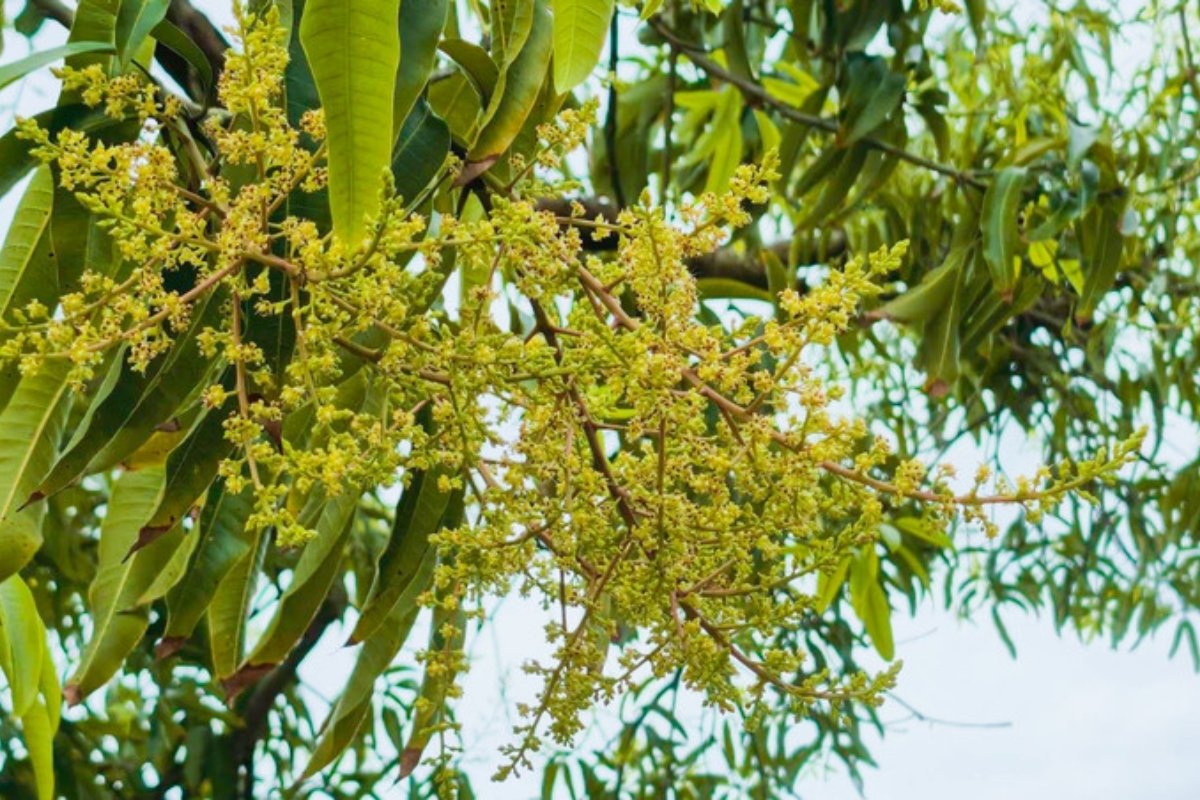
SENAMHI monitors mango in two areas of Alto Piura, Chulucanas and El Bigote, and publishes its observations in its weekly agrometeorological impact report for the Peruvian coast. In the report for 23 to 29 June, Edward was at fruit set, Criollo was flowering and Kent was in vegetative growth, and the service noted that above-normal temperatures, together with irrigation, were promoting excessive flushes of new leaves and raising the trees' water demand. Kent stayed in vegetative growth in the reports for 30 June to 6 July, 21 to 27 July, 4 to 10 August, 11 to 17 August and 1 to 7 September, each time with temperatures above normal.
In the week of 4 to 10 August, with Edward in fruit development on 70% of the plot, SENAMHI recorded abnormal fruit drop in Chulucanas and El Bigote and attributed it to rising temperatures. In early September Edward was being harvested green, and in the reports for 8 to 21 September the service recorded a new wave of flowering in Edward, probably due to a slight drop in night temperatures, and noted that this could make the phenological stages in the orchards less uniform. After 7 September the Piura reports mention only Edward, and no report up to early November records Kent flowering in Piura.
July to September nights were the warmest in NASA's Piura data since 1991
On the grid of NASA's POWER service, which gives estimates for cells of about half a degree, the average minimum temperature from July to September 2026 in the Piura cell was 21.92 °C, 4.1 °C above the 1991 to 2020 average and the highest in the 36 years from 1991. Next come 1997 with 21.14 °C and 2023 with 20.61 °C, the only other years above 20 °C, while the average maximum for the same three months reached 35.0 °C this year against 32.1 °C on average, the second highest after 1997. Grid values are estimates for the whole cell rather than station measurements, and they agree with SENAMHI's weekly reports, which describe temperatures above normal in Alto Piura throughout the period.
SENAMHI gives 13 to 18 °C as the optimal minimum temperature for Kent floral induction
In the tables that accompany its observations of Kent at the Pasabar and Tongorrape stations in Lambayeque, the second northern mango area it monitors, SENAMHI lists the optimal thermal requirement as a minimum of 13 to 18 °C for the floral induction period, a maximum of 30 to 33 °C for flowering and a maximum of 27 to 36 °C for fruit development. The July to September average minimum in the Piura cell, about 21.9 °C, was above that range, with the caveat that the range refers to the Lambayeque stations and that SENAMHI nowhere states that Kent in Piura failed to go through induction. For Lambayeque, in the reports for 7 to 13 July and from early to late August, the service wrote that the high temperatures, which it associates with the influence of El Niño, could delay the floral induction phase. Likewise, cool nights trigger mango flowering in Australia's Northern Territory, where the harvest ran late this season, one with fewer cool nights than normal.
Kent in Lambayeque flowered in September with a low flowering rate
At the Pasabar station Kent was still in vegetative growth in the week of 25 to 31 August, with temperatures from 17.4 to 35.1 °C, above normal, as in the previous week with 18.9 to 31.8 °C. In the report for 8 to 14 September it was flowering, with an average maximum of 32.2 °C and an average minimum of 20.8 °C, and SENAMHI noted that night temperatures had not favoured floral induction and development, so the percentage of flowering was still low. In the week of 20 to 26 October Kent was at fruit set at both Lambayeque stations, and at Pasabar the minimum temperature was 24.1 °C, higher than usual, while the maximum, 33.0 °C, was slightly above normal, and the service noted that the high temperatures, which it associates with coastal El Niño, raised the crop's water needs.
October rain may raise the risk of anthracnose in Piura
In the week of 13 to 19 October Edward in Chulucanas was in fruit development and harvesting was under way in parts of El Bigote and Chulucanas, with temperatures from 22.6 to 37.4 °C and 6.2 mm of rain at the station, and SENAMHI wrote that the rain, together with the warm conditions, could raise the risk of anthracnose, a disease that affects the fruit. From late October the service issued a series of red warnings for rain on the northern coast and in the highlands, for 27 to 29 October, 30 October to 1 November and 4 to 6 November, then for rain on the coast and in the highlands for 6 to 8 and 9 to 11 November, together with a red warning for higher daytime temperatures from 9 to 12 November.
In its statement of 16 October, ENFEN judged it most likely that coastal El Niño would stay at "extraordinary" magnitude until January 2027 and then ease to strong and last until early southern hemisphere autumn 2027, while in the central Pacific sea surface temperatures would stay at very strong magnitude until February 2027, as part of the strong El Niño developing this year. For the rest of 2026 the commission expected rain to rise gradually above normal on the northern coast, flows above normal from November in the Tumbes, Chira and Piura rivers and air temperatures far above normal along the whole coast, with possible new records, and it noted that the high temperatures and the changes in rainfall should be taken into account for their possible effects on crops.
EU mango imports from Peru fell 59.7% in 2023/24
From October to March in each winter from 2015/16 to 2022/23, the EU imported between 62,283 and 105,110 tonnes from Peru under the mango code, 46.1% to 54.2% of its imports from non-EU countries, Eurostat data show. From October 2023 to March 2024, after the hot southern hemisphere winter in Peru, imports from the country fell from 96,333 to 38,800 tonnes, down 59.7%, while the average import value rose from 1.48 to 3.19 euros per kilo, about 2.15 times higher. Total EU imports from non-EU countries fell 18.9% to 160,484 tonnes, with an average value of €2.10 per kilo against €1.48, as Brazil raised its shipments by 20.0% to 111,940 tonnes and supplied 69.8% of imports.
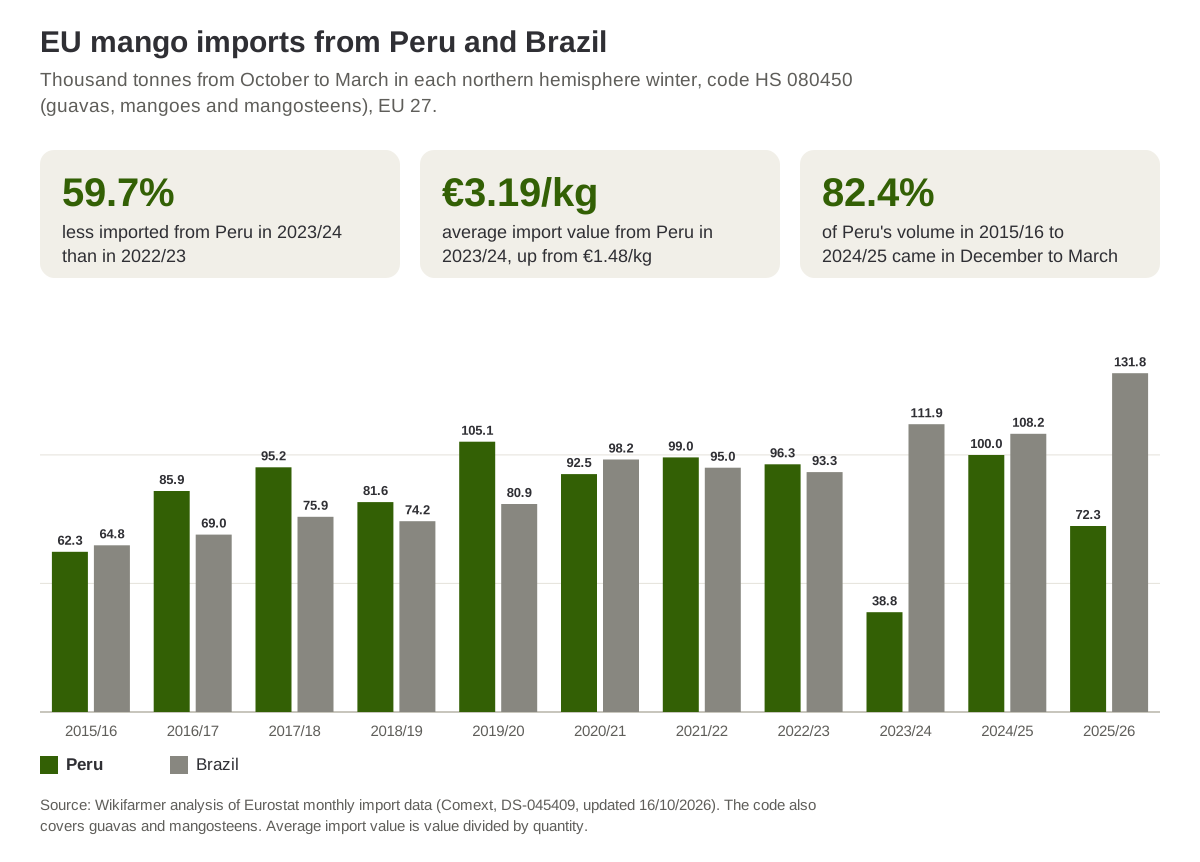
Source: Wikifarmer analysis of Eurostat monthly import data (Comext, DS-045409, updated 16/10/2026). Code HS 080450 also covers guavas and mangosteens.
The following winter, 2024/25, Peru returned to 99,959 tonnes, while in 2025/26 it shipped 72,322 tonnes, 33.6% of imports, with Brazil at 131,770 tonnes. The comparison with 2023 rests on a single earlier year with such warm nights within Eurostat's EU 27 series, which starts in 1999, so it shows what coincided the last time rather than a rule. In 2015, with an average minimum of 19.26 °C in the same three months, imports from Peru rose in the following winter, from 44,573 to 62,283 tonnes, and none of the official sources used here attributes the 2023/24 fall to temperatures.
EU buyers rely on Peru from December to March
From December to March the EU received 82.4% of all the volume Peru shipped to the EU in 2015/16 to 2024/25, between 78.2% and 93.9% depending on the year, Eurostat data show, so flowering during Peru's past winter matters directly to European importers and retailers for the next four months. In 2023/24 the gap was partly filled by Brazil, and the average import value rose for all origins combined. For growers in Peru, SENAMHI's reports point to higher water needs and the risk of anthracnose while the rain and heat continue.
The official sources examined by Wikifarmer up to 10 November, namely SENAMHI's reports and warnings, ENFEN's statement and Eurostat data, contain no estimate of the volume of this season's mango production or exports in Peru. Later SENAMHI reports on Kent flowering in Piura, an official estimate from the Ministry of Agrarian Development and Irrigation (MIDAGRI) or the plant health certification service (SENASA), and Eurostat import data for December to March, published with a lag of about two months, will complete the picture.
Frequently asked questions
Why does heat affect mango flowering?
SENAMHI gives an optimal minimum temperature of 13 to 18 °C for floral induction in the Kent variety, and this year it wrote for Lambayeque that the high temperatures associated with El Niño could delay induction. The government of Australia's Northern Territory describes the same effect, writing that cool night temperatures trigger mango flowering.
Did mango flower in Piura this year?
The Criollo and Edward varieties flowered, Criollo in late June and Edward with a new wave of flowering in September, according to SENAMHI. Kent was recorded in vegetative growth until 7 September, and no later report up to early November mentions Kent flowering in Piura.
When does Peruvian mango reach Europe?
In 2015/16 to 2024/25, 82.4% of all the volume Peru shipped to the EU arrived from December to March, between 78.2% and 93.9% depending on the year, with the peak in January, February and March, Eurostat data show.
What happened to imports the last time Peru's winter was this warm?
After the warm winter of 2023, EU imports from Peru from October 2023 to March 2024 fell by 59.7% to 38,800 tonnes, and the average import value rose from €1.48 to €3.19 per kilo, while Brazil raised its shipments by 20.0%. This is a single case, so it sets no rule for this year.
Important notes
Wikifarmer took the temperatures from the daily data of NASA's POWER service for the cell of about half a degree that contains the point 5.2° S, 80.6° W near the city of Piura, and the average refers to 1991 to 2020, so the values are estimates for the area rather than station measurements. The grid's October rainfall differs widely from SENAMHI's measurement at Chulucanas and is therefore not used. Phenological stages and thermal requirements come from SENAMHI's weekly agrometeorological impact reports for the Peruvian coast from 23 June to 2 November 2026, and the 13 to 18 °C range refers to the Lambayeque stations. The areas covered by each SENAMHI red warning were not examined one by one. Imports refer to the EU 27 and code HS 080450, which also covers guavas and mangosteens, and the average import value is the declared value divided by the quantity, not a market price. The comparison with 2023/24 rests on a single year, because Eurostat's EU 27 series starts in 1999 and leaves 1997 out, and the data show coincidence, not cause.
Sources
- SENAMHI. (2026). Reporte agrometeorológico de impactos, Región Costa, 23 al 29 de junio del 2026.
- SENAMHI. (2026). Reporte agrometeorológico de impactos, Región Costa, 30 de junio al 06 de julio del 2026.
- SENAMHI. (2026). Reporte agrometeorológico de impactos, Región Costa, 07 al 13 de julio del 2026.
- SENAMHI. (2026). Reporte agrometeorológico de impactos, Región Costa, 21 al 27 de julio del 2026.
- SENAMHI. (2026). Reporte agrometeorológico de impactos, Región Costa, 04 al 10 de agosto del 2026.
- SENAMHI. (2026). Reporte agrometeorológico de impactos, Región Costa, 11 al 17 de agosto del 2026.
- SENAMHI. (2026). Reporte agrometeorológico de impactos, Región Costa, 18 al 24 de agosto del 2026.
- SENAMHI. (2026). Reporte agrometeorológico de impactos, Región Costa, 25 al 31 de agosto del 2026.
- SENAMHI. (2026). Reporte agrometeorológico de impactos, Región Costa, 01 al 07 de septiembre del 2026.
- SENAMHI. (2026). Reporte agrometeorológico de impactos, Región Costa, 08 al 14 de septiembre del 2026.
- SENAMHI. (2026). Reporte agrometeorológico de impactos, Región Costa, 15 al 21 de septiembre del 2026.
- SENAMHI. (2026). Reporte agrometeorológico de impactos, Región Costa, 13 al 19 de octubre del 2026.
- SENAMHI. (2026). Reporte agrometeorológico de impactos, Región Costa, 20 al 26 de octubre del 2026.
- SENAMHI. (2026). Reporte agrometeorológico de impactos, Región Costa, 27 de octubre al 02 de noviembre del 2026.
- SENAMHI. (2026). Avisos meteorológicos a nivel nacional, accessed 9 November 2026.
- ENFEN. (2026, 16 October). Comunicado Oficial ENFEN N°18-2026, Alerta de El Niño Costero.
- Northern Territory Government, Department of Primary Industry and Resources. (2017). Manipulation of mango flowering.
- NASA Langley Research Center. (2026). POWER daily point data, T2M_MIN and T2M_MAX, 1991 to 2026, retrieved 23 October and 9 November 2026.
- Eurostat. (2026). EU trade since 1988 by HS2-4-6 and CN8 (DS-045409), EU 27 imports under code 080450, updated 16 October 2026.