
In March 2026 the Tindal station of the Australian Bureau of Meteorology (BoM), near Katherine, recorded 509.6 mm of rain, the highest March total in its record, while from May to August it had only 36 nights with a minimum temperature below 15 °C, against an average of 61.6 for 1991 to 2020, according to a Wikifarmer analysis of BoM data. In October the trade press attributed this season's mango delay in some major Australian producing areas to rain. The stations confirm very heavy wet-season rain, but they also show a dry season with far fewer cool nights than normal, and the Northern Territory government writes that cool night temperatures trigger mango flowering.
Trade press attributes the delay to rain
FreshFruitPortal reported on 20 October 2026 that the ripening and market availability of mangoes in some major Australian producing areas were significantly delayed by abnormal weather, that in the north rainfall had delayed blossoms, and that, according to local growers, this season started later than in any year since 2008, without naming its sources. Earlier, on 24 August, Marie Piccone of Manbulloo told FreshPlaza that the company's farms had been flowering since early June, but that its Katherine farms were then having a big flowering of the main varieties, KP and R2, much later than usual. She said it was the latest major flowering she had seen since around 2008.
Piccone believed the unusually long wet season may have contributed, while stressing that this was speculation. She said there had been a lot of rain, that the wet season had lasted until the end of April, and that temperatures and other conditions changed after it ended. KP stands for the Kensington Pride variety, also known as Kensington, the variety that ELGO-DIMITRA also evaluated in a greenhouse in western Crete.
Katherine had the wettest March in its station record
Tindal received 1,140.0 mm of rain from January to March 2026, against a 1991 to 2020 average of 667.1 mm, the second-highest total in the 44 years with complete data since 1970, and March alone brought 509.6 mm, against an average of 172.6 mm, the highest March total in the same 44 years. The March value has not yet passed BoM quality control. At Darwin Airport March brought 515.2 mm, against an average of 313.7 mm, the ninth-highest March total in 86 years, so the stations confirm the heavy wet-season rain that growers describe.
From April onwards rainfall was minimal
April 2026 brought 0.8 mm at Tindal, against an average of 39.75 mm, May to August brought 0.2 mm, and September had no rain. At Katherine the dry season is normally almost rainless, with a May to August average of 4.6 mm, so 2026 was not materially different from usual in those months. At Darwin Airport May to August brought 5.2 mm, against an average of 24.6 mm, and April has incomplete data. According to the fact sheet of the Australian Mango Industry Association, Northern Territory mangoes flower in the cool-season months from April to August, so the rain the trade press refers to fell before the flowering period.
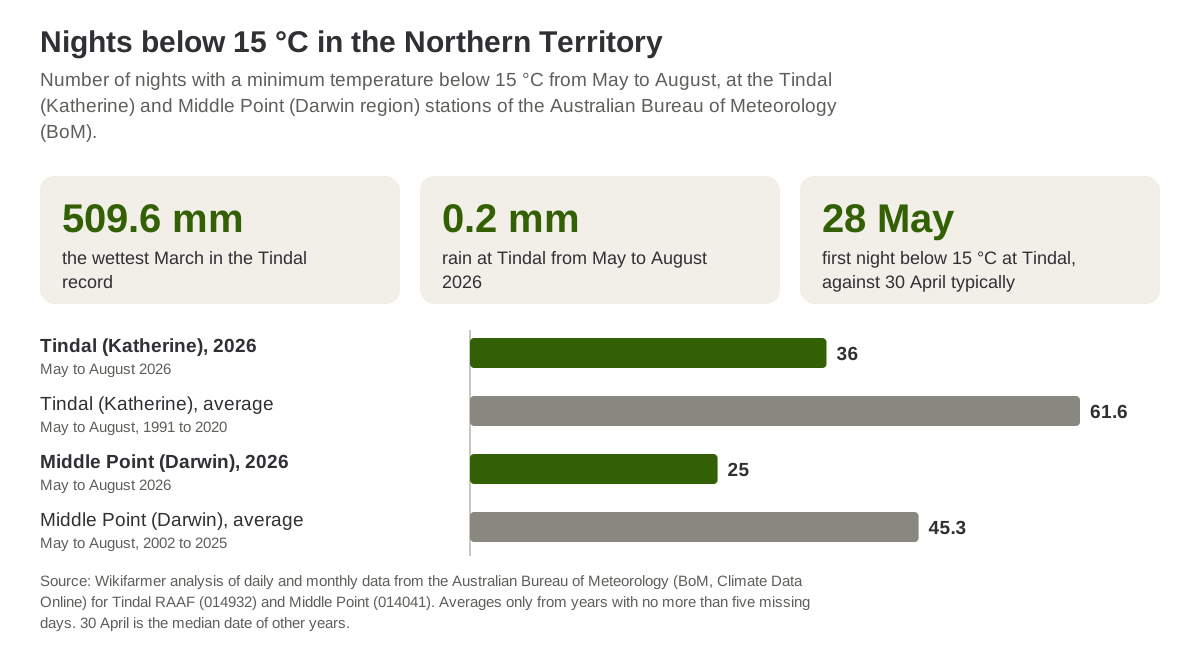
Source: Wikifarmer analysis of daily and monthly data from the Australian Bureau of Meteorology (BoM, Climate Data Online) for the Tindal (Katherine) and Middle Point (Darwin region) stations.
Katherine had 36 nights below 15 °C against an average of 61.6
The 36 nights with a minimum temperature below 15 °C at Tindal from May to August 2026 were among the fewest in the station record: of 34 years with no more than five missing days in those four months, only 1986 and 1993 had fewer, with 29 each. The first such night of the dry season came on 28 May, while the median date in other years is around 30 April, and in only a few years, such as 1993 and 2016, did it come later. At Middle Point, the station the industry fact sheet uses for the Darwin region, there were 25 nights below 15 °C, against an average of 45.3 for 2002 to 2025, and only 2017 had fewer, with 24, while the first cool night came on 28 May, close to the median date of other years. The mean minimum temperature from May to August was 16.2 °C at Tindal, 1.3 °C above the 1991 to 2020 average, and about 21.3 °C at Darwin Airport, 1.0 °C above average.
The Northern Territory government links flowering to cool nights
In a fact sheet on the manipulation of mango flowering, the Northern Territory Department of Primary Industry and Resources writes that cool night temperatures trigger mango flowering and that in 2016 the cool weather took much longer than usual to arrive in the dry season, which resulted in a late mango season. It also notes that such warm starts to the dry season could be correlated with poor production seasons, and that its 2016 research may indicate a high-temperature inhibition of flowering as well as a low-temperature requirement. According to the industry fact sheet, the production cycle in the Northern Territory is dictated by the arrival of cool-season weather between April and August, which can vary from year to year, and changes to the timing of its arrival change the timing of flowering.
In 2008, the season the growers in these reports use for comparison, Tindal had 81 nights below 15 °C from May to August and its first cool night as early as 18 April, while Middle Point had 64, so a late season does not always come with few cool nights.
Wet-season rain encourages vegetative growth in the trees
According to the industry fact sheet, the warm temperatures of the off-season, from December to March, coincide with monsoonal rainfall, which encourages vegetative growth and tree recovery, and this is when carbohydrate reserves for flowering build up. The same fact sheet lists, as the first key practice for flower induction, preventing new vegetative growth immediately before flowering by limiting irrigation and avoiding nitrogen fertilisers. Station data do not show how much new growth the orchards had before flowering, so they cannot test whether the March rain affected flowering through vegetative growth. The data show that this season's delay coincided with very heavy wet-season rain and with few cool nights in the dry season, without showing which of the two, or some other factor, caused it.
No official estimate of this season's production exists yet
The official sources Wikifarmer examined up to 27 October, namely BoM data and the Northern Territory government fact sheet, contain no estimate of this season's mango volume. FreshFruitPortal notes that the problem stems primarily from the delayed market entry of northern production rather than from a confirmed significant reduction, and, without naming its source, reports a forecast of about 8.2 million 7-kg boxes for Australia in 2026/27, of which 2.3 million are for Darwin and 2 million for Katherine. According to the industry fact sheet, the Northern Territory harvest usually starts around August in the Darwin region and continues into December in Katherine and Mataranka, so the flowering delay carries over into harvest, post-harvest handling of mangoes and fruit supply. FreshFruitPortal adds that the region's fruit normally reaches southern city markets from September, while this year the initial supply has been relatively limited. For growers, the industry fact sheet notes that the onset of cool weather, brought by cool dry south-easterly air streams from high-pressure systems in southern Australia, can be observed and forecast on BoM wind maps.
Frequently asked questions
Why is the Northern Territory mango harvest late this year?
The trade press, citing growers, attributes the delay to rain. BoM data show very heavy wet-season rain up to March and then a dry season with fewer cool nights than normal, and the Northern Territory government writes that cool nights trigger flowering. The data do not show which factor caused the delay.
Did it rain during flowering?
Hardly at all. From May to August 2026 Tindal recorded 0.2 mm and Darwin Airport 5.2 mm, while April brought 0.8 mm at Tindal. The heavy rain fell from January to March.
How many cool nights did Katherine have this year?
From May to August Tindal recorded 36 nights with a minimum temperature below 15 °C, against a 1991 to 2020 average of 61.6, and the first came on 28 May.
Will this season's production be smaller?
In the sources Wikifarmer examined there is no official estimate of volume, while FreshFruitPortal reports a forecast of about 8.2 million 7-kg boxes nationally and notes that the problem is primarily a delayed market entry. The Northern Territory government fact sheet notes that warm starts to the dry season could be correlated with poor production seasons.
Important notes
Wikifarmer analysed daily minimum temperature and monthly rainfall data from the Australian Bureau of Meteorology (BoM, Climate Data Online) for Tindal RAAF (014932) in Katherine, Middle Point (014041) in the Darwin region and Darwin Airport (014015). The 15 °C threshold is the one used in the Northern Territory government fact sheet, and Wikifarmer's counts are not comparable with the fact sheet's table, which does not name its station. Cool-night comparisons include only years with no more than five missing days from May to August, and the first-cool-night comparison only years with no more than five missing days from March to July, so years with larger gaps, such as 2010, are excluded. Tindal's 1991 to 2020 rainfall average is based on 26 years with complete data, and Middle Point has data from 2001, so its average covers 2002 to 2025. The data show coincidence, not cause. The claims about the late season and the 8.2 million-box forecast come from the trade press, without an official source. The Australian Mango Industry Association fact sheet is an industry publication.
Sources
- Bureau of Meteorology. (2026). Climate Data Online, daily minimum temperature and monthly rainfall for Tindal RAAF (014932), Middle Point (014041) and Darwin Airport (014015), retrieved 23 and 27 October 2026.
- Northern Territory Government, Department of Primary Industry and Resources. (n.d., data to 2016). Manipulation of mango flowering.
- Australian Mango Industry Association. (n.d.). Mango flowering in the Northern Territory.
- Gutiérrez G., S. (2026, 20 October). Weather disruptions delay mango season in Australia. FreshFruitPortal.
- FreshPlaza. (2026, 24 August). NT mangoes set to be late after unusual flowering.