Coffee and cocoa both reached prices in 2024 and 2025 that neither market had ever seen in nominal terms. A new FAO study, Price dynamics in global beverage markets, sets out why, and the answer is more ordinary than speculation or currency swings. Across coffee, cocoa and tea, shifts in supply and demand explain more than 90% of short-run price movements, with market uncertainty amplifying them and macroeconomic factors playing only a minor part. In plain terms, the harvests fell short while demand kept climbing, and thin stocks turned each weather scare into a price spike.
Two features make these crops unusually prone to those spikes. Production is concentrated in a handful of countries, so a bad season in one origin moves the whole market, and the beans themselves are highly weather-sensitive perennials that cannot be replanted quickly when a crop is lost. When those two facts meet a run of droughts, frosts and disease, prices do exactly what they did over the past three years.
Key takeaways
- Supply and demand did the work. Across coffee, cocoa and tea, production and consumption shifts explain more than 90% of short-run price volatility, while macroeconomic factors play a limited role.
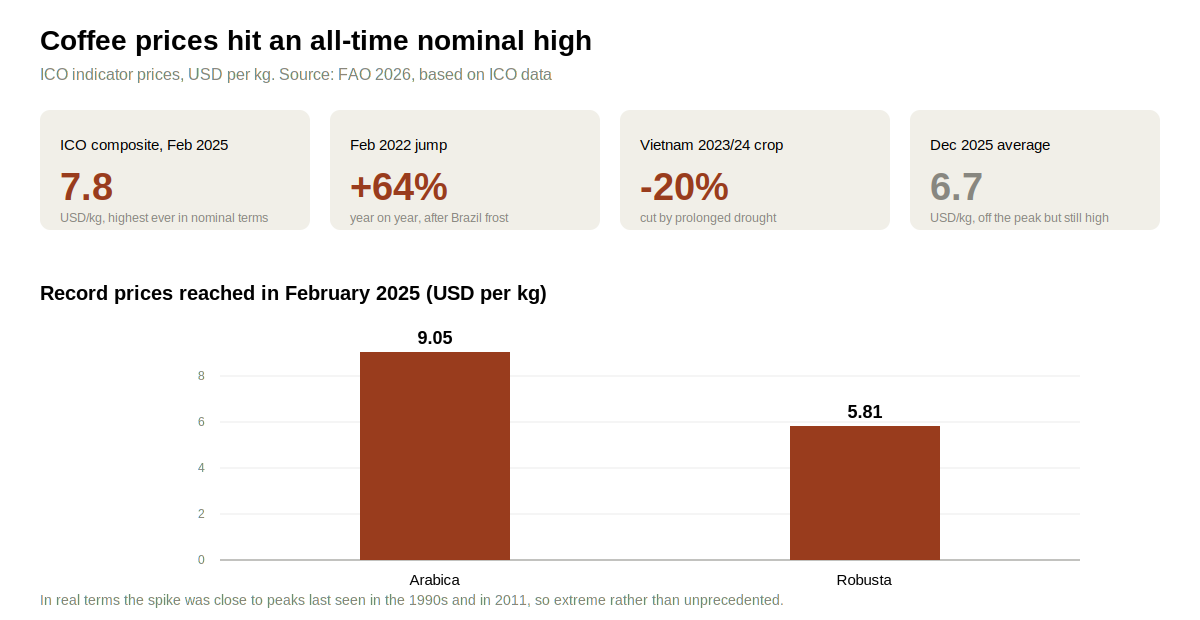
- Coffee set a nominal record. The ICO composite price reached USD 7.8/kg in February 2025, its highest ever in nominal terms, with the Arabica and Robusta indicators peaking at 9.05 and 5.81 USD/kg.
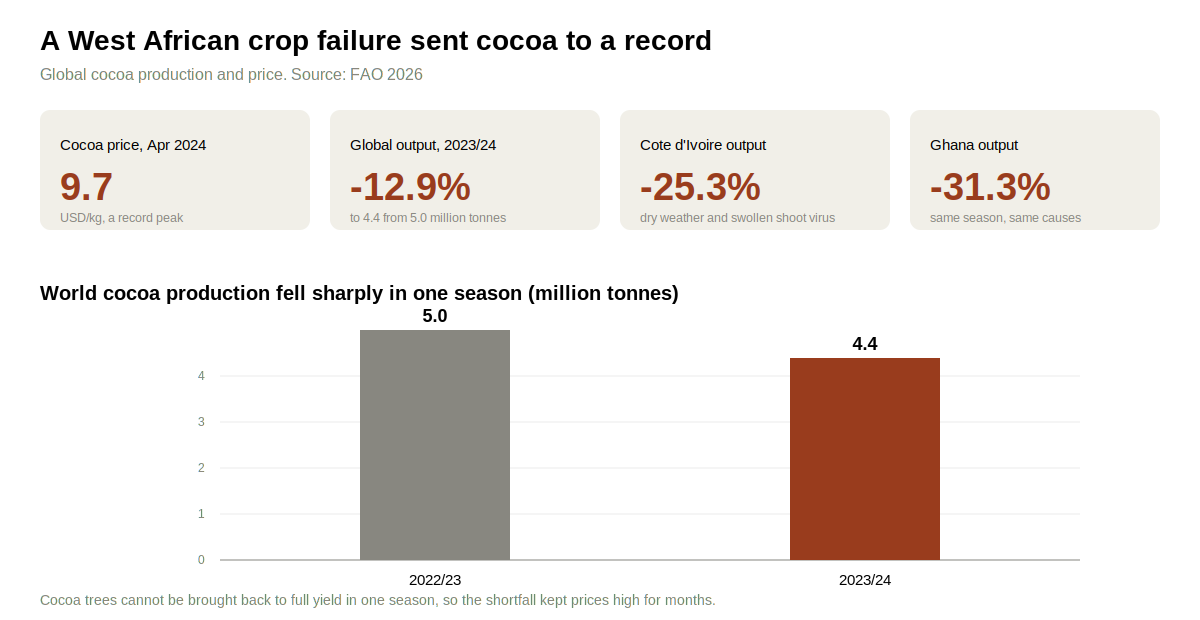
- Cocoa's rise was even sharper. Prices climbed to USD 9.7/kg in April 2024 after global production fell 12.9% in a single season, and to an all-time high of USD 10.7/kg in January 2025.
- West Africa drove the cocoa shock. Output dropped 25.3% in Côte d'Ivoire and 31.3% in Ghana, hit by dry weather and the cocoa swollen shoot virus.
- Low stocks made everything worse. When inventories are thin, even a small disruption produces a large price move.
Beverage prices outran the rest of farming
Over recent years coffee and cocoa prices rose much faster than other agricultural commodities. The reason sits in their structure. Coffee production leans heavily on Brazil and Vietnam, which together account for close to half of the world crop, while cocoa depends on West Africa, with Côte d'Ivoire alone handling around 30% of global trade and Ghana the next largest source. That concentration means the world has little to fall back on when one major origin has a poor year. At the same time demand has kept rising, with coffee consumption growing fast across Asia and chocolate demand steady in Europe and North America, so any dip in supply meets a market that is not shrinking to match.
What pushed coffee to an all-time high
Coffee's climb came in two waves. The first followed dry weather and frost in the key producing state of Minas Gerais in Brazil during 2021, which cut the Arabica crop and pushed prices to a multi-year high by February 2022, around 64% above their level a year earlier. Prices eased through 2022 and 2023, then surged again from late 2023 as drought hit Brazil and Vietnam once more. Prolonged dry weather cut Vietnam's 2023/24 crop by about 20%, tightening the supply of Robusta at the same time as Arabica stayed short.
By February 2025 the ICO composite price stood at USD 7.8/kg, the highest nominal figure the index has ever recorded, with Arabica and Robusta peaking at 9.05 and 5.81 USD/kg. The nominal record comes with one important qualification. Adjusted for inflation, the spike sat only a little above levels seen in the 1990s and in 2011, so this was an extreme move rather than an unprecedented one in real terms. After the February peak prices drifted down, averaging USD 6.7/kg by December 2025, still about 2% above their already high level a year earlier.
What sent cocoa to a record
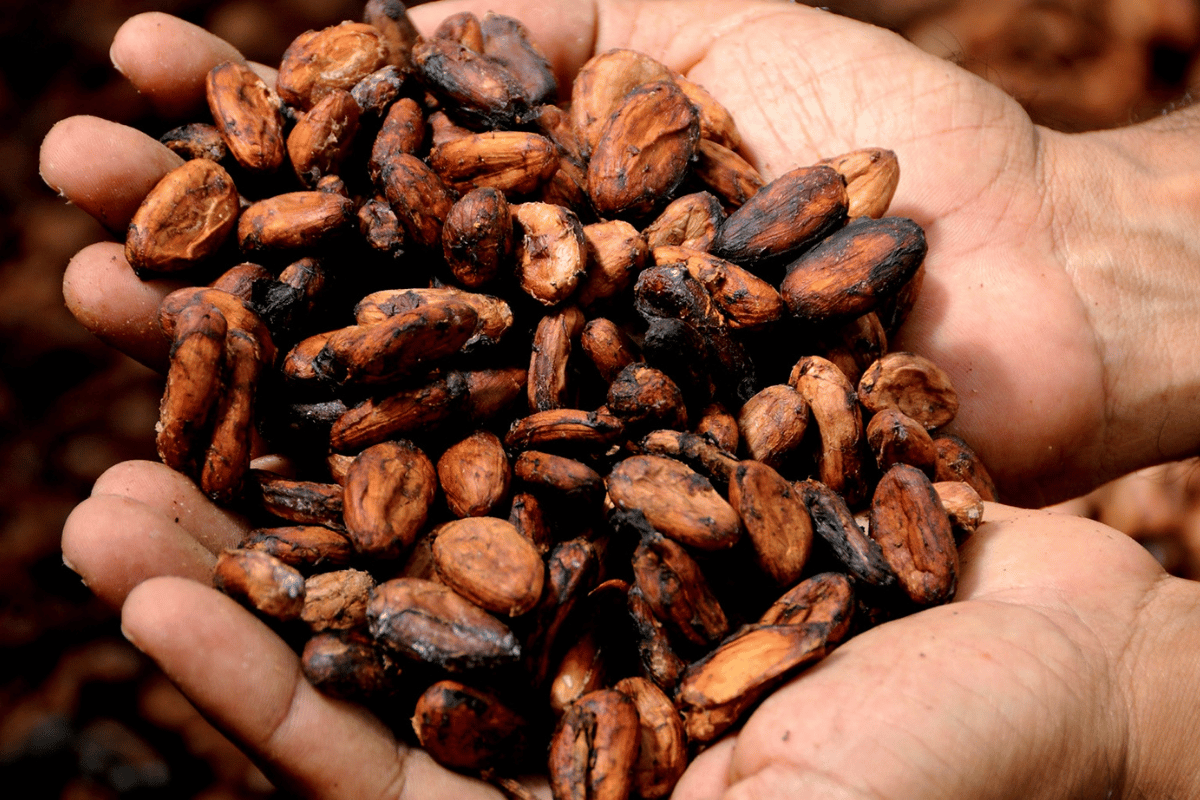
Cocoa's surge was steeper and more concentrated in a single cause. The rally began in 2023 and reached a first peak of USD 9.7/kg in April 2024, driven by a sharp shortfall in West Africa. Global cocoa production fell 12.9% in the 2023/24 season, down to 4.4 million tonnes from 5.0 million the year before, opening a large gap between what was grown and what the chocolate industry needed to grind. Almost all of that decline came from two countries, with output dropping 25.3% in Côte d'Ivoire and 31.3% in Ghana. Both were hurt by dry weather and by the spread of the cocoa swollen shoot virus, a disease that permanently reduces the yield of infected trees and forces growers to cut and replant.
Because cocoa cannot be replanted and brought back to full yield in a single season, that kind of loss takes time to repair, which is why the price stayed high for months rather than snapping back. Prices eased after April as weather improved and the 2024/25 crop was forecast to recover by more than 10%. They rebounded in late 2024, when dry weather in Côte d'Ivoire and Ghana revived fears for the crop, and reached an all-time high of USD 10.7/kg in January 2025.
Concentrated supply, rising demand and thin stocks
The common thread across both crops is that fundamentals, not financial forces, set the price. The FAO analysis finds that production and consumption shifts account for more than 90% of the short-run swings in coffee, cocoa and tea, while exchange rates and broad macroeconomic conditions matter far less. Weather is the primary trigger, with droughts, frosts and excessive rain the usual starting point, joined by plant disease, higher input and labour costs, and shipping delays.
Rising demand keeps the pressure on. Coffee consumption has expanded quickly in Asia and other emerging markets, cocoa grinding has grown in both consuming and producing countries, and tea drinking has risen sharply in producing countries such as China. A market that is growing on the demand side has less room to absorb a supply shock, so the same weather event moves prices more than it would have a decade ago.
Why thin stocks turned scares into spikes
Stocks are the shock absorber that was missing. When inventories are high, buyers can draw on them to ride out a poor harvest and prices stay calm. When stocks are already low, as they were going into both the coffee and cocoa runs, there is no buffer, so markets react sharply to small disruptions and expectations of further tightness feed on themselves. This is why the same-sized weather problem can pass almost unnoticed in one year and set a record in another.
For growers and buyers the practical lesson is about resilience rather than prediction. The report points to climate-resilient production, replanting and better pest and disease control to steady output, clearer information on stocks and crop conditions to curb expectation-driven spikes, and a fairer share of the final price reaching the farmers who carry most of the risk. None of that removes volatility, but it lowers how far prices swing when the next dry season arrives.