
The rain that arrived too late for Europe's summer crops has become the deciding factor for the next season. In its September bulletin, the European Commission's Joint Research Centre reported that rainfall from mid-August was beneficial for the sowing of winter cereals across much of north-western and central Europe, while south-western and south-eastern Europe received little of it. Dry soils there increasingly affect the establishment of winter rapeseed, and the bulletin warns that dry weather forecast for central and south-eastern Europe may further constrain the establishment of winter crops.
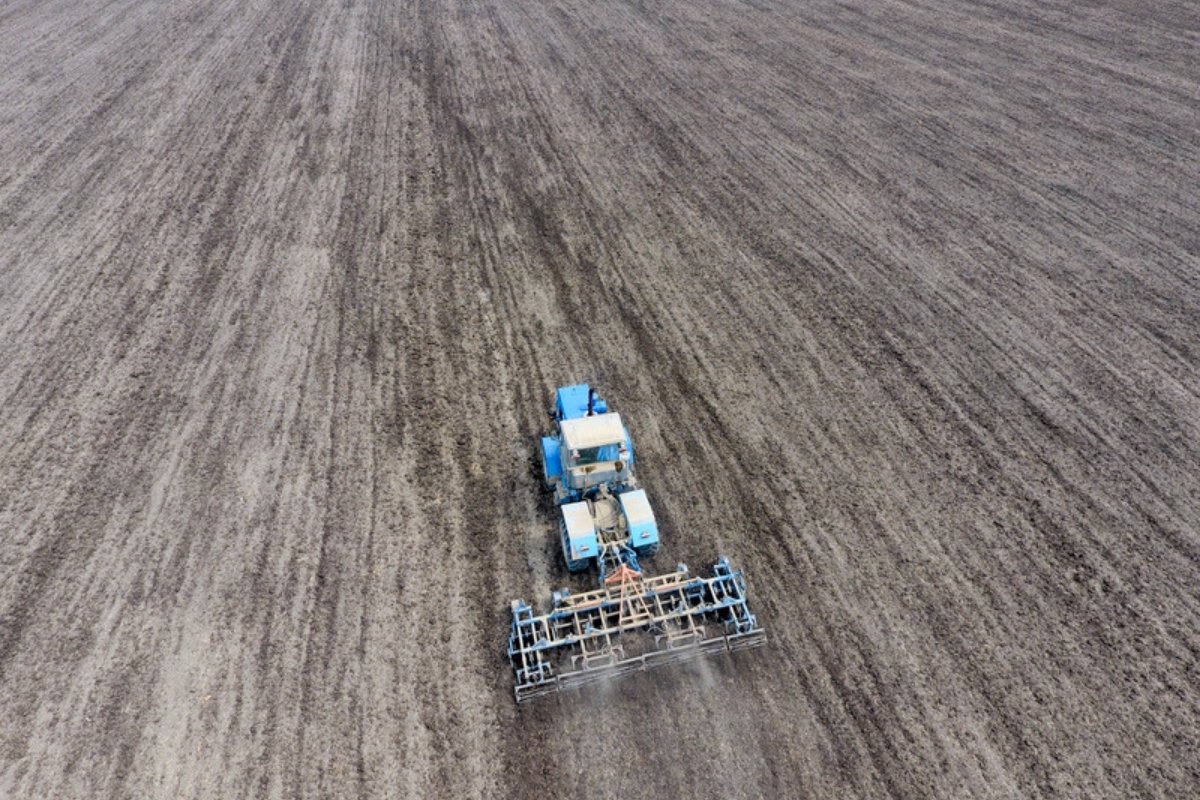
The timing is what makes this matter now. Rapeseed is sown from late August into September and has to emerge before the cold, so it is the first crop to feel a dry autumn. Winter wheat and barley are sown in October, and in Greece, the sowing season runs from early October to mid-January. Most of those fields are rainfed, which means the decision of when to sow depends almost entirely on how much moisture the soil holds and how much rain is on the way.
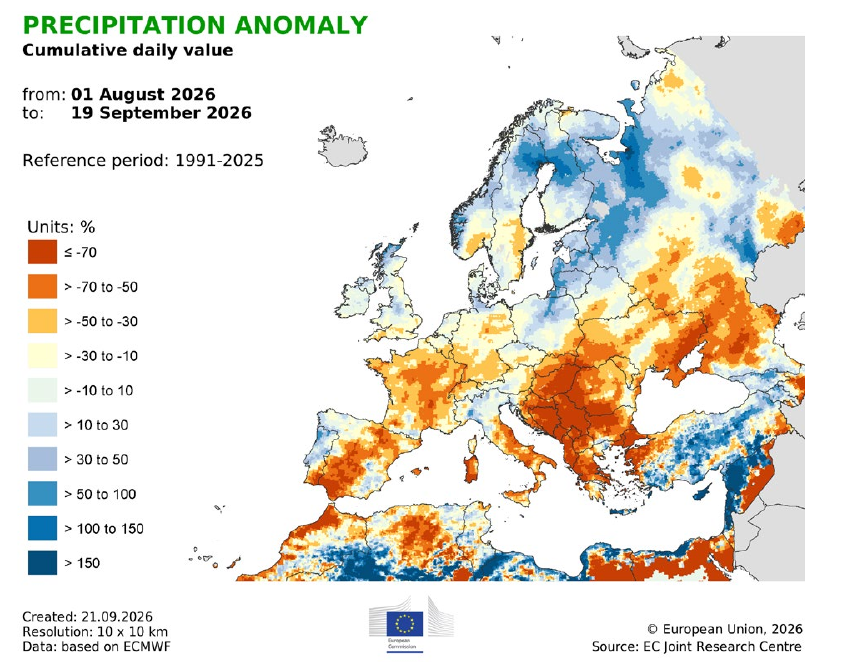
Rainfall from 1 August to 19 September 2026 against the 1991 to 2025 average. Deficits of 50% to more than 70% cover Hungary, much of the Balkans and parts of Romania, Italy, France and Spain, while northern and north-eastern Europe recorded a surplus. Source: JRC MARS Bulletin Vol. 34 No. 8, © European Union, 2026.
Rapeseed is the first crop to feel the drought
Rapeseed needs moisture in the seedbed to germinate and a head start before winter to survive it. The French oilseed institute Terres Inovia puts the minimum at about 15 millimetres of rain to bring rapeseed up in a prepared soil, and 30 to 40 millimetres in other situations, and sets the goal of reaching the four-leaf stage before 20 September so that the plants can better withstand pest attacks. Without that rain, the seed sits in dry soil or emerges unevenly.
That is the picture the JRC describes across central and south-eastern Europe. In Hungary, soils are too dry to cultivate, seedbeds have not been prepared, and inadequate moisture has hampered or delayed rapeseed sowing, so a decrease in rapeseed area is probable as the sowing window closes in late September. Romania's rapeseed campaign started late, at the end of August, because of dry topsoil. In Bulgaria, mid-September rain raised topsoil moisture, but more is needed for rapeseed to be sown and to emerge successfully. In Austria, Czechia, and Slovakia, dry August seedbeds led to delayed or uneven emergence in some areas.
France is the partial exception. Late-August rain made winter rapeseed sowing the main positive development of the season there, with generally favourable conditions for emergence, although the JRC notes that subsoil moisture remains severely low in many areas and further rain will be needed to secure a good start. Even so, the most pessimistic professionals in the French sector predict the country's rapeseed area will fall below one million hectares, according to La France Agricole.
Winter cereals had more help from the rain
Winter cereals are sown later and benefit more from the change in weather. In Germany, dry weather and early harvests allowed rapeseed to be sown early, and the recent rain was beneficial for the remaining winter cereal sowing. In Austria, Czechia and Slovakia, an unusually early winter cereal harvest allowed an early start to the sowing campaign, and recent rainfall improved surface moisture ahead of winter cereal sowing.
The relief is incomplete. The JRC's water deficit alert still covers France, Italy, Germany, Luxembourg, southern Belgium, Austria, Czechia, Slovenia, Croatia, Slovakia, Hungary, western Romania and north-western Bulgaria, where soil moisture remains low despite lower temperatures and some rain. In all of them, dry soils are a concern for late-harvested crops and, increasingly, for the preparation and sowing of winter cereals and rapeseed.
South-eastern Europe remains the driest
The precipitation deficits of the past seven weeks were concentrated in the Balkans, with parts of southern and western Romania, Hungary, Slovakia and western and south-western Europe also affected. In most of these regions, cumulative rainfall was up to 70% below the long-term average, and the western Balkans, western Romania and Hungary recorded six to ten fewer wet days than usual.
In Greece, the JRC reports that a precipitation deficit combined with a late-August heatwave raised crop water requirements and irrigation demand over the summer. Grasslands have largely remained in summer dormancy, with only localised, limited regrowth after the September rain, a sign that the rain was not sufficient to wet the soil.
The forecast offers only a partial easing. From 2 October, the JRC expects colder-than-usual conditions in the Balkans and western Türkiye, with average temperatures locally up to 4°C below normal, and dry or limited rainfall in central-eastern Europe. For October to December, the long-range outlook points to warmer-than-average conditions across most of Europe and, with higher uncertainty, above-average rainfall in southern and western Europe during October.
Sowing into dry soil leaves three choices
For a rainfed wheat grower facing a dry field, the choice comes down to when and how deep to sow. Greek agronomic guidance treats weather as the main factor in the timing, because a crop grown without irrigation cannot carry the cost of watering, and warns that sowing too early can expose the crop to frost or drought. Evangelos Korpetis of the Hellenic Agricultural Organisation DEMETER adds that the sowing date has to account for the variety's earliness, whether the soil is heavy or light, and the area's frost risk.
The Greek advisory firm Farmacon outlines three options for dry soil. The first is to sow at the normal depth and date and wait for rain, which keeps the seed viable in the soil until moisture arrives, but requires a higher seed rate, fungicide-treated seed, and a starter fertiliser. Its risks are that a heavy downpour can erode bare soil, and that a light shower may start germination without enough follow-up rain to carry the crop through winter. The second is to sow deeper to reach moisture, which requires a variety with a long coleoptile, the protective sheath that pushes the shoot to the surface. Deeper seed takes longer to emerge, and slower emergence means more exposure to disease and pests. The third is to wait for rain and sow once the soil holds enough moisture, which works well if the rain comes within the optimal window and leaves the grower with unsown fields if it does not.
An expert quoted by La France Agricole adds a caution that applies to all three. Rushing to prepare and sow shallowly into dry soil risks the cereal and the weeds emerging at the same time, and in cloddy soil, it can be better to delay sowing than to work the ground dry. Starting with seed of verified quality and germination matters more than usual in a year when every emerged plant counts, and the erosion risk from a heavy autumn storm on bare, freshly sown fields is the same as the one already leaving much of Europe's arable land losing soil faster than it forms.
Sources
- European Commission Joint Research Centre. (2026). JRC MARS Bulletin, Crop monitoring in Europe, September 2026, Vol. 34 No. 8. 28 September 2026.
- Action Agricole Picarde. (2026). Sécheresse, de lourdes incertitudes sur les dates de semis de colza. Terres Inovia guidance, 17 August 2026.
- Terre-net. (2026). Comment sécuriser la levée des colzas dans le contexte de sécheresse. 6 August 2026.
- La France Agricole. (2026). La sécheresse pèse déjà sur la prochaine campagne. September 2026.
- Farmacon. (2026). Πότε σπέρνουμε το σιτάρι; Όταν το έδαφος είναι ξηρό ή περιμένουμε τη βροχή να έρθει;. Updated 12 September 2026.
- Agronews. Οι 5 παράγοντες στη σπορά χειμερινών σιτηρών που ορίζουν τη σοδειά.
- Agro-tec. Τεχνική καλλιέργειας του σιταριού. Ευάγγελος Κορπέτης, ΕΛΓΟ-ΔΗΜΗΤΡΑ.