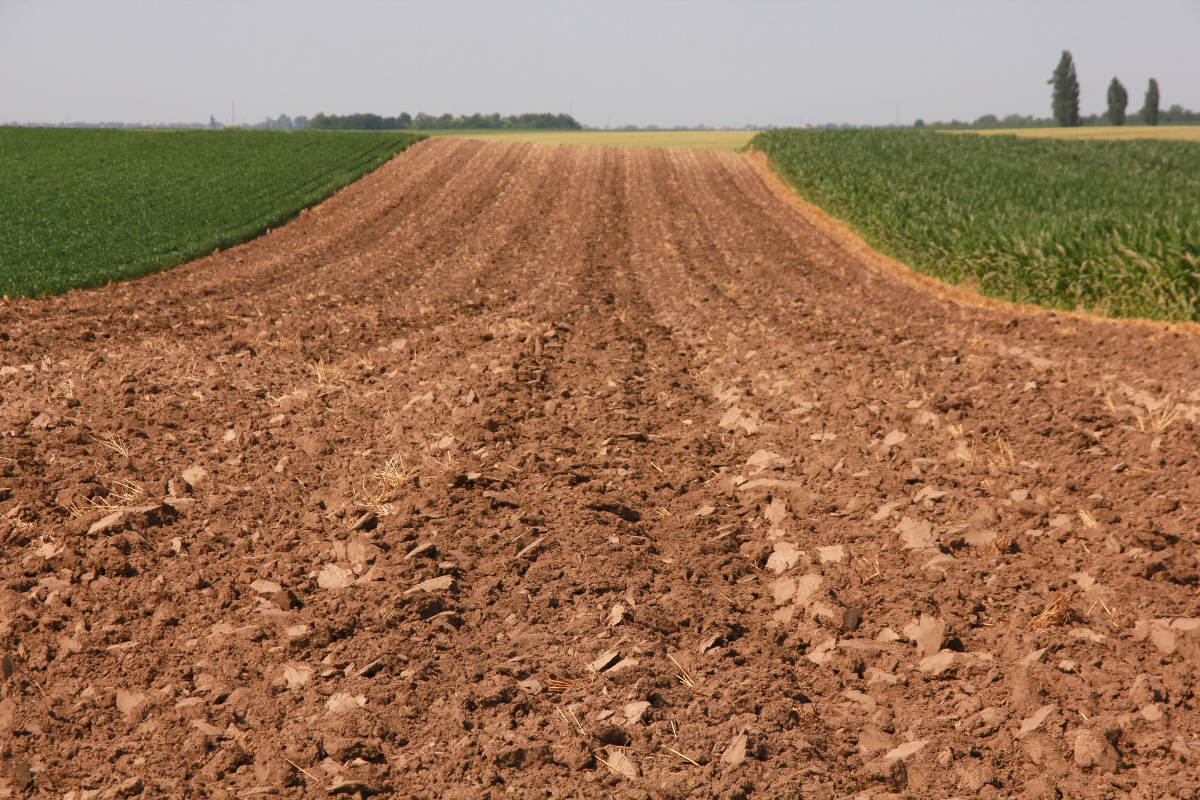
Soil is eroding at unsustainable rates on 54% of arable land across the EU and the United Kingdom, an area of roughly 55 million hectares, with 13% suffering severe erosion above 10 tonnes per hectare a year. The figures come from the Status of the World's Soil Resources 2026, published by FAO and its Intergovernmental Technical Panel on Soils, and they carry a cost estimated at EUR 1.25 billion per year due to lost productivity across the European Union.
Water erosion is the second most widespread degradation process in the EU, behind only the broad category of threats to soil biological functions. That ranking places it above nitrogen surplus, soil sealing, compaction and heavy metal contamination as a driver of unhealthy soil.
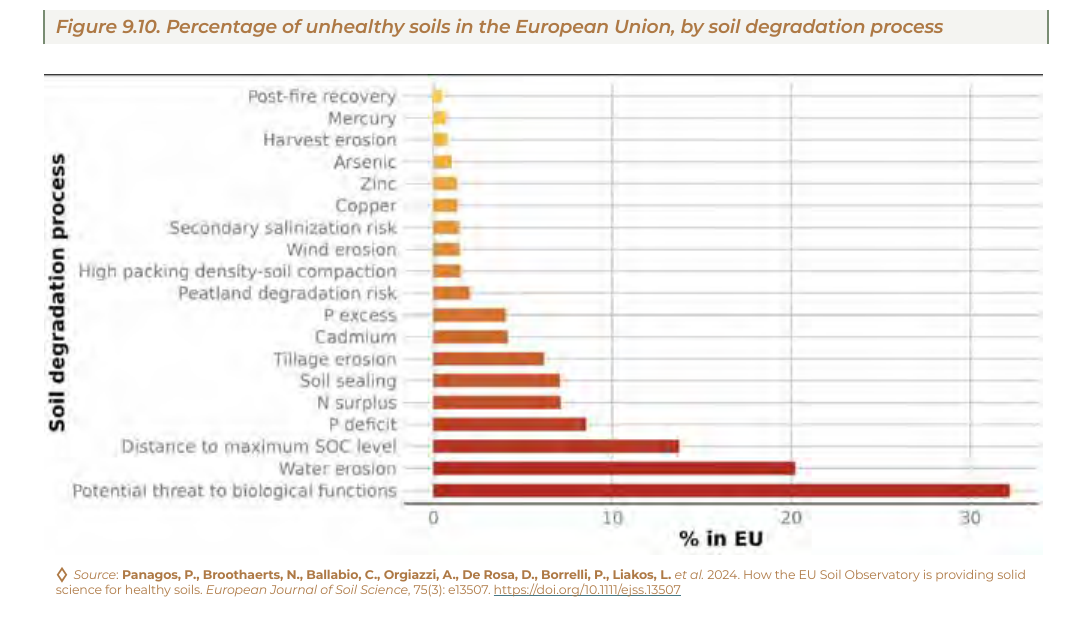
Water erosion affects around 20% of EU soils, second only to threats against soil biological functions at roughly 32%. Source: FAO and ITPS, Status of the World's Soil Resources 2026, Figure 9.10, after Panagos et al. (2024).
The north and south of Europe are not the same problem
National figures reveal a divide that the continental average hides. Erosion rates in southern Europe are far higher than those in central and northern Europe, a pattern that reflects rainfall intensity, terrain, and centuries of cultivation on slopes rather than recent management failures alone.
The numbers make the contrast concrete. Denmark reports a national mean below 3 tonnes per hectare per year, and Finland reports values between 0.1 and 1.3 tonnes per hectare per year. Italy reports a national mean of 8.4 tonnes, rising to 30.6 tonnes in Calabria, where about 13% of land experiences very severe erosion of 75-300 tonnes per hectare annually. Portugal records 10 tonnes per hectare per year, with two-thirds of the country exposed to potential losses above 6 tonnes. Hungary averages 8.74 tonnes, and at least 16% of the country exceeds 5 tonnes.
That disparity leads the report to question the tool itself. Applying a uniform 2-tonne threshold across Europe would classify all of southern Europe as severely degraded, even where erosion has accumulated over centuries of established land use. The panel raises this directly as an argument for thresholds calibrated to national circumstances rather than a single continental line.
Greece has a number for erosion and none for carbon
Greece appears in the report's country table with 700,000 hectares affected, equal to 50% of its arable land, based on national work published in 2015. Half the country's cropland carries a recognised erosion problem, and the most recent national figure available to a global assessment in 2026 is now a decade old.
On soil organic carbon, there is no figure at all. The report states plainly that no national soil organic carbon monitoring data were obtained for Cyprus, Greece, and Italy. Three Mediterranean countries, all facing the same combination of high temperatures, intense seasonal rainfall and long agricultural history, have no national record of what is happening to the carbon in their soils.
The absence matters for practical reasons rather than statistical ones. Soil organic carbon governs water-holding capacity, nutrient supply, and structural stability, which are precisely the properties that determine how a soil copes with drought and heavy rain. Without a baseline, there is no way to know whether Greek soils are gaining or losing that buffer, no way to evaluate whether a subsidised practice worked, and no evidence base for the country's position in EU soil policy discussions. Managing the balance of organic matter in soil is possible at the farm level, regardless, but doing so as national policy requires data that does not currently exist.
Reliable erosion monitoring exists in three places in Europe
Greece is not an outlier in this respect, which is the more uncomfortable finding. Across the whole of Europe, only Austria, the Wallonia region of Belgium and Finland provide reliable soil erosion monitoring data. No national soil monitoring information was obtained for Ireland, Lithuania, Luxembourg, Slovenia, or Sweden.
Continental modelling fills the gap, and the 54% figure that opens this article comes from exactly that kind of modelling rather than from measurements on European fields. The report is careful about what this means. Continental assessments identify broad patterns, regional disparities and priority areas well enough to inform policy. What they cannot do is confirm whether current farming practices are improving or worsening the situation in a given country, because the effect of management and climate on erosion remains uncertain without representative national monitoring.
Europe, therefore, knows that its soil is eroding but, in most member states, does not know whether the trend is up or down. For soil organic carbon, the same applies, with only a few countries reporting long-term trends across grassland, cropland and forestland.
What the gap means for farms in the Mediterranean
Erosion control does not wait for national statistics, and the practices that work on a slope in Greece are the same ones the report recommends everywhere. Maintaining vegetative cover through the season when the heaviest rain falls, working across the contour rather than up and down it, reducing tillage intensity, and keeping crop residues on the surface all measurably reduce soil loss. The mechanisms behind each are set out in the standard account of soil erosion causes and prevention strategies, and the accompanying gains in water infiltration matter as much as the soil retained in a climate where rainfall arrives in short, intense bursts.
The report's own conclusion for Europe is that erosion remains poorly addressed at the scale the problem requires, with the trend deteriorating and management rated inadequate across the region. Greek farms sit at the harder end of that assessment, on steeper ground with more erosive rainfall and less monitoring than almost anywhere in northern Europe. The practices are documented and available. What is missing is a measurement that would show whether they are being used and working.
Sources
- FAO and ITPS. (2026). Status of the world's soil resources 2026. Rome, FAO.