













What every farmer and landowner needs to know about one of the planet’s most urgent environmental challenges.
What is soil erosion?
Soil erosion is the wearing away of the top layer of soil — the most fertile, organic-rich, and biologically active layer — by natural forces such as wind and water, as well as human activity.
It is a natural geological process, but human actions have accelerated erosion rates by 10–40 times, turning it into a global environmental crisis.
The top few centimetres of soil can take 500–1,000 years to form, meaning once it is lost, it is effectively non-renewable on a human timescale.
What are the main types of soil erosion?
Not all erosion looks the same. Geologists and agronomists identify four primary forms:
Sheet erosion is the uniform removal of a thin layer of soil across a broad area, often invisible to the naked eye until significant damage has already occurred. It is typically caused by rainfall washing evenly across bare ground.
Rill erosion occurs when surface water concentrates into small, defined channels — rills — that cut into the soil. These are repairable with cultivation but signal that sheet erosion has progressed.
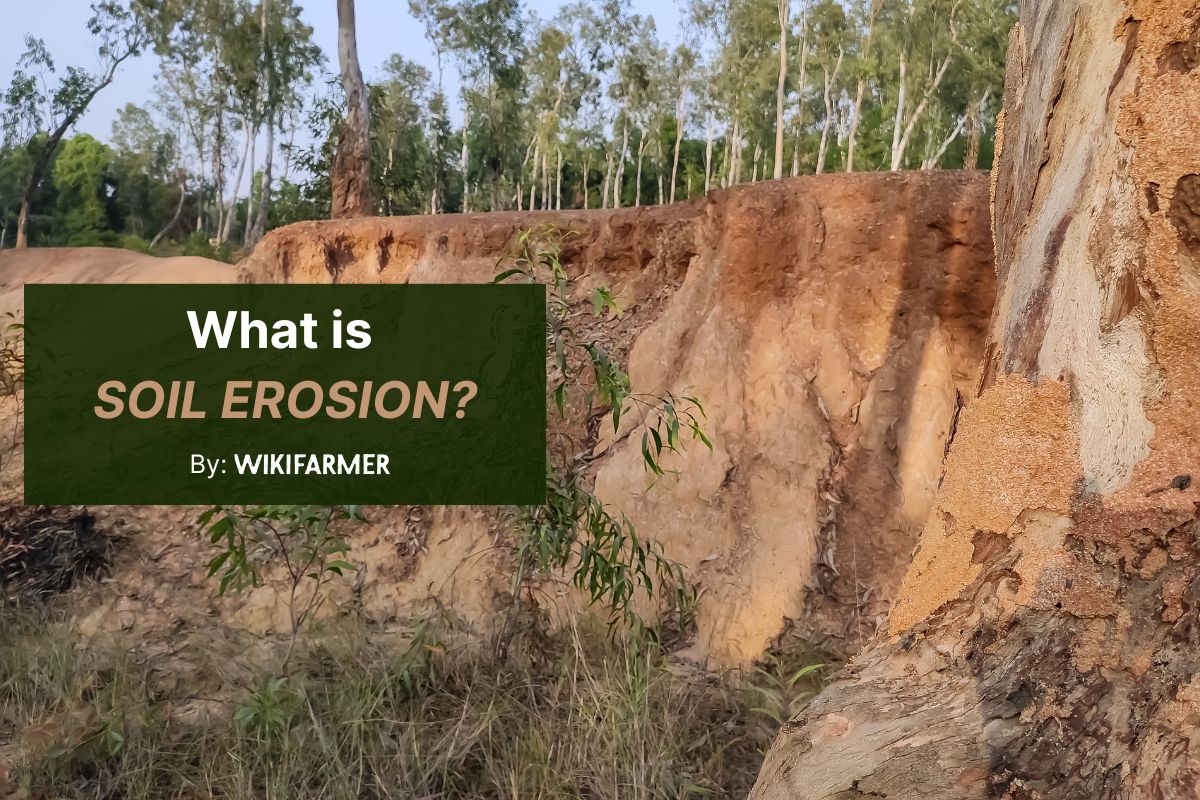
Gully erosion is the advanced stage of rill erosion, where channels deepen into permanent gullies that cannot be farmed across. It is the most visually dramatic and most difficult to reverse.
Wind erosion occurs in dry or arid regions when strong winds lift fine soil particles and carry them over long distances. This is the mechanism behind dust bowls, and it can strip topsoil from vast areas in a single storm event.
What are the main causes of soil erosion?
Soil erosion has both natural and human-driven causes, and they almost always work together.
Natural causes
- Water runoff and rainfall: Heavy rainfall is one of the most powerful agents of erosion. Raindrops physically dislodge soil particles on impact, and the resulting runoff carries them downhill. The faster and harder the rain falls, the greater its erosive force. In clay-rich soils, heavy rain can form a hard crust that prevents infiltration, increasing surface runoff significantly.
- Wind: In dry or arid regions, wind lifts fine soil particles and transports them over long distances. This is how dust bowls form.
- Gravity: On steep slopes, soil naturally moves downhill over time through mass movement.
Human-driven causes
- Deforestation: This is one of the most significant drivers of accelerated erosion. Tree roots bind soil together and anchor it in place. The forest canopy intercepts rainfall, reducing the impact force of raindrops. When forests are cleared, both protections vanish. Rain hits bare soil directly, runoff increases, and with no roots holding the soil matrix together, the ground becomes highly vulnerable. This effect is particularly severe in hilly and mountainous areas.
- Urbanization: As cities expand, natural land is replaced with impermeable surfaces — roads, rooftops, car parks. Rainwater that once would have soaked into the ground now rushes across these hard surfaces, carrying soil from exposed construction sites and verges. Urban erosion is often underestimated because it is concentrated and fast-moving.
- Overgrazing: When livestock are kept in numbers exceeding the land's carrying capacity, vegetation is stripped bare. Plant roots that once held soil in place are destroyed, and animal hooves compact and disturb the surface, leaving it exposed to wind and rain.
- Monoculture farming: Growing a single crop year after year depletes soil nutrients and leaves land bare between growing seasons. Leaving soil residue — the stubble and plant matter after a harvest — does significantly reduce erosion by protecting the surface and adding organic matter. Removing it entirely leaves the soil exposed.
- Illegal mining: Mining operations disturb large volumes of soil and rock, destabilize slopes, and often involve heavy water use that moves sediment into waterways.
Does crop rotation cause or prevent soil erosion? Crop rotation prevents it. Rotating crops maintains soil health, breaks pest cycles, and ensures the ground is covered by a variety of root systems year-round. It is frequently confused with monoculture farming, which has the opposite effect.
Does heavy rainfall always cause soil erosion?
Not necessarily. Whether rainfall causes erosion depends on vegetation cover, soil type, slope steepness, and land management. Healthy, vegetated soil on flat ground can absorb even heavy rain with minimal erosion. Bare, compacted soil on a steep slope will erode significantly even in moderate rainfall. The soil's condition matters as much as the rainfall itself.
Which soils are most vulnerable to erosion?
Soil type has a major influence on erosion risk:
Sandy soils are easily detached and transported by both wind and water. Their large, loosely packed particles offer little resistance.
Silty soils are the most erodible overall. Their fine particles are easily suspended in water and lifted by wind, and they form poor structural bonds.
Clay soils are the most resistant. Strong particle cohesion and the tendency to hold together under pressure give clay soils substantially higher resistance to erosion — though once degraded, they can form hard, impermeable crusts that increase runoff.
In all soil types, low organic matter and poor biological activity significantly increase vulnerability. Healthy, humus-rich soil with an active microbial community holds together far better than chemically depleted subsoil.
How does soil erosion affect soil fertility?
Topsoil — the layer that erodes first — contains the highest concentration of organic matter, nutrients, microorganisms, and the fine particle structure that holds water. When it is stripped away, what remains is subsoil: less fertile, less biologically active, and far less able to support crops or plant life.
Erosion reduces soil fertility in several ways:
- It removes the humus that gives soil its nutrient-holding capacity.
- It strips out nitrogen, phosphorus, and potassium — the three primary plant nutrients.
- It exposes lower layers with poor water retention and structure.
- It reduces microbial activity, which plants depend on to access nutrients from the soil.
Over time, heavily eroded land becomes unproductive. Farmers respond by applying more chemical fertilizer, which masks the problem without solving it and can itself contribute to water pollution.
What are the effects of soil erosion?
The consequences of soil erosion reach well beyond the farm field.
Reduced agricultural productivity is the most immediate impact. Lower soil fertility leads directly to lower crop yields, higher farming costs, and in many regions, food insecurity. In developing countries, soil degradation and rural poverty are deeply intertwined: as soil degrades, farming becomes less viable, incomes fall, and communities lack the resources to invest in the land management practices that would halt further decline.
Increased flooding follows naturally from reduced soil absorption capacity. When topsoil is lost and surfaces compact, water that once soaked into the ground rushes over it instead. This swells rivers and streams faster than drainage systems can cope with, raising flood risk downstream. Eroded sediment compounds the problem by clogging riverbeds and reducing their carrying capacity.
Reshaping the Earth's surface happens over longer timescales. Erosion has carved river valleys, built deltas, created plains, and formed sedimentary rock over geological time. Accelerated erosion speeds these processes: gullies open up in farmland within years rather than millennia, riverbanks collapse, and coastal cliffs retreat faster than they would naturally.
Biodiversity loss follows habitat degradation. Bare, compacted, or nutrient-depleted soil supports fewer plant species, which in turn supports fewer insects, birds, and mammals. Soil erosion is one of the primary drivers of terrestrial habitat loss globally.
Water quality degradation occurs when eroded soil washes into rivers and streams, raising turbidity, smothering aquatic habitats, and delivering agricultural chemicals into watercourses. Suspended sediment reduces light penetration, disrupts aquatic food chains, and can kill fish and invertebrates. Riverbank erosion can also undermine the root systems of established trees — including native species like the coast live oak — causing them to collapse into waterways.
How does soil erosion affect humans?
Beyond agriculture, erosion increases landslide and flood risks, threatening lives and infrastructure. It contaminates drinking water supplies with sediment and agricultural chemicals. It undermines roads, bridges, and building foundations — particularly in hilly or mountainous regions. And through its connection to food insecurity and agricultural decline, it drives rural poverty and, in some cases, population displacement.
What is the connection between soil erosion and climate change?
The relationship runs in both directions, making it one of the more troubling feedback loops in environmental science.
Climate change intensifies erosion: more frequent and intense rainfall events increase water erosion; longer droughts leave soil dry, loose, and vulnerable to wind erosion; and more frequent wildfires strip vegetation that would otherwise protect the ground.
At the same time, erosion worsens climate change. Healthy topsoil is a significant carbon store. When it erodes, that carbon is released into the atmosphere. Degraded soil also loses its capacity to absorb and store carbon, removing a potential climate mitigation tool.
How do plants, trees, and forests prevent soil erosion?
Plants are the primary natural defence against erosion and work through several interconnected mechanisms.
Root systems are the most important factor. Tree roots penetrate deep into the soil, binding it into a stable matrix that resists dislodgement by water or wind. Shallow-rooted grasses and ground cover plants form a dense network in the top few centimetres — exactly where erosion begins. Removing roots, whether through deforestation, aggressive tilling, or harvesting root crops, directly increases vulnerability.
Canopy cover intercepts rainfall before it reaches the ground, breaking its fall and dramatically reducing the impact force of individual raindrops on soil particles below. This is one of the key reasons forests remain stable during even heavy rainfall events.
Leaf litter and ground cover form a physical barrier at the soil surface, absorbing the impact of raindrops and slowing the flow of surface water.
Transpiration — the release of water vapour through plant leaves — regulates soil moisture, reducing the likelihood of waterlogged, unstable ground prone to movement.
Mosses deserve particular attention. These low-growing, non-vascular plants form dense, sponge-like mats that absorb water, prevent compaction, and stabilize surfaces where other plants cannot establish — including rocky slopes, stream banks, and disturbed ground.
Which grass is best for preventing soil erosion?
In tropical regions, vetiver grass is highly effective due to its deep, dense root system that stabilizes slopes and prevents runoff.
Which agricultural practices prevent soil erosion?
Crop rotation — alternating different crop species across growing seasons — is one of the most effective and widely practiced soil conservation methods. Different crops exhibit distinct root architectures, nutrient requirements, and soil interactions. Rotating them maintains soil structure, prevents nutrient depletion, keeps the ground covered by varied root systems year-round, and significantly reduces erosion compared with monoculture. Crop rotation does not cause erosion; monoculture farming does.
Cover crops — plants grown specifically to protect bare soil between main crop cycles — are among the most impactful interventions available to farmers. By covering the ground surface, they reduce raindrop impact, slow runoff, and hold soil in place through their root systems. They also add organic matter when turned into the soil. Common cover crops include clover, rye, vetch, and buckwheat. Studies consistently show that cover crops reduce soil loss by 50 to 90% compared with leaving the ground bare over winter.
Contour plowing involves tilling across a hillside along its natural contours rather than straight up and down the slope. This creates furrows that act as barriers to water flow, slowing runoff and allowing it to infiltrate rather than rushing downhill carrying topsoil with it.
Strip cropping alternates strips of erosion-resistant crops (such as grasses or legumes) with more vulnerable crops across a slope. The resistant strips act as sediment traps, catching soil carried from the strips above.
Leaving soil residue after harvest — retaining the stubble, straw, and plant matter rather than removing or burning it — protects the soil surface through the vulnerable winter and dry-season months. It is one of the simplest, lowest-cost erosion-reduction practices available.
Streambank protection combines riparian vegetation (willows, native grasses, deep-rooted shrubs) with physical structures such as rock revetments or timber barriers to slow bank erosion and trap sediment before it enters waterways.
What steps can be taken to control soil erosion in hilly areas?
Hilly and mountainous terrain presents the greatest erosion risk due to the combined effects of gravity, rainfall runoff, and the difficulty of maintaining vegetation on steep slopes. The most effective interventions are:
- Terrace farming — cutting level platforms into slopes to break up the flow of water.
- Reforestation — replanting trees on denuded hillsides, particularly with species that have deep root systems.
- Check dams — small barriers built across gullies and streams to slow water velocity and trap sediment.
- Contour bunding — building low embankments along slope contours to catch runoff.
- Grassed waterways — establishing dense grass in natural drainage channels to absorb and slow runoff.
- Avoiding cultivation on very steep slopes — land above certain gradients should be left under permanent vegetation rather than farmed.
Why are invasive species a cause of soil erosion?
Invasive plant and animal species can accelerate erosion in several ways. Some invasive plants have shallow root systems that fail to anchor soil as effectively as native vegetation. Others grow rapidly, crowd out deep-rooted native species, and then die back seasonally — leaving soil bare at vulnerable times of year. Some invasive animals graze or root in ways that strip vegetation and compact or churn the soil. The net effect is a reduction in the density and diversity of root systems that hold soil together.
Which soils are most vulnerable to erosion?
Some soil types are more prone to erosion than others:
- Sandy soil: Easily detached and transported by wind or water
- Silty soil: Highly erodible due to fine particles
- Clay soil: More resistant due to strong particle cohesion
Soil with poor structure or low organic matter is at higher risk.
What is the relationship between soil erosion and climate change?
Climate change intensifies soil erosion through:
- More frequent heavy rainfall events
- Increased droughts (dry soil is easier to erode by wind)
- Loss of vegetation due to extreme weather
At the same time, erosion reduces the soil’s ability to store carbon, worsening climate change.
Why is controlling soil erosion important?
Soil is effectively non-renewable on any human timescale. The UN Food and Agriculture Organisation estimates that approximately 33% of the world's arable land has been degraded through erosion and poor management. With the global population continuing to grow and agricultural demand rising, protecting the soil base that produces food is one of the most consequential environmental challenges of this century.
Beyond food production, healthy soil underpins clean water, flood regulation, carbon storage, and biodiversity. Erosion degrades all of these simultaneously. The good news is that the solutions are well understood, and early action is always more effective and less costly than attempting to restore what has already been lost.
Conclusion
Soil erosion is not only a natural process — it is an accelerating human-driven crisis. Its effects touch food security, flood risk, water quality, biodiversity, and climate. But the solutions are proven and available: reforestation, cover cropping, contour farming, terracing, and sustainable land management have all demonstrated their effectiveness at scale. The challenge is not knowledge but adoption — and the urgency of that adoption grows with every centimetre of topsoil lost.