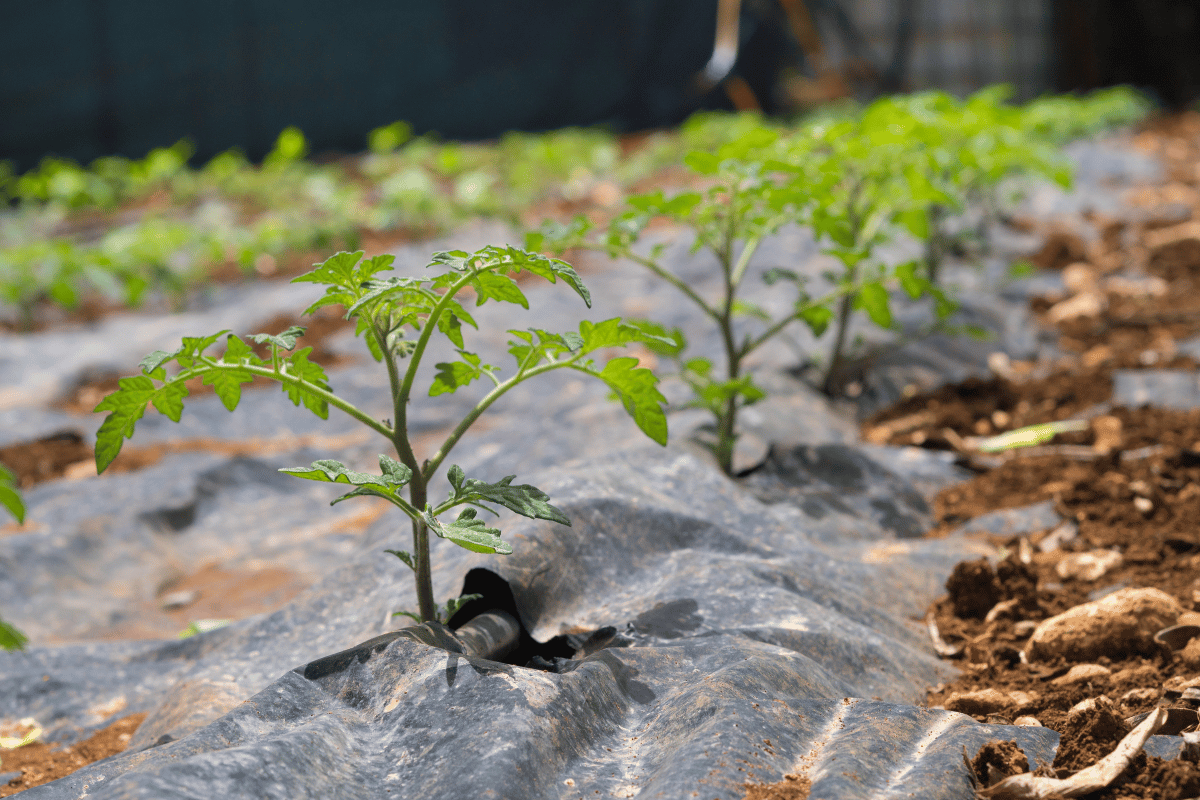
Growers switching from polyethylene to biodegradable mulch film are usually told they are solving the plastic problem. A new FAO working paper on plastic pollution in soils reaches a blunter conclusion. Reviewing the experimental evidence at realistic contamination levels, it finds no evidence that biodegradable plastics are safer than conventional plastics for soil and crops, and documents effects at concentrations as low as 0.02% of soil mass.
That matters because the material is designed to stay. Polyethylene film is lifted and removed at the end of the season. Biodegradable film is generally left in the field and worked into the soil, so whatever does not break down stays where the next crop will root.
Key takeaways
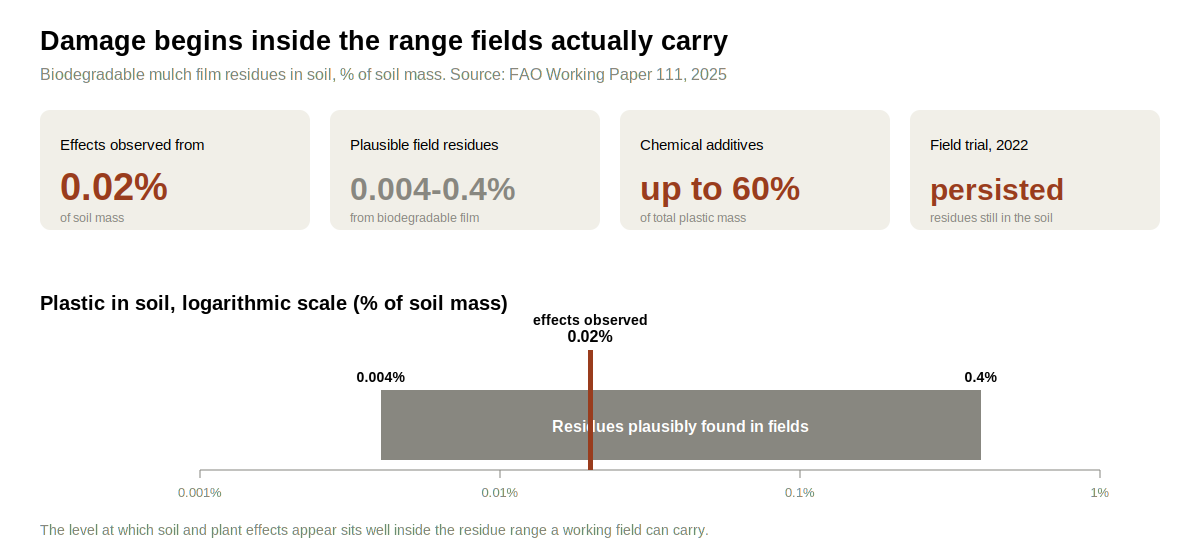
- Effects on soil and plants appear at 0.02% plastic in soil, well inside the range plausibly left by biodegradable film.
- Field residues plausibly run from 0.004% to 0.4%, so real fields can sit above the level where damage is observed.
- Biodegradable film fragments more readily than conventional plastic under sun, heat and mechanical stress.
- One 2024 study found PBAT microplastics did more harm than polyethylene across five measures of soil and plant health.
- Additives can be up to 60% of the mass of a plastic and are released as the polymer breaks down.
The words on the packaging describe different properties, and only one of them is about what happens in a field.
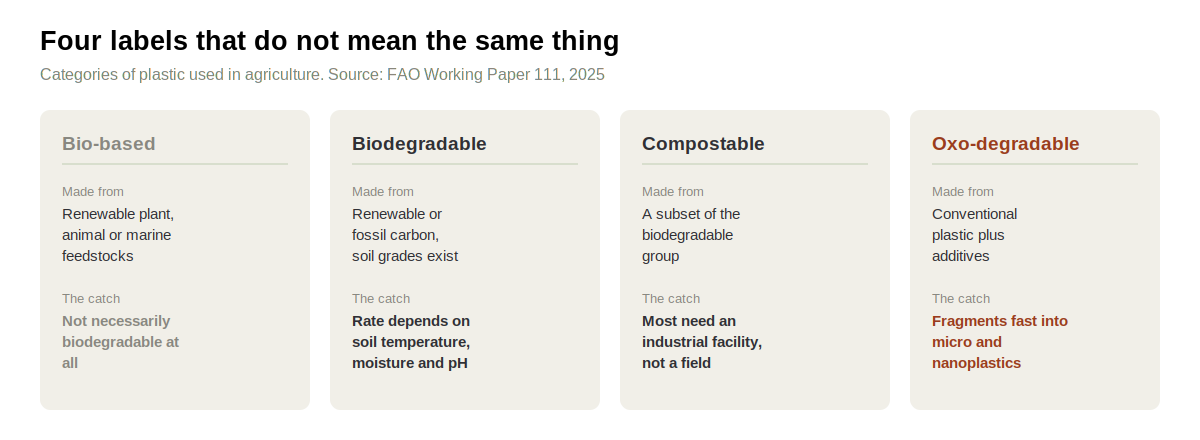
Bio-based plastics are made in whole or in part from renewable biological feedstocks, and they are not necessarily biodegradable, since that depends on the polymer chemistry and the additives. Biodegradable plastics may be bio-based or made entirely from fossil carbon, and they are designed to break down biologically faster than conventional plastics under specific conditions. The grades used for agricultural mulch film are those designed to degrade in soil. Compostable plastics are a subset of the biodegradable group, and most of them need the conditions of an industrial composting facility, which a field does not provide. Oxo-degradable plastics are conventional plastics with additives that cause them to break down under heat and light rather than by biological processes, and this process rapidly produces large numbers of micro- and nanoplastics that can persist.
For anyone buying film, the practical point is that a bio-based label says nothing about whether the residue disappears, and a compostable label may mean the material needs a facility rather than a furrow.
Why does biodegradable film break up faster than it breaks down
Biodegradation converts plastic into carbon dioxide, water, mineral salts, new microbial biomass, and sometimes methane. How fast that happens depends on soil temperature, moisture, and pH; the microbial community present; and the film itself, including its shape, polymer type, and the mix of additives and fillers. The same film can degrade at very different rates in different fields, and the report notes particular concern about cold conditions and about the water environments created by soil runoff.
Before any of that biology happens, the film is exposed to the same physical forces that embrittle conventional plastic, meaning mechanical stress, temperature swings, solar radiation and fragmentation by animals. Biodegradable films appear to be generally more susceptible to these processes than conventional plastics. A sheet therefore breaks into fragments quickly, and those fragments enter the soil as debris while the slower biological step is still pending.
Evidence from the field supports the concern. A 2022 trial documented that biodegradable mulch film residues persisted in soil, and analyses of certified biodegradable film residues show they fall within the microplastic size range, with a distribution pattern similar to that of conventional microplastics. Residues of PBAT-based film have been recovered from farm soil in Norway.
The report is also critical of how risk has been assessed. Some exposure estimates assume a single application of film and complete degradation within one or two years, which does not describe a field where film is laid every season.
What the evidence says about soil and crops
Effects on plants have been documented at concentrations that fields can plausibly reach. Studies report changes in the number of leaves in lettuce, in chlorophyll content and photosynthetic parameters, and in the nitrogen, phosphorus and potassium content of leaves. They also record accelerated accumulation of hydrogen peroxide and superoxide, increased malondialdehyde, a fall in soluble protein content in leaves, and increased accumulation of cadmium in rice roots.
Several of these responses were similar between biodegradable and conventional plastic particles. In one 2024 study the biodegradable material performed worse, with PBAT microplastics producing significantly greater impacts than polyethylene microplastics on oxidative damage, photosynthetic rate, soil aggregation, microbial activity and soil ammonium. The report treats that as preliminary rather than settled, and it is the direction of the finding that matters for anyone assuming the substitution is automatically an improvement.
Placed against the plausible residue range of 0.004% to 0.4%, an effect threshold of 0.02% sits comfortably inside the concentrations a working field can carry. This is the same pattern the report finds for plastics generally, where over half of the agricultural soils analysed already hold enough plastic for adverse effects to be likely, a picture set out in more detail in our overview of how microplastics affect soil health and yield.
The additives do not disappear with the film
A plastic is not only its polymer. Chemical additives can account for up to 60% of total plastic mass, and they include plasticisers, antioxidants, UV filters and other compounds with recognised toxic properties. The additives used in biodegradable plastics can be as complex and as hazardous as those used in conventional plastics.
As the polymer matrix degrades, those chemicals are released, and their fate becomes independent of the material that carried them. A film can therefore biodegrade as advertised while leaving its additive load behind in the soil. That is why the report treats degradation rate and environmental safety as two separate questions rather than one.
What this means for choosing mulch
None of this argues for going back to polyethylene, which is not biodegradable in soil at all and has to be lifted, and lifted imperfectly. It argues for treating biodegradable film as a material that still requires management rather than as a disposal solution.
Certification matters, since some bioplastics are not designed to biodegrade in soil at all, and standards for in-soil biodegradation exist in some jurisdictions. Clear labelling and traceability are worth insisting on at the point of purchase. Where the agronomy allows, non-plastic mulches such as straw, paper, or living cover avoid the question entirely, and thicker films that can be lifted cleanly reduce what stays behind. Reducing the area under film and improving the collection and recycling of the film that is used addresses the volume side of the problem, which matters given that agricultural plastic use is running at about 13.4 million tonnes a year, with films making up roughly 40% of it.
The wider case for mulching in vegetable systems is unchanged, and the practice earns its place for weed suppression, moisture retention and soil temperature, as covered in our guide to mulching in vegetable production. The question this report raises is narrower. It is about which material a grower leaves behind, and whether the label on the roll describes what actually happens once it is ploughed in, which is ultimately a question about long-term soil health.
Sources
- Nizzetto, L. and Hurley, R. 2025. State of research on the impacts of plastic pollution on soil health and crops. Environment and Natural Resources Management Working Paper 111. Rome, FAO.