

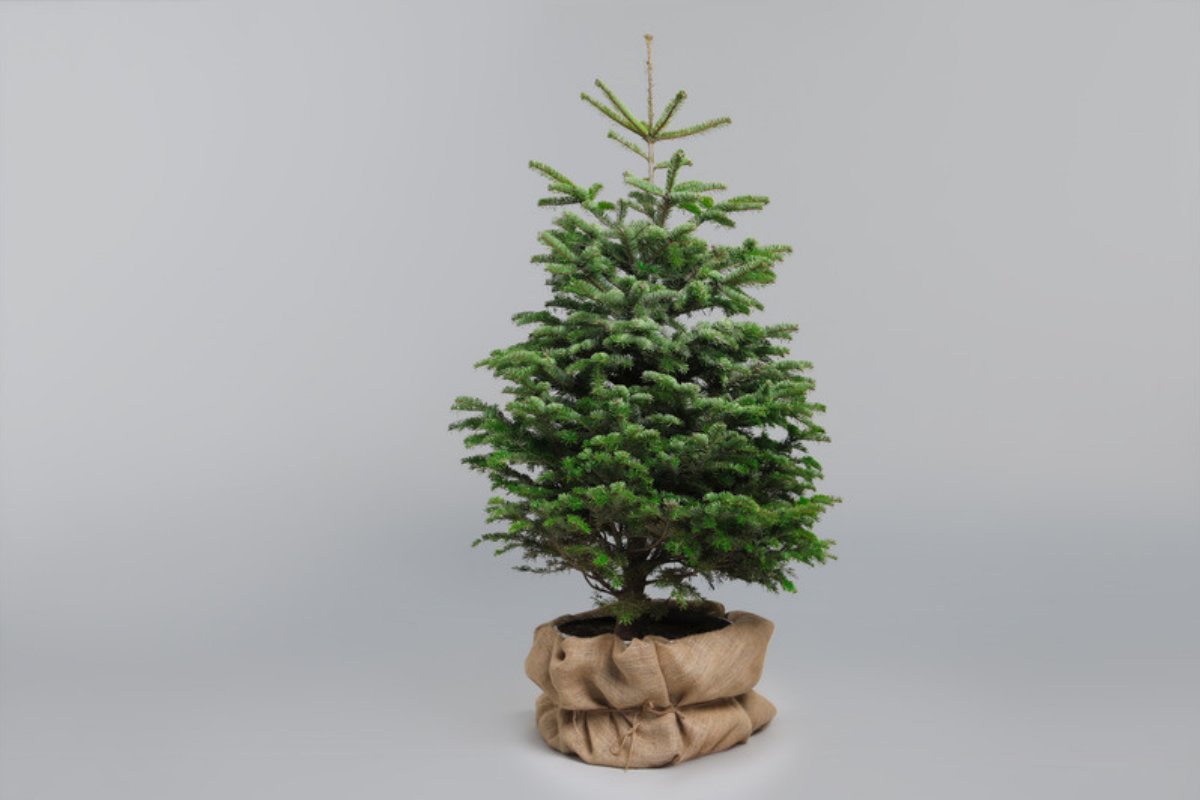
A fir grown in a pot can decorate the house over the holidays and go on living afterwards, on a balcony, on a patio or planted in the garden. To survive, it spends as few days as possible in the warm house, in a cool spot away from any heat source, and its root ball never dries out. University extension services and horticultural institutions set a limit of five to twelve days indoors and agree on the rest, meaning a gradual move from cold to warm and back, regular watering without standing water and a return outdoors right after the holidays.
Which trees are sold as potted Christmas trees
The trees sold as Christmas trees usually belong to two genera of conifers, the firs (Abies) and the spruces (Picea). According to the Royal Horticultural Society (RHS), the Nordmann fir (Abies nordmanniana) has dark green needles that drop very slowly, while the Norway spruce (Picea abies), the traditional Christmas tree of northern Europe, has a fine scent but sheds its needles quickly. That is why the Nordmann fir keeps its needles better indoors.
Mediterranean firs grow in the mountains. The Greek fir (Abies cephalonica), endemic to the mountains of Greece, grows at 400 to 1,800 metres above sea level on moist, well-drained soils, according to the European forest genetic resources programme EUFORGEN, and it is more tolerant of drought, insects and stony, shallow soils than the other Mediterranean firs.
For anyone who wants to keep the tree in a pot for years, the RHS suggests slow-growing cultivars that reach a limited final size. Picea glauca var. albertiana 'Conica', known as the dwarf Alberta spruce, eventually reaches 4 metres in height and 3 metres in spread, Picea abies 'Wills Zwerg' 3 by 2 metres and Picea pungens 'Fat Albert' 3 by 2.5 metres. The University of California Master Gardeners (UC Master Gardeners), writing for California's Mediterranean climate, also note that the dwarf Alberta spruce does well for several years in a pot outdoors.
How to choose a potted Christmas tree
Living Christmas trees are sold either in a container, where they have grown from early on, or with the root ball wrapped in burlap. According to the guidance of North Carolina State University Extension (NC State Extension), a tree meant for planting in the garden is better kept to no more than 1.5 to 1.8 metres in height. A conical conifer 1.5 metres tall needs a root ball about 56 centimetres in diameter to survive transplanting, so a large tree in a small pot has less chance of carrying on after the holidays.
How many days it can stay indoors
Colorado State University gives seven days as the upper limit and considers five better, NC State Extension one week to ten days, the UC Master Gardeners about ten days and the RHS twelve at most, with the advice to move the tree back outside sooner if it looks stressed. The RHS also suggests bringing the tree indoors as late as possible, ideally the weekend before Christmas.
So that the tree does not go suddenly from cold to warm and back to cold, Colorado State University recommends keeping it for a few days in an intermediate, unheated space before it comes indoors, and the same after Christmas before it goes back out. This space can be a covered porch, a shed or a garage.
Where to place it in the house
The tree needs the coolest spot in the house. The RHS suggests a cool room and points out that near a fireplace or radiator the tree loses too much moisture and drops its needles. Colorado State University adds heating vents and the television to the places to avoid, and NC State Extension direct sunlight. Turning the thermostat down by a few degrees, especially when nobody is in the room, puts less stress on the tree, and LED or small low-heat lights are the better choice for decoration.
How to water the tree indoors
The root ball has to stay moist but not soaked, and it must not dry out even once while the tree is indoors. The root ball is checked often, as Colorado State University recommends, because the warmth of the house dries it quickly. According to NC State Extension, watering should be regular without flooding, and the saucer or tub under the pot should hold no more than 2.5 to 5 centimetres of water. The same service suggests scattering crushed ice on the root ball from time to time so that the water is absorbed slowly, and notes that a large tree may need up to 3.8 litres of water a day. Overwatering is just as dangerous, and NC State Extension stresses that a tree should never be overwatered.
What to do with the tree after Christmas
After the holidays the tree first goes into the intermediate space for a few days and then outside. The UC Master Gardeners suggest a sheltered spot with good light but without much direct sun, so that it can get used to the outdoor environment again. From there, there are two options.
Planting in the garden: if the plan is to plant it, it can stay in the pot until early spring in the northern hemisphere, when the weather is milder. According to NC State Extension, the planting hole should have the same diameter as the root ball and be slightly shallower, and an area four to five times larger than the root ball should be loosened to a depth of 15 centimetres. After planting, the tree is watered well and mulched to a depth of 5 to 7.5 centimetres, for example with pine bark, which keeps the soil moist. In a windy spot NC State Extension recommends tying the tree to a stake, while the UC Master Gardeners consider that a small conifer is unlikely to need staking and that it is better avoided. From then on the tree needs the same care as other garden conifers.
Keeping it in a pot: if it stays in a pot, the RHS recommends repotting every year into a slightly larger pot, up to the size that can still be moved comfortably, about 45 centimetres in diameter and depth, using a soil-based growing medium (in the UK the peat-free John Innes No 2 is suggested). In practice this means a mix of garden soil and growing media that drain well. The RHS notes, however, that a Christmas tree kept in a pot may live only a few years, as it is not naturally suited to long-term pot cultivation.
Fertilizer is not given straight away. According to NC State Extension, feeding takes place in spring, once the tree has started to grow, and in the first year in moderation, especially with nitrogen. In the first spring the dose of an organic or organo-mineral fertilizer stays small.
How a potted fir gets through a hot summer
Firs are mountain trees, and the Greek fir grows from 400 metres upwards. In lowlands and cities with hot summers, summer is the hardest period for a fir in a pot, as the potting soil heats up and dries quickly. The UC Master Gardeners, writing for California's Mediterranean climate, recommend at least six hours of sun a day but shade in the afternoon, especially while the tree is small, and stress that the roots must not dry out. On a balcony facing south or west in the northern hemisphere, this means moving the pot to a spot with afternoon shade from June to September and watering regularly, while a light-coloured pot heats up less than a black plastic one.
Frequently asked questions
Why does a Christmas tree drop needles indoors? The most common cause is heat and dry air near a fireplace, radiator or vent, which according to the RHS cause heavy moisture loss. The species also plays a part, since the Norway spruce sheds its needles much faster than the Nordmann fir. Check as well whether the root ball has dried out.
How many days can a potted Christmas tree stay indoors? From five to twelve days, depending on the source. The fewer, the better for its survival, and always in a cool room.
Can I keep a Christmas tree in a pot for many years? For a few years, yes, with repotting into a larger pot every year. For a permanent life in a pot, dwarf spruce cultivars such as 'Conica', which reach a limited height, are better suited.
When should I plant the tree in the garden? Right after the holidays, once the tree has spent a few days getting used to an intermediate space, or later, in early spring in the northern hemisphere. Until then it stays in its pot in a sheltered spot and its roots must not dry out.
Can a fir grow in a lowland garden with hot summers? The Greek fir grows naturally at 400 to 1,800 metres, so in a lowland garden it needs afternoon shade, mulch and regular watering in summer. In mountain and upland areas the conditions are closer to its natural ones.
Does a potted Christmas tree need fertilizer? Not right after the holidays. Feeding takes place in spring, when new growth starts, and with moderate nitrogen in the first year.
Important notes
Every plant and every balcony or garden is different, depending on aspect, exposure to wind, water quality and altitude. The guidance above is general and is a starting point. If the tree yellows or dries out despite proper care, it is worth having it checked by an agronomist.
Sources
- Royal Horticultural Society. Christmas trees: types and care
- NC State Extension. Selection and care of living Christmas trees
- Colorado State University Extension, PlantTalk. Christmas trees: care of living trees
- UC Master Gardeners of Contra Costa County. Planting your living Christmas tree
- EUFORGEN. Abies cephalonica