
Bulgaria's National Institute of Meteorology and Hydrology (NIMH) has issued a red warning, valid from 14:00 local time on 3 November 2026 until midnight, for heavy rain in the provinces of Dobrich, Varna, Kardzhali, Haskovo and Smolyan, where the institute says rainfall will exceed 65 mm in 24 hours, and for strong wind in the first four. The warning comes while wheat sowing continues: by 22 October it had reached 393,037 ha, almost twice the area sown in the same week of 2025, according to Bulgaria's Ministry of Agriculture and Food, although NIMH says that the agronomically recommended sowing dates for wheat and barley were missed in October.
NIMH warns of more than 65 mm of rain in five provinces
In the warning NIMH published on the European Meteoalarm system, the level is red for Dobrich and Varna in the north-east and for Kardzhali, Haskovo and Smolyan in the south, from 14:00 on 3 November until midnight, with significant rain during the night exceeding 65 mm in 24 hours, while the red warning for strong north-north-easterly wind covers Dobrich, Varna, Kardzhali and Haskovo. An orange warning for the same day applies in 19 other provinces, among them Pleven, Ruse, Silistra, Shumen, Veliko Tarnovo and Stara Zagora, with rain above 35 and 55 mm in 24 hours, and for 4 November NIMH has issued an orange warning for Burgas, Sliven and Yambol, with 20 to 35 mm and locally up to 60 mm.
In its review of October, published on 2 November, NIMH gives monthly rainfall from 29% of the climate normal at Kyustendil to 241% at Silistra in the north-east, with the largest amounts on 12 to 14 October and on 23 and 30 October, and the highest 24-hour total of 65.9 mm at Burgas on 13 October. The institute notes that the figures are operational and that the full monthly hydrometeorological bulletin is published between 17 and 25 November.
393,037 ha had been sown with wheat by 22 October according to the agriculture ministry
In its weekly operational analysis of 28 October, Bulgaria's Ministry of Agriculture and Food gives 393,037 ha sown with wheat by 22 October, against 202,023 ha on 23 October 2025, that is 94.6% more, as well as 73,260 ha of barley, 71.4% more, and 142,107 ha of rapeseed, 15.6% more. The figures come from the regional agriculture services. Wheat sowing gathered pace through October, rising from 9,289 ha on 1 October, 19.9% less than in the same week of 2025, to 50,872 ha on 8 October and 196,498 ha on 15 October.
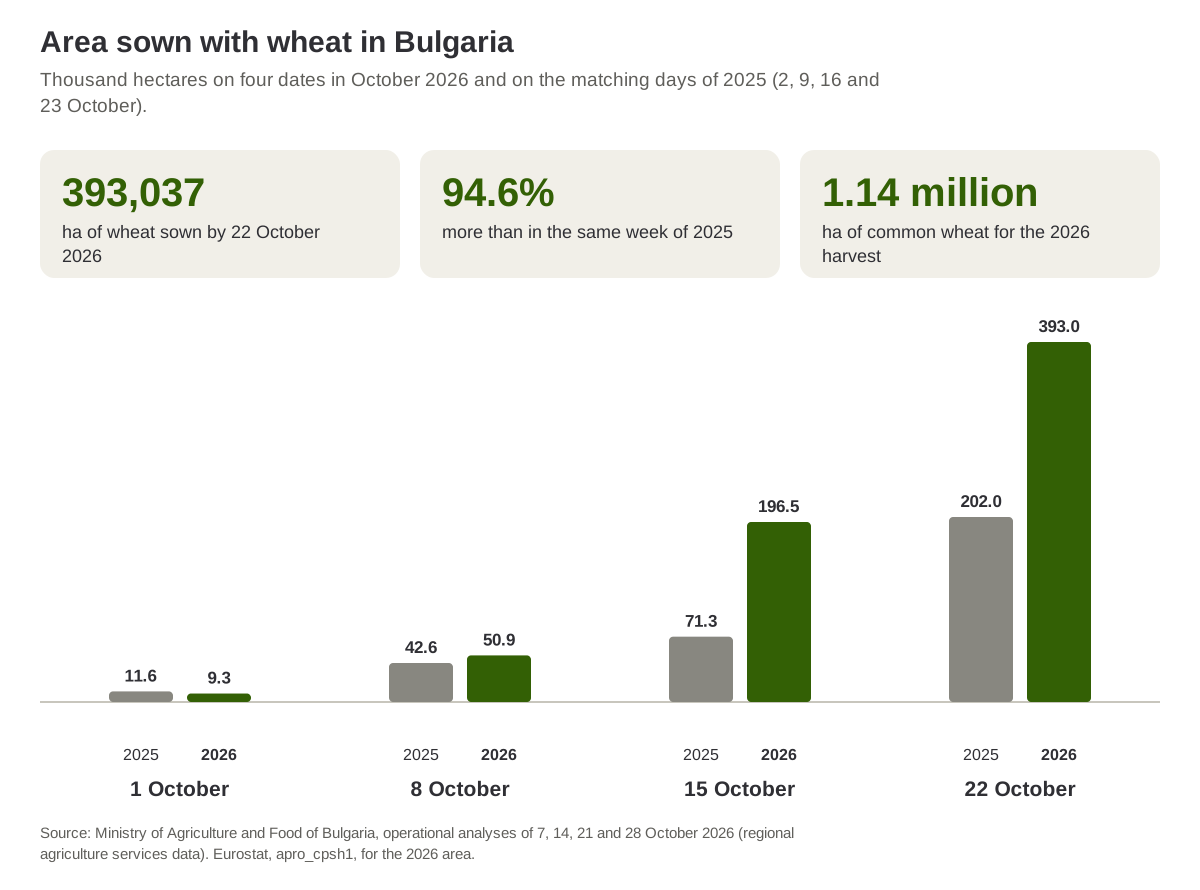
Source: Bulgaria's Ministry of Agriculture and Food, operational analyses of 7, 14, 21 and 28 October 2026, and Eurostat for the 2026 area.
For the 2026 harvest, Eurostat gives 1.14 million ha of common wheat in Bulgaria, so, with that area as the denominator, the wheat sown by 22 October 2026 corresponds to about 34%, against about 18% in the same week of 2025, the autumn that produced the 1.14 million ha harvest. In its MARS bulletin of 26 October on winter sowing in Europe, the European Commission's Joint Research Centre (JRC) writes that in north-western Bulgaria the particularly dry conditions hampered soil preparation, reduced the area sown with rapeseed and compromised its germination, while wheat and barley sowing began in early October and is accelerating, and recent rainfall caused some delay but improved soil moisture.
NIMH says the recommended October sowing dates for wheat and barley were missed
On October's agrometeorological conditions, NIMH writes that the relatively dry first ten days of the month suited the harvest of late row crops and grapes, but the drought hampered and in many places postponed pre-sowing work on the fields intended for winter cereals, such as soil preparation for sowing wheat. Rain in the second and early third ten-day periods improved the condition of the topsoil layers and the conditions for seasonal tillage, while in the last week of the month significant rain in many parts of the country left them over-wet and delayed sowing further. According to the institute, the unfavourable conditions meant that the agronomically recommended sowing dates for wheat and barley were missed in October, and the few winter cereal fields that had been sown were mostly at emergence. NIMH also reports an increased population of the common vole, Microtus arvalis, a dangerous pest of winter cereals. The description of "few" sown fields is the institute's and differs from the ministry's 393,037 ha.
NIMH expects above-normal rain in the first half of November
In its monthly agrometeorological forecast for November, NIMH expects most days in the first half of the month to be unstable and cold for the season, with above-normal rain that will delay wheat and barley sowing in many parts of the country, and it also writes that because of the drought at the start of autumn the recommended October sowing dates were missed in much of the lowland area. In its weekly forecast for 29 October to 5 November, the institute writes that below-normal temperatures in early November will slow the growth of autumn-sown crops and that in the high plains, where snow is not ruled out, the mean daily temperature will approach the biological minimum for the growth of winter cereals.
The ministry's next bulletin should show how far sowing went before the November rain
For growers in north-eastern and southern Bulgaria, the information of immediate use is NIMH's warnings for 3 and 4 November and the rainfall measurements it will publish afterwards. For wheat buyers, Bulgaria grew 1.14 million ha of common wheat for the 2026 harvest according to Eurostat, and the ministry's next weekly analysis is expected to show how much had been sown shortly before the November rain. Sowing progress in October and conditions after sowing are two of the factors that affect the 2027 harvest in a country for which the JRC MARS bulletin of 26 October gives maize and sunflower yield forecasts well above the five-year average.
Frequently asked questions
Which Bulgarian provinces have a red warning?
Dobrich, Varna, Kardzhali, Haskovo and Smolyan, from 14:00 on 3 November 2026 until midnight, for rain above 65 mm in 24 hours, and the first four also for strong wind, according to NIMH.
How much wheat has been sown in Bulgaria?
By 22 October 2026, 393,037 ha had been sown, 94.6% more than in the same week of 2025, according to Bulgaria's Ministry of Agriculture and Food.
Why does NIMH write of a sowing delay when the area is larger than last year?
The ministry compares the sown area with the same week of 2025, while NIMH compares sowing with the agronomically recommended dates, which according to the institute were missed in much of the lowland area because of the drought at the start of autumn.
What does NIMH forecast for November?
For the first half of November NIMH expects unstable and cold weather for the season, with above-normal rain that will delay wheat and barley sowing in many places.
Important notes
The warning comes from the Meteoalarm feed for Bulgaria, with NIMH as sender, as read at 11:07 UTC on 3 November 2026, and warnings change during the day. The October review, the monthly agrometeorological forecast for November and the weekly forecast are NIMH's, and the October rainfall values are operational, not final. The sown areas are operational data from the regional agriculture services as published by the ministry, which compares each week with the same weekday of 2025. Wikifarmer made the comparison with the Eurostat area for the 2026 harvest, used as the denominator for both years, and Eurostat covers common wheat and spelt while the ministry gives wheat in general, so the two shares are indicative. The Bulgarian term rendered as "agronomically recommended sowing dates" is "агротехнически срокове". The article was written before the red warning came into force and does not include rainfall measurements for 3 and 4 November or estimate effects on production or prices.
Sources
- National Institute of Meteorology and Hydrology (NIMH). (2026). Warnings for Bulgaria, via the Meteoalarm feed, accessed 3 November 2026.
- National Institute of Meteorology and Hydrology (NIMH). (2026, 2 November). Справка за времето през октомври 2026 г. (Weather in October 2026).
- National Institute of Meteorology and Hydrology (NIMH), Agrometeorology Section. (2026). Monthly agrometeorological forecast for November 2026 and weekly agrometeorological forecast 29.10-5.11.2026, accessed 3 November 2026.
- Ministry of Agriculture and Food of Bulgaria. (2026, 28 October). Оперативен анализ (Operational analysis).
- Ministry of Agriculture and Food of Bulgaria. Current operational analyses of main agricultural crops, analyses of 7, 14 and 21 October 2026.
- European Commission, Joint Research Centre. (2026, 26 October). JRC MARS Bulletin, Crop monitoring in Europe, Vol. 34 No. 9.
- Eurostat. Crop production in EU standard humidity (apro_cpsh1), accessed 3 November 2026.