


In the first three full weeks of October 2026 the price of milling wheat was higher than in the same weeks of 2025 in all 25 EU markets with complete data, with a median rise of 12.5%, according to a Wikifarmer analysis of the weekly prices that member states report to the European Commission. In most markets the price also rose compared with September, in the same period in which wheat futures posted nine consecutive weekly losses up to 30 October, according to Grain Central.
The rise from a year earlier reached 23.4% in Zaragoza and 20.2% in Poland
The two Spanish markets recorded the largest rises, Zaragoza at 272.2 euros per tonne against 220.7 euros a year earlier, up 23.4%, and Huesca, up 21.5%, followed by the Polish national average at 219.5 euros, 20.2% above the 182.6 euros of 2025 (European Commission). In the eight Italian markets the rise ranged from 9.0% in Bologna to 15.2% in Naples, in Romania from 10.1% to 14.9%, and in Hungary it was 10.7% and 14.5%. In Bulgaria the rise ranged from 0.9% in Ruse to 15.4% in Burgas, while in Ioannina, the only Greek market in the comparison, the price was 243.3 euros against 240.0 euros a year earlier, up 1.4%.
In 12 of the 25 markets the price was the same in all three weeks in at least one of the two years, which may mean that one week's price was carried over into the following weeks. Without these markets 13 remain, and in all of them the price was higher than a year earlier, with a median rise of 14.5% and a range from 10.1% to 23.4%.
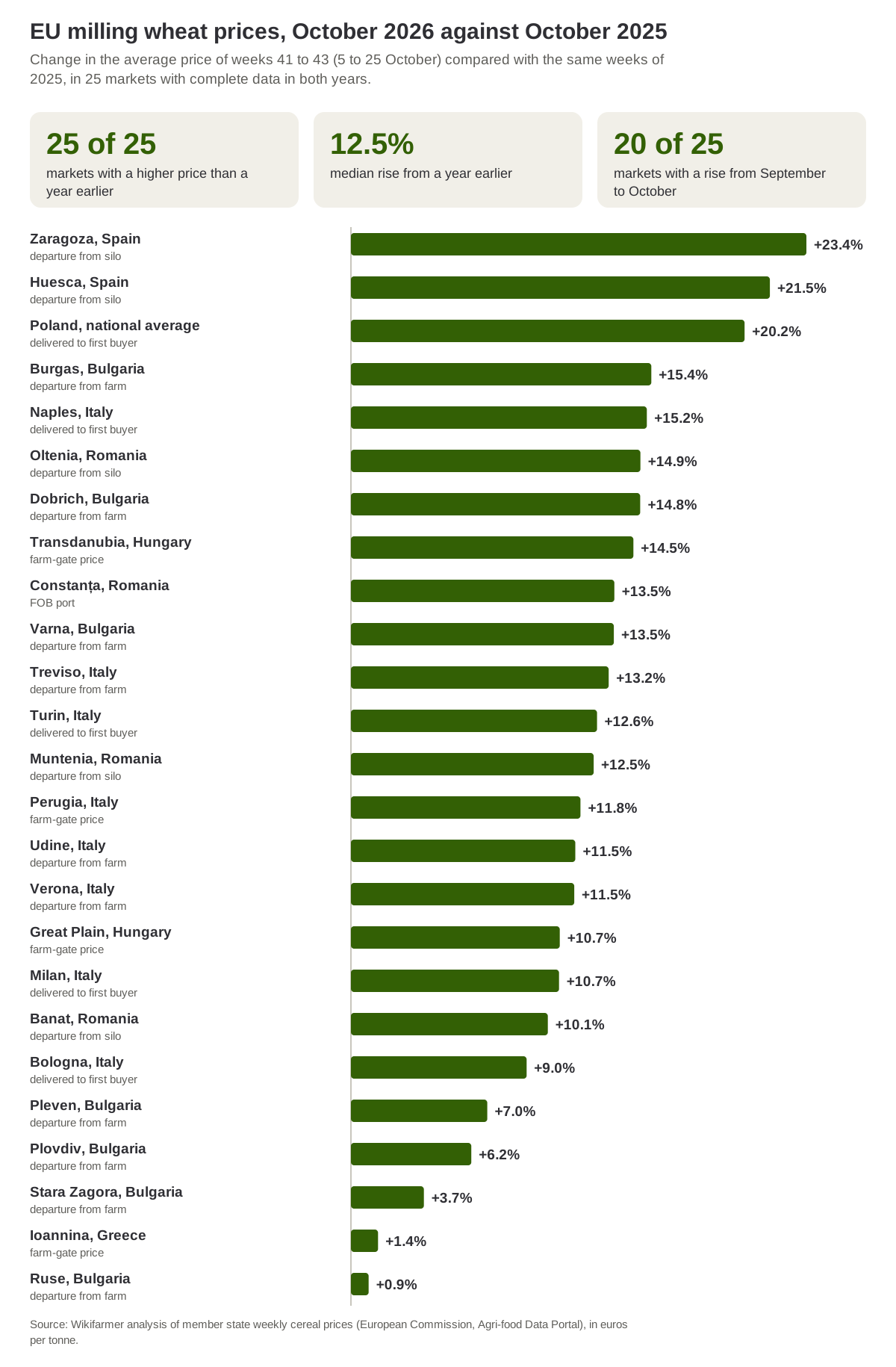
Source: Wikifarmer analysis of member state weekly cereal prices (European Commission, Agri-food Data Portal), in euros per tonne.
From September to October the price rose in 20 of 25 markets
Compared with the September weeks, the October price was higher in 20 markets, lower in 4 and unchanged in one, with a median rise of 3.3%. The four falls were in Varna by 4.6%, Dobrich by 3.7%, Burgas by 2.0% and Ioannina by 0.7%, while the largest rises were in Muntenia and Oltenia in Romania, by 6.2%. On the exchanges, according to Grain Central, wheat futures posted their ninth consecutive weekly loss in the week to 30 October, with US SRW down 3.44% and the Euronext (MATIF) contract down 2.56%, but there are no EU prices yet for that week. Futures refer to delivery in later months, while the member state prices are representative prices for each local market and a specific stage, so the two series do not always move together.
In 16 of 25 markets it was the highest October price since 2022
The Commission's weekly cereal prices start in November 2015, so for most markets October can be compared with every year since 2016. In 16 of the 25 markets the October 2026 price was higher than in October 2023, 2024 and 2025, and in 14 of them only October 2021 and October 2022 had a higher price. In Zaragoza, for example, the price of 272.2 euros is above the 238.3 euros of October 2024 but remains 29% below the 384.3 euros of October 2022. By contrast, in all seven Bulgarian markets the October 2026 price stayed below October 2023 and October 2024, and in Ioannina it stayed below 2021, 2022 and 2023.
In September the US wheat export price was 34.6% above a year earlier
The World Bank publishes each month the average export price of US winter wheat at US Gulf ports. In September 2026 soft red winter wheat (SRW) reached 278.6 dollars per tonne, 34.6% above September 2025 and 5.9% above August, the highest price since March 2023, while hard red winter wheat (HRW) reached 347.0 dollars, 48.4% above a year earlier and the highest level since May 2023 (World Bank). In the same month the EU milling wheat price was higher than a year earlier in all 26 EU markets with complete data, but with a median rise of 7.9%.
US prices are in dollars and EU prices in euros, so their changes cannot be compared directly, and the World Bank's monthly price for October is expected in early November. In the same period, on the world market, the USDA cut its forecast for Russian wheat exports to a five-year low in October.
The comparison uses the same weeks in each year
The European Commission publishes each week the cereal prices that member states report for their main markets, in euros per tonne and for different stages, such as the farm-gate price, the price on departure from silo or the price delivered to the first buyer. Each combination of market and stage is treated separately, and for each one the average price of weeks 41 to 43 of 2026, which begin on 5, 12 and 19 October, was compared with the same weeks of 2025. A market counts only when it has a price for all three weeks in both years, so of the 40 markets with a price in October 2026, 15 were left out, among them the six German markets, three Spanish and three Italian markets, as well as Rouen and La Pallice in France, which did not yet have a price for the week beginning 19 October. September was compared in the same way using weeks 36 to 40.
The analysis uses data up to the week beginning 19 October 2026 and the World Bank Pink Sheet (update of 2 October 2026, data to September 2026), not adjusted for inflation. EU prices refer to different stages in each market, so each is compared only with the same market and stage a year earlier, and the most recent weeks may be revised. The EU average published by the Commission was not used. The weekly futures changes come from Grain Central and were not checked against exchange data. All figures were recomputed independently from the original files.
The rise matters to EU growers and flour millers
October prices matter to wheat growers selling after the northern hemisphere summer harvest, to traders and flour millers buying milling wheat, and to countries outside the EU that import European wheat. Prices differ from market to market and from stage to stage, from 178.0 euros per tonne in Ruse, on departure from farm, to 290.8 euros in Naples, delivered to the first buyer, and the price analysis does not examine the causes of the rise.
In the coming months, the World Bank's October export price, the EU weekly prices from 26 October and the course of prices to December are worth following, since from 2016 the EU milling wheat price was higher in mid-December than in early October in 8 of the 10 years, usually by small amounts. The figures describe what prices did and are not a forecast.
Sources
- European Commission. (2026). Agri-food data portal, API guide (cereal prices). Directorate-General for Agriculture and Rural Development.
- World Bank. (2026). Commodity Markets, Pink Sheet monthly prices. World Bank Group.
- Grain Central. (2026, 2 November). Daily Market Wire 2 November 2026.