
The US Department of Agriculture cut its forecast for Russian wheat exports in 2026/27 by 3 million tonnes on 9 October, to 40.0 million tonnes, the lowest in five years. According to the monthly WASDE report, logistical disruptions caused by the continuing conflict in the Black Sea region have kept shipments to date well below their long-term average. The Russian analytics firm SovEcon had gone further a week earlier, to 36.7 million tonnes, the lowest since 2021/22 and about 20% below the 46 million tonnes it estimates for the previous season, while the International Grains Council had lowered its own forecast to 41.5 million tonnes in September.
The forecasts were made before US President Donald Trump said on 11 October that Ukraine and Russia had agreed to an immediate energy ceasefire. Wheat prices fell for a fourth consecutive day, but according to Bloomberg, Ukrainian President Volodymyr Zelenskyy said he supported the ceasefire while awaiting clarification, the market was waiting for confirmation from Moscow, and even an energy ceasefire would not guarantee the safety of grain infrastructure or commercial vessels.
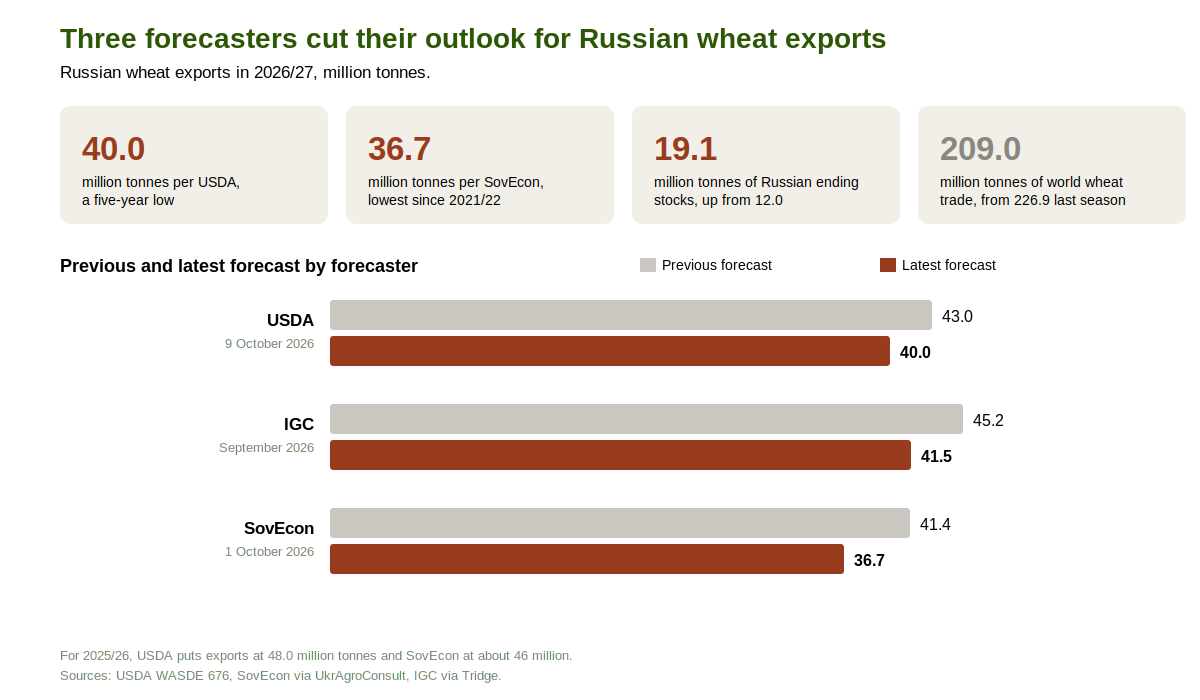
All three forecasters lowered their outlook for Russian wheat exports in 2026/27, by 3 to 4.7 million tonnes. Sources: USDA WASDE 676, SovEcon via UkrAgroConsult, IGC via Tridge.
Black Sea ports are running at reduced capacity
Russian exporters no longer expect shipments through the Black and Azov Seas to return to normal before 2027, according to SovEcon. Several major grain terminals in Novorossiysk and Tuapse continue to operate at reduced capacity, limiting the scope for a quick recovery in exports.
Russia is turning to alternative routes. Rail shipments in September were estimated at around 1 million tonnes, transshipment through the ports of the Baltic countries could rise by 60% to 0.4 million tonnes, and shipments are also increasing from Russia's own Baltic and Caspian ports and through the Volga-Don Canal, as described in our analysis of how Russia is converting Baltic and Arctic terminals to ship grain. According to SovEcon, however, these routes add only hundreds of thousands of tonnes a month, while the volumes missing from the Black Sea amount to millions.
Wheat that cannot move is staying in Russia
The Russian harvest remains large. USDA left its forecast for Russian wheat production unchanged at 88 million tonnes and raised ending stocks by 3 million tonnes to 19.1 million tonnes, against 12.0 million at the start of the season. FAO, in its monthly brief of 2 October, also raised its forecasts for Russian and Ukrainian wheat stocks because of reduced export expectations.
Ukraine is in a similar position. USDA kept its wheat exports at 12.5 million tonnes, against 14.1 million in the previous season, with ending stocks rising to 6.1 million tonnes from 2.0 million at the start of the season.
World wheat trade is shrinking
With the two large Black Sea exporters shipping less, USDA cut world wheat trade in 2026/27 by 2.8 million tonnes to 209.0 million tonnes, against 226.9 million in the previous season. Argentina and Canada fill part of the gap, with exports raised by 0.5 million tonnes each to 16.0 million and 30.5 million tonnes. World wheat ending stocks are almost unchanged at 276.0 million tonnes, as decreases for the EU, China, Argentina and Egypt are nearly offset by increases for Russia, Australia and the United States.
The picture matches FAO, which on 2 October cut world trade in all cereals by 3.5 million tonnes to 505.8 million, citing constrained Black Sea shipping routes. It is the same trend we recorded in September, when wheat supply was rising while trade was falling.
Prices retreated in October
World wheat prices rose 6.3% in September to their highest level since August 2023, according to FAO's September food price index. In October the pressure came from two directions. On 9 October USDA unexpectedly raised US corn production by 234 million bushels to 16.0 billion, corn futures posted their largest decline in three years, and wheat followed, falling as much as 3.2% during the session. Two days later came the energy ceasefire announcement, and Chicago wheat fell as much as 1.3% on Monday 12 October before paring losses.
According to an analyst quoted by Bloomberg, the market is reacting less to the pause in strikes on energy infrastructure than to broader expectations of reduced tensions. Whether the export picture changes depends on whether the ceasefire is confirmed and whether it extends to ports and ships. The next reference points are the FAO Food Price Index on 6 November and the next WASDE report on 10 November.
Sources
- USDA. (2026). World Agricultural Supply and Demand Estimates, WASDE-676. 9 October 2026.
- UkrAgroConsult. (2026). Russian exporters no longer expect normalization as wheat export forecast falls to a multi-year low. SovEcon forecast, 1 October 2026.
- UkrAgroConsult. (2026). Wheat prices fall for fourth consecutive day on Black Sea truce hopes. Based on Bloomberg, 12 October 2026.
- FAO. (2026). FAO Cereal Supply and Demand Brief. 2 October 2026.
- Tridge. (2026). IGC Lowers Russian Wheat Export Forecast for 2026/27 Amid Black Sea Shipping Disruptions. September 2026.