
The Food and Agriculture Organization of the United Nations' Food Price Index averaged 136.0 points in September 2026, up 2.0 points or 1.5% from a revised August, according to data FAO published on 2 October. It was the third consecutive monthly increase, and the index now stands at the same level as in November 2022, its highest since then. It is 5.8% higher than a year earlier but remains 15.1% below its peak of March 2022.
Crop-based commodities drove the rise, with the cereal, vegetable oil and sugar indices all increasing while meat declined and dairy held stable. FAO chief economist Máximo Torero, in a statement carried by international news agencies, described a persistent and increasingly broad-based build-up in commodity prices as disruptions in the Strait of Hormuz and the Black Sea combine with climate shocks, putting pressure on energy, transport and key foods. He warned that if these pressures are sustained they will soon pass through to consumer food prices, especially in countries dependent on food and energy imports.
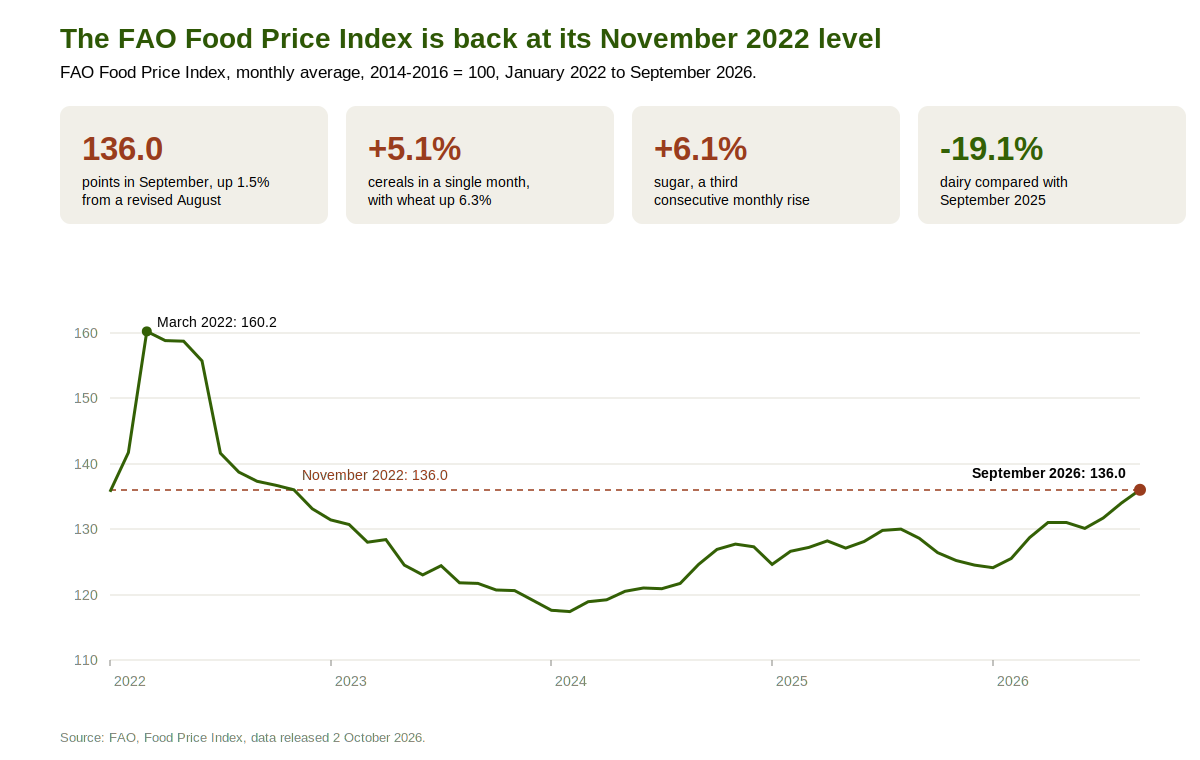
The index returned to 136.0 points in September, its November 2022 level, after three months of increases. Source: FAO, Food Price Index, data released 2 October 2026.
Wheat and maize lifted cereals 5.1% in a single month
The cereal index reached 122.8 points, 5.1% above August and 17.2% above September 2025, its highest level since December 2023. World wheat prices rose 6.3% to their highest since August 2023, although daily quotations eased towards the end of the month. FAO attributes the rise mainly to logistical constraints in the Black Sea region, which pushed importers towards other origins, and to dry weather in parts of North America ahead of winter wheat planting. It is the same pressure that led Russia to convert terminals in the Baltic and the Arctic to ship grain.
Maize prices rose 5.6% to their highest level in more than three years. FAO points to lower-than-expected yields in the United States, reduced export availability in Brazil and disruption in the Black Sea, while uncertainty over shipping through the Strait of Hormuz kept concern over fuel, fertiliser and freight costs high, giving particular support to commodities used as biofuel feedstocks, such as maize. Sorghum rose 13.7% and barley 3.9%, partly on expectations of larger Chinese sorghum purchases after trade discussions between China and the United States, and the rice index rose 1.4%.
Sugar rose for a third month as the EU beet crop shrinks
The sugar index reached 114.0 points, 6.1% above August and 14.7% above a year earlier, its third consecutive monthly increase and its highest level since the spring of 2025. FAO attributes the rise to expectations of tighter global supply in 2026/27. In the EU, a smaller planted area and adverse weather during the growing season are expected to reduce sugar beet output, which matches the JRC's decision to cut its September forecast for EU sugar beet to 11% below the five-year average, continuing the story of European sugar swinging from glut to shortage.
Added to that are forecasts of lower production in Thailand, concerns over India amid below-normal rainfall and strengthening El Niño conditions, and heavy rain disrupting harvest progress in Brazil's key Centre-South growing region.
Palm oil kept vegetable oil prices high
The vegetable oil index averaged 198.6 points, 0.9% above August and 18.3% above a year earlier, its highest level since June 2022. The rise was driven mainly by palm oil, which increased for a fourth consecutive month on strong import demand and concern over the effect of dry weather on production in Southeast Asia. Sunflower oil, by contrast, fell for a third month on expectations of ample supplies from the Black Sea region, although logistical difficulties and limited export capacity through alternative routes contained the decline. Soy oil was little changed but remained well above its year-earlier level, supported by biofuel demand, and rapeseed oil was unchanged.
Livestock products did not follow the rise
The meat index fell to 127.9 points, 1.1% below a revised August and in line with a year earlier, on lower poultry and pig meat prices. Poultry quotations declined on ample export supplies from Brazil and weaker import demand from the EU after new antimicrobial-related import requirements entered into force on 3 September, with part of the imports brought forward ahead of the rules. Pig meat prices fell on abundant supplies in major exporting countries, and in the EU animal growth rates returned to normal after the decline during the summer heatwaves.
The dairy index was almost unchanged at 119.1 points but 19.1% below a year earlier. Lower cheese prices, driven mainly by weak buying interest in the EU and competition from abundant US export supplies, were almost offset by higher milk powder prices, with skim milk powder 33.1% above its year-earlier level on demand from Asia. Butter was little changed, as lower prices in Oceania were offset by firmer prices in Europe, where milkfat is scarce after a hot, dry summer that left European livestock farms short of winter fodder.
The Black Sea is shrinking world cereal trade
In its monthly cereal supply and demand brief, released the same day, FAO kept its forecast for world cereal production in 2026 broadly unchanged at 2,979 million tonnes, 2.1% below last year's record but still the second largest harvest on record. It raised wheat by 3.2 million tonnes to 813.9 million, thanks to Australia, and cut coarse grains by 3.3 million tonnes to 1,612 million, because of maize hit by heat and drought in the EU and the United States.
The largest change concerns trade. FAO cut its forecast for world cereal trade in 2026/27 by 3.5 million tonnes from September to 505.8 million tonnes, 3.5% below the previous season, citing constrained Black Sea shipping routes and insufficient alternative transport capacity. Maize exports were lowered for the EU, on smaller supplies, and for Ukraine, on logistical constraints, while in wheat higher shipments from Kazakhstan do not offset smaller exports from Russia and Ukraine. Wheat that cannot move is staying in store, as FAO raised its forecasts for Russian and Ukrainian wheat stocks precisely because of reduced export expectations, and world cereal stocks at the close of the season are forecast at 950.0 million tonnes.
The next FAO Food Price Index is due on 6 November 2026, following August's reading, when world food prices reached their highest level since late 2022.
Sources
- FAO. (2026). FAO Food Price Index. Release and data of 2 October 2026.
- FAO. (2026). FAO Cereal Supply and Demand Brief. 2 October 2026.
- Forbes. (2026). Global food prices approach four-year high, UN says. 2 October 2026.
- ThePigSite. (2026). World food prices hit highest level since late 2022, FAO. October 2026.