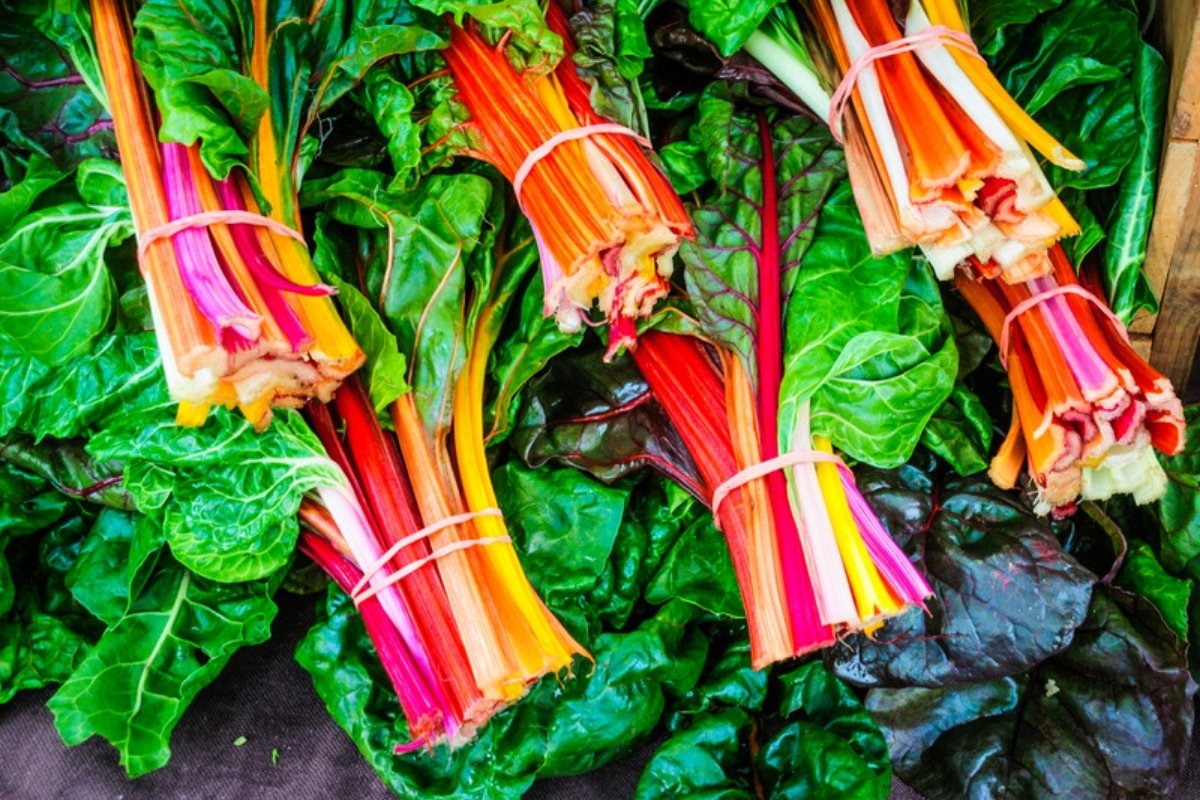
Commercial Swiss chard is grown mainly for fresh leaves sold in bunches, and it is harvested progressively, by cutting the outer leaves from the same plants for several months. The first harvest begins about 2 months after sowing. According to the KwaZulu-Natal Department of Agriculture in South Africa, where chard is one of the most widely grown leafy vegetables, yields normally range from 20 to 30 tonnes per hectare and can exceed 40. The crop needs nitrogen after every cut to keep producing leaves, and the main disease is Cercospora leaf spot, which limits how long production lasts. This guide covers climate and soil, rotation, sowing and thinning, fertilisation, irrigation, crop protection, harvest and yields.
Swiss chard as a commercial crop
Swiss chard is the same species as beetroot (Beta vulgaris subsp. vulgaris), selected for its leaves and stalks. According to the same South African department, it is widely used as a substitute for true spinach, because it gives a considerably higher yield, is grown with less trouble and has a similar flavour. In Greece it is a traditional vegetable for boiled greens, pies and stews, and is usually sold fresh, in bunches.
Climate
According to Texas A&M, chard performs best in cool, dry conditions, with day temperatures of 15 to 24°C and nights of 4 to 7°C. It tolerates frost and mild freezes, and it handles heat better than spinach, so it keeps producing, at a slower rate, as the weather warms. In Mediterranean regions the main sowings take place from late summer into autumn, for production from autumn to spring, and in early spring.
As a biennial, chard sends up a flower stalk after a period of cold, usually in its second spring. According to Penn State, prolonged freezing can make some varieties bolt earlier, so in colder areas variety choice for autumn sowings matters.
Soil and rotation
Chard prefers well-drained loam to clay loam soils rich in organic matter, and it tolerates a wide range of loamy soils with a pH of 6.5 to 7.5. It needs deep, fertile soil with steady moisture.
Rotation is particularly important, because chard shares pests and diseases with beetroot, sugar beet and spinach. According to KwaZulu-Natal, chard should not be established near beetroot or follow beetroot in a rotation, while field sanitation and rotation are the key practices against Cercospora leaf spot.
Sowing and thinning
Chard is direct-seeded or transplanted from trays, at a depth of about 1 to 2 cm. Its "seed" is a cluster of several seeds, as in beetroot, so two or more seedlings emerge from each point. In direct seeding this means thinning, a task that costs labour and has to be done on time, when seedlings are 2.5 to 5 cm tall. With transplants, thinning takes place in the trays, leaving one or two seedlings per cell.
Spacing depends on the leaf size the market wants. According to Michigan State University, for full-sized leaves spacing is about 15 cm within the row and 45 cm between rows, while for baby leaf sowing is very dense, with about 2.5 cm between seeds. In long crops harvested over many months, plants grow larger, so spacing increases.
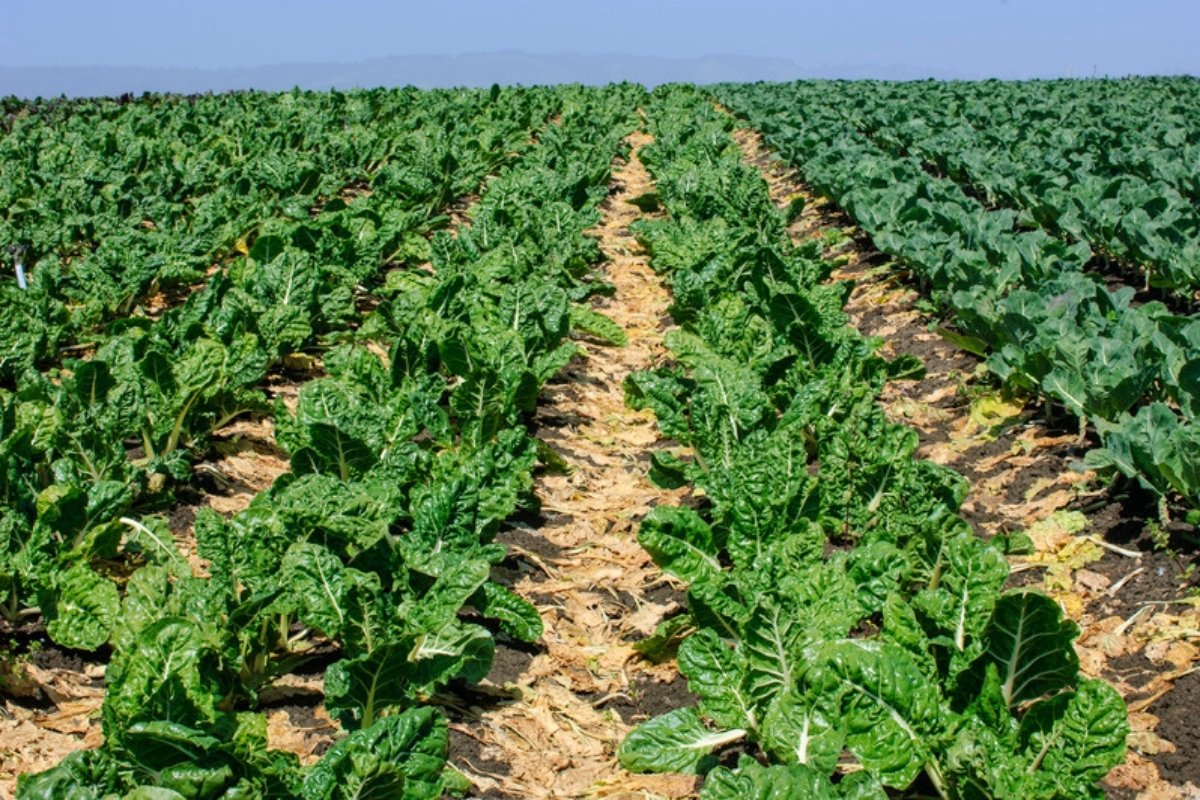
Commercial Swiss chard is grown in rows, with spacing set by the leaf size the market wants.
Fertilisation
Chard has high nutrient requirements, and fertilisation is always based on a soil analysis. Texas A&M gives as an indicative programme:
- Nitrogen: 112 to 168 kg per hectare in total, with 84 to 112 kg before planting and 22 to 34 kg after each cut, ideally guided by tissue analysis
- Phosphorus: 84 to 112 kg of P₂O₅ per hectare, banded about 5 cm below the seed at planting
- Potassium: based on the soil analysis
The logic behind fertilising after each cut is that every harvest removes foliage, and the plant needs nitrogen to regrow quickly. According to KwaZulu-Natal, regular nitrogen side-dressings ensure continuous, rapid growth, and the crop also responds very well to organic manures.
Irrigation
Chard needs plentiful, steady moisture to produce large, tender leaves. Drip irrigation is the most suitable system, because it keeps the foliage dry and limits Cercospora leaf spot, which is favoured by wet leaves. Water shortage slows regrowth between cuts and gives smaller, tougher leaves.
Crop protection
- Cercospora leaf spot: the most important disease, with small brown or grey spots with reddish margins that lower the market value of the leaves. According to KwaZulu-Natal, harvesting often continues until Cercospora becomes too severe, so controlling it decides how long production lasts
- Leafminers: larvae tunnel inside the leaves and make them unmarketable
- Aphids and slugs: mainly on young plants and in wet weather
- Root-knot nematodes: galls on the roots and stunted plants
- Powdery mildew: white growth on the leaves
Prevention rests on rotation, removing crop residues and infected leaves, correct spacing and irrigation at the root. Every treatment uses only products registered for chard in your country, after diagnosis by an agronomist, with strict observance of the pre-harvest interval, which in a crop cut every few weeks also sets the spray schedule.
Harvest and marketing
According to KwaZulu-Natal, chard can be marketed from about 2 months, once the leaves reach a good size. The outer leaves are harvested successively as soon as they are large enough, and the heart of the plant is left intact so it keeps producing. Harvesting from the same plants can continue for several months, until Cercospora becomes too severe or the plants run to seed.
After cutting, leaves are washed and tied in bunches, which should keep a fresh appearance. Chard leaves are highly perishable, so they are cooled and marketed as quickly as possible after harvest.
Yields
| Source | Yield per hectare |
|---|---|
| Texas A&M, anticipated yield | About 17 tonnes |
| KwaZulu-Natal, normal yields | 20 to 30 tonnes |
| KwaZulu-Natal, high yields | 40 tonnes and more |
Final yield depends mainly on the length of the harvest, meaning how many months the plants keep producing before Cercospora or bolting stops them. Correct fertilisation after each cut and control of Cercospora are therefore the two factors that decide the result.
Frequently asked questions
What is the yield of Swiss chard per hectare
Normally 20 to 30 tonnes per hectare, according to the KwaZulu-Natal Department of Agriculture, and more than 40 tonnes is possible. Texas A&M gives an anticipated yield of about 17 tonnes per hectare.
How many times can Swiss chard be harvested
The outer leaves are cut successively as they grow, and harvesting from the same plants continues for several months, until Cercospora becomes severe or the plants bolt.
What fertiliser does Swiss chard need
According to Texas A&M, 112 to 168 kg of nitrogen per hectare in total, with 84 to 112 kg before planting and 22 to 34 kg after each cut, plus 84 to 112 kg of P₂O₅ at planting. Rates are always set from a soil analysis.
What is the most serious disease of Swiss chard
Cercospora leaf spot, with brown or grey spots with reddish margins on the leaves. It is limited by rotation, field sanitation, correct spacing and irrigation at the root.
Why does Swiss chard need thinning
Because each chard "seed" is a cluster of several seeds, so two or more seedlings emerge from each point. Thinning is done promptly, when seedlings are 2.5 to 5 cm tall.
Can Swiss chard follow beetroot
It is not recommended, because they are the same species and share diseases such as Cercospora leaf spot. According to KwaZulu-Natal, chard should not even be planted near a beetroot crop.
Important notes
Spacing, fertilisation and the length of the harvest are adapted to the variety, the soil and market requirements, and treatment timing follows local plant protection guidance.
Use only products registered for chard in your country, follow the label and the pre-harvest interval, and apply cultural measures first. For serious or persistent problems, consult a local agronomist for an accurate diagnosis.
References
- Texas A&M AgriLife Extension, Swiss chard.
- KwaZulu-Natal Department of Agriculture, Swiss chard.
- Michigan State University Extension, Swiss chard.
- UC Statewide IPM Program, Cultural tips for growing chard.
- Penn State PlantVillage, Chard.
- University of Maryland Extension, Growing Swiss chard in a home garden.
- University of Illinois Extension, Chard.
- UC Cooperative Extension Sacramento County, Growing beets.