
Hay production in Hungary came in at roughly one-third of the annual average this season, and in southern and south-western Germany, poor silage maize prospects are already depleting stocks and have been linked to early livestock slaughter. Both findings appear in the August bulletin from the European Commission's Joint Research Centre, which records a marked deterioration in grassland across much of western and central Europe and raises the question of whether there will be enough fodder to get through the winter.
Greek livestock farming sits on the other side of that picture. Greek green maize is forecast at 46.7 tonnes per hectare, 13% above the five-year average and 73% above a weak 2025.
Where grass growth fell furthest
In France, repeated heatwaves and drought substantially reduced grassland growth, with satellite vegetation signals now below average across most regions, grazing opportunities limited and concerns compounded by poor green maize prospects. Ireland saw a marked deterioration as well, particularly in the south-east, where warm, dry conditions kept grass growth below usual levels.
Across the Benelux countries, grassland development has largely stopped, and pasture availability is currently poor, though several high-quality cuts taken earlier in the season have provided substantial forage stocks. Silage maize is becoming more important to the overall fodder balance there while showing growing signs of drought stress. In Austria, Czechia, and Slovakia, grassland productivity fell substantially below average, especially along their shared borders, with heat and rainfall deficits causing fodder shortages and further tightening winter feed supplies.
Hungary saw widespread drying and early dormancy in grasslands under severe drought, making winter feed availability a major concern. Conditions ran the other way in Sweden, Finland and the Baltic states, where adequate rainfall kept biomass at or above average, and Sweden combines that with record green maize acreage for an above-average fodder outlook. Poland had near-average biomass; Romania stayed close to average in the east, south, and centre, with very low accumulation along its western border; and Bulgaria remained broadly average despite falling rainfall since late July.
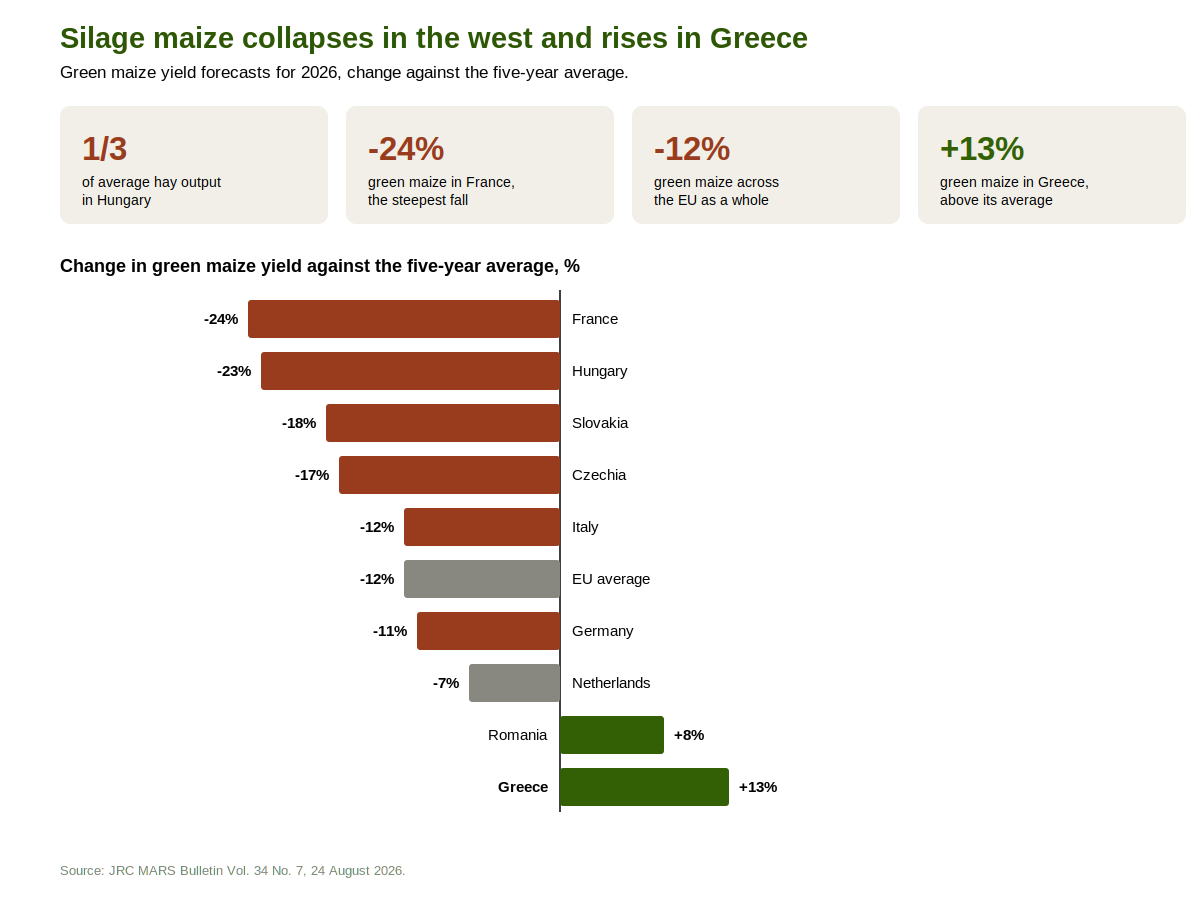
France and Hungary lose close to a quarter of their green maize yield, while Greece and Romania run above their own averages. Source: JRC MARS Bulletin Vol. 34 No. 7, August 2026.
Silage maize falls 24% in France and 23% in Hungary
Across the Union, green maize is forecast at 37.8 tonnes per hectare, 12% below the five-year average. The country picture varies sharply, with France dropping to 33.0 tonnes per hectare for a 24% loss, Hungary falling to 19.1 tonnes per hectare for a 23% loss, Slovakia down 18%, and Czechia down 17%.
Italy follows with a 12% loss, Austria and Germany at 11%, the Netherlands at 7%, and Belgium at 6%. On the other side sit Denmark with a marginal gain, Romania 8% above average and Greece 13% above.
These numbers matter differently for livestock than they do for cereal figures. Silage is bulky and wet, which makes long-distance transport uneconomic, so it is consumed close to where it is grown. A shortfall in one region is not easily covered by a surplus in another, and it translates directly into the need to buy supplementary feed at a higher cost.
Early slaughter in southern Germany
Heat and low soil moisture reduced grassland productivity across central and western Germany, and conditions in the south and south-west are described as critical, since further cuts are barely possible and pasture productivity is insufficient. Poor silage maize prospects are already affecting fodder stocks and, according to the bulletin, are reportedly contributing to early livestock slaughter. The north of the country fared better, where intermittent rainfall kept biomass near average in places.
Early slaughter serves as an indicator of pressure on a farm because it means the producer has chosen to reduce the herd rather than buy feed at prices the enterprise cannot afford. The effect shows up in meat markets within months and in next year's milk production.
Italy is counting milk losses from heat and missing forage
In Italy, the fodder squeeze has already reached milk production. Coldiretti, the country's largest farming organisation, estimates an average fall in milk output of more than 20% across June and July, while Confagricoltura records a smaller decline in the Po Delta of between 5% and 10%. Both are estimates from farm organisations rather than official statistics, and the gap between them is a fair measure of the uncertainty.
The picture is clearer in the mountain pastures of Piedmont, where daily production fell from 7 to 8 quintals in a normal year to 2 to 3, with a direct effect on cheese output. Forage production across northern Italy dropped by 30% to 40%, according to Coldiretti, and valleys in Trentino recorded declines of over 40%. Roughly 60% of Italian farmland was affected by drought, and the cost of milk refrigeration and barn cooling rose by around 30%.
The direction has been confirmed by an international source. The FAO Dairy Price Index rose 2.3% in August, its first increase in four months, with the organisation attributing much of the rise to tightening milk supplies in the European Union amid hot and dry weather.
Greece covers its own roughage needs
Greek grasslands are in their normal summer dormancy, which is the expected pattern for the Mediterranean zone, where growth halts over summer and resumes with autumn rain. Combined with green maize 13% above average, domestic roughage production is running at comfortable levels this year.
Greek feed costs do not depend solely on domestic production, since a large share of concentrate feed comes from international markets. With EU maize 7% below average and soybeans 14% below average, raw material prices are being set in a market with reduced supply, regardless of how well the harvest went in Greek fields.
Sources
- Il Sole 24 Ore. (2026). Alarm bells ringing for livestock farms as drought scorches maize and pastureland. 12 August 2026.
- FAO. (2026). Supply concerns drive FAO Food Price Index higher in August. 4 September 2026.
- European Commission Joint Research Centre. (2026). JRC MARS Bulletin, Crop monitoring in Europe, August 2026, Vol. 34 No. 7. Publications Office of the European Union, Luxembourg.