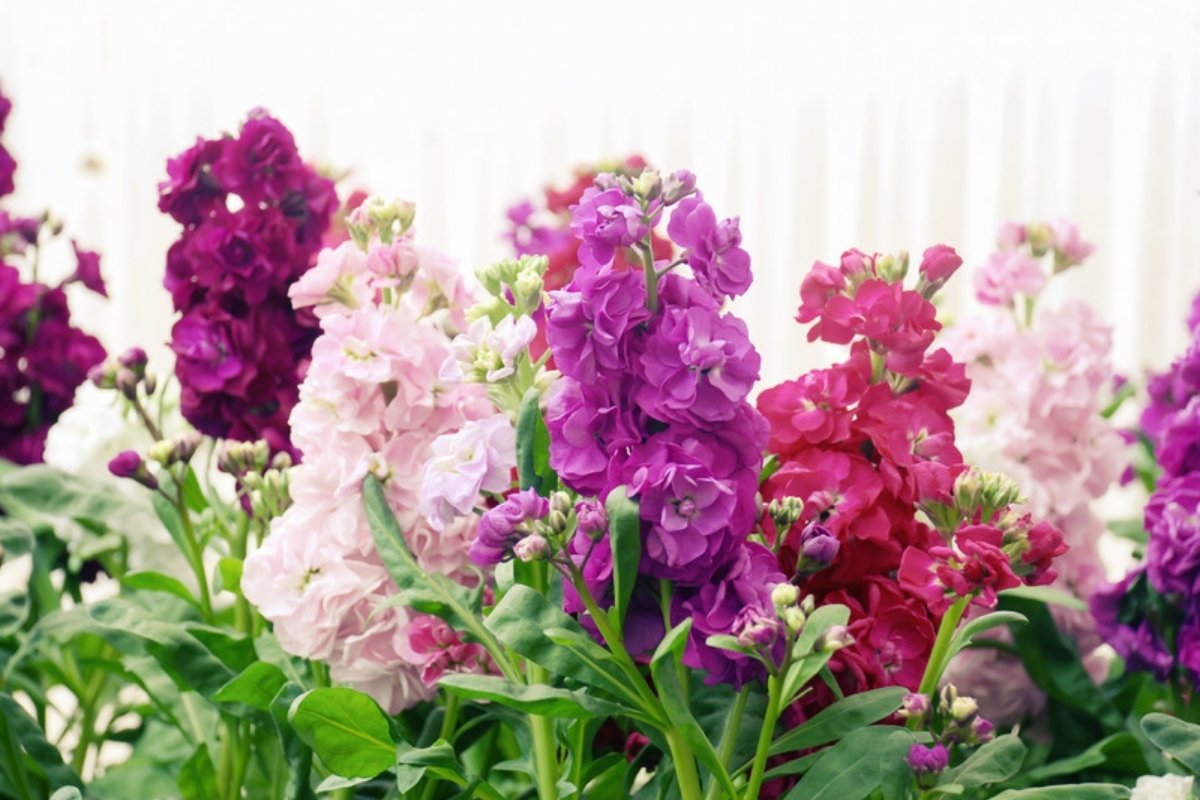
Stock, Matthiola incana, is a fragrant flowering plant of the cabbage family, related to cabbage and kale, with a clove-like scent and single or double flowers on upright spikes. In mild-winter regions it is sown in late summer or early autumn and flowers from winter into spring, because it needs cool temperatures to form flower buds and stops flowering in the heat. In Greece, where it grows wild, stock is sold in nurseries and seed packets under the name "violeta", violet, a naming mix-up with a long history.
Stock sold as violeta in Greece is not a true violet
In Greek, violet, menexes or ion is the common name for species of Viola, yet Greek nurseries and seed packets sell Matthiola incana as "violeta", and many Greek gardening texts mix the two plants up. The confusion is ancient. In classical Greek, leukoion, "white ion", was the name for Matthiola incana in Theocritus and Dioscorides, while ion was the violet.
Matthiola incana grows wild on Mediterranean coasts from Spain to Greece, and incana means grey-white, after the felt on its leaves. The same genus includes night-scented stock, Matthiola longipetala, whose scent comes out in the evening. The four plants that get called violets are easy to tell apart.
| Plant | Leaves | Flowers | Where it is grown |
| Stock (Matthiola incana) | Narrow, grey-green, felty | Four petals on an upright spike, single or double | Garden, pots, cut flowers |
| Sweet violet (Viola odorata) | Heart-shaped, low | Small, five petals, scented | Part shade, under trees |
| Pansy (Viola × wittrockiana) | Oval, toothed | Large, five petals, with a "face" | Winter window boxes |
| African violet (Saintpaulia) | Round, velvety, in a rosette | Small, many, all year | Indoors |
Sources: Greek Wikipedia, Liddell and Scott Greek lexicon, NC State Extension.
Pansies are grown and flower quite differently and share only part of a name with stock.
Annual and biennial stocks are sown at different times
Advice on when to sow stock looks contradictory because two groups of varieties are sold. Annual stocks, known as ten-week stocks, flower about 10 to 12 weeks after sowing depending on day length and temperature, so in cool climates they can be sown in late winter or spring for flowers in early summer.
Biennial and winter-flowering stocks, including the giant double strains sold in Greece, are sown in August and September and flower from March to May. In mild-winter regions, sowing in late summer to early autumn gives flowers through the winter, and this is the safest choice wherever summers are hot.
Stock needs cool weather to flower
Stock forms flower buds only after a spell of cool temperatures. In Japanese research on a late-flowering cultivar, the optimum temperature for flower bud initiation was 10°C, with a minimum duration of 20 days, and cold also enhanced stem elongation. Heat works the other way, and stock cannot tolerate warm night temperatures, so flowering stops as summer temperatures rise.
Most failures come from this. Stock sown late in spring in a hot area can grow well and never flower, while the same variety sown in autumn goes through the winter it needs and flowers freely.
The seed is sown shallowly and germinates in about two weeks
Seed germinates in 7 to 14 days at 18 to 24°C and is sown very shallowly, barely covered. Sowing is done in seed trays with a light seed compost, and seedlings are transplanted once they have four or five true leaves.
In the garden, plants are spaced about 30 to 40 cm apart, while in containers, each plant needs a pot of at least 20 cm. Pinching the young plants gives bushier stock with more spikes, while those who want long stems for cutting leave the growing tip alone.
Double flowers set no seed
Double-stock flowers are completely sterile, lacking reproductive organs, because the stamens and pistil have turned into petals. Seed comes only from single-flowered plants, and in the "eversporting" strains, single plants produce about 50% doubles in every generation. After generations of selection, many modern strains give doubles at 60% or even 80%, which is why a packet of double stock always produces some singles.
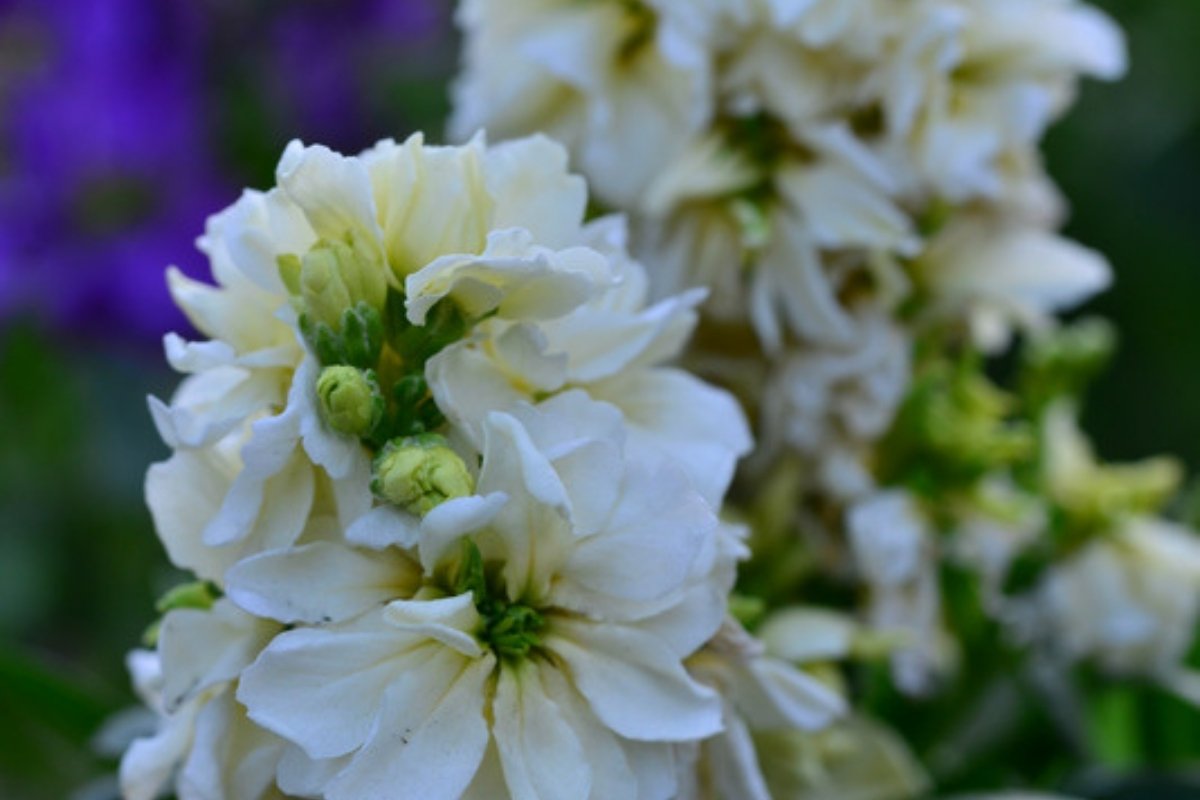
Double-stock flowers are sterile because the stamens and pistil have turned into petals.
In strains labelled selectable, doubles can be picked out at the seed-leaf stage. When seedlings are held for 3 to 4 days at 4 to 7°C, future doubles have pale green cotyledons and singles dark green ones, and in Korean research, cup-shaped cotyledons almost always gave double flowers. In the garden selection is optional, since single flowers are just as fragrant, but for cut flowers, doubles are far more marketable.
Stock wants sun and well-drained soil
Stock grows best in full sun, tolerates light shade and wants soil rich in organic matter, consistently moist but well drained, and it will not do well in acidic soil. Positions sheltered from strong winds keep the spikes upright, and tall plants often need staking.
Watering and feeding are done in moderation
Keep the soil evenly moist, watering at the base rather than over the foliage, because water splashing onto the leaves spreads stock's bacterial disease. Feed lightly with a fertiliser low in nitrogen and richer in phosphorus and potassium, since too much nitrogen gives leaves rather than flowers.
Stock is also sensitive to potassium deficiency, which shows at flowering as brown leaf tips and margins.
Stock is a perennial grown as a biennial
Botanically Matthiola incana is a herbaceous perennial that develops a woody base and is grown as a biennial or annual. In mild climates a plant may live a few years, with increasingly woody stems, but flowering declines, so most growers sow new plants each year.
Stock lasts several days in the vase
Stock is one of the most fragrant cut flowers, but it is especially sensitive to ethylene, the gas given off by ripening fruit. Cut stems keep best at 2 to 5°C and away from fruit, and vase water is changed often.
Pests and diseases are those of cabbages
Because it belongs to the same family as cabbage, stock is attacked by the same pests. Aphids and thrips are the most common, while cabbage white caterpillars, flea beetles, snails and slugs also feed on it.
The most destructive disease is bacterial blight, which yellows and drops the lower leaves and causes dark cankers on the stem until the plant breaks at the base. The bacterium is seed-borne, survives in soil for two years and is favoured by cool, wet weather, so prevention relies on clean seed, watering without splashing and a 2 to 3 year rotation. Fusarium wilt, downy mildew, grey mould, clubroot and damping-off also affect stock, so it is not planted where cabbages or other brassicas have recently grown.
Frequently asked questions
When should stock be sown?
In mild-winter regions, sow in August and September and plant out seedlings in autumn for flowers from winter to May. Annual ten-week stocks can also be sown in late winter or spring in cooler climates, but they flower only briefly before the heat.
Is stock a perennial?
Botanically yes, but it is grown as a biennial or annual, because after the first flowering plants become woody and flower less.
Why is my stock not flowering?
Usually because it has not spent enough days at cool temperatures. Stock forms flower buds in the cool weather of autumn and winter, and when sown late in spring in a hot area it may never flower.
How is stock propagated?
From seed, which comes only from single-flowered plants. Double flowers are sterile, and seed from single plants gives a mix of single and double plants.
Is stock the same as a violet?
No. Stock is Matthiola incana, with grey-green felty leaves and flowers on an upright spike, while the sweet violet is Viola odorata, a low plant with heart-shaped leaves.
Can stock be grown in a pot?
Yes, in a pot of at least 20 cm with free-draining compost and a sunny spot sheltered from strong winds. Dwarf varieties suit window boxes best.
Important notes
Every plant and every environment is unique. Conditions vary considerably with region, exposure, water quality, soil pH and the overall health of the plant. The guidance above is general and a starting point.
If you suspect a serious nutrient deficiency or a disease that basic practices do not resolve, contact an agronomist for an accurate diagnosis.
Plant protection products should be used carefully and responsibly. Always try non-chemical methods first (cultural practices, soft soap, summer oil). When chemical intervention is needed, use only approved products and follow the label instructions.
Sources
- Greek Wikipedia. Violeta (in Greek).
- Liddell, H. G., Scott, R. leukoion, Ancient Greek lexicon.
- Wikipedia. Matthiola incana.
- NC State Extension. Matthiola incana, plant toolbox.
- Mississippi State University Extension. Stock (Matthiola incana) for the farmer florist.
- The Journal of Horticultural Science and Biotechnology (2000). Cold treatments enhance responsiveness to gibberellin in stock (Matthiola incana), 75(6).
- Horticultural Science and Technology (2017). Early selection of double flowers based on cotyledon shape in cut stock (Matthiola incana) flowers.
- Plant Science (2017). Molecular characterization of a double-flower mutation in Matthiola incana.
- PanAmerican Seed. GrowerFacts, Stock Hot Cakes series.
- Ball Australia. Stock Iron series, cultural notes.
- UC IPM. Floriculture and ornamental nurseries, stock.
- PNW Plant Disease Management Handbook (2026). Stock (Matthiola spp.), bacterial blight.
- iNaturalist. Hoary stock (Matthiola incana).
- Harvest to Table. How to grow stock, Matthiola.