

Fish meal cost $2,840 a tonne in October 2026, 35.0% more than in July, according to a Wikifarmer analysis of the World Bank's monthly commodity prices, while in the first eight months of the year the European Union paid an average of €1.848 per kilo for fish meal imported from outside the EU, 28.7% more than in the same months of 2025, according to Eurostat's foreign trade data. In October, after the rise had already been recorded, Peru's Ministry of Production announced that it would not allow a second anchovy fishing season in 2026. Peru is the EU's largest supplier of fish meal from outside the EU, and a trade publication linked the decision to El Niño and a very low anchovy biomass.
The World Bank price rose from $2,103 to $2,840 a tonne
On the World Bank's monthly series, fish meal cost $2,103 a tonne in July 2026 and $2,605 in August, reached $2,916 in September and eased to $2,840 in October. That is a rise of 38.7% from July to September and of 35.0% from July to October. The prices are in US dollars and are not adjusted for inflation.
Since July 2026 the World Bank has quoted herring fish meal with 64% protein, free on board in northern Germany. From 2021 to June 2026 it quoted fish meal with 64% protein free on board in Bremen, and from 1999 to 2020 German fish meal with 64% protein ex warehouse in Hamburg. Because the specification changed, prices from July 2026 onwards can only be compared with each other. September's price is the highest in the series since it starts in 1979, but it refers to a different product from the older prices and so cannot be called a record.
The EU paid 28.7% more for fish meal imported from outside the EU
From January to August 2026 EU countries imported 217,575 tonnes of fish meal from outside the EU, against 203,861 tonnes in the same months of 2025, and paid an average of €1.848 per kilo, against €1.436 a year earlier, according to Eurostat's Comext foreign trade database. It is the highest January to August average since at least 2010; the previous highest was €1.694 in 2023. Month by month, the average rose from €1.606 per kilo in January 2026 to €2.150 per kilo in August, against €1.416 in August 2025.
Peru was the largest supplier of the EU's fish meal imports from outside the EU in the eight months, with 60,904 tonnes or 28.0% of the tonnage, up from 21.9% in the same months of 2025, followed by Chile with 26,507 tonnes and Morocco with 23,846 tonnes. The average import price is the declared value divided by the declared quantity and mixes fish meal of different grades and origins, so it cannot be compared directly with the World Bank price, which refers to one product in one market.
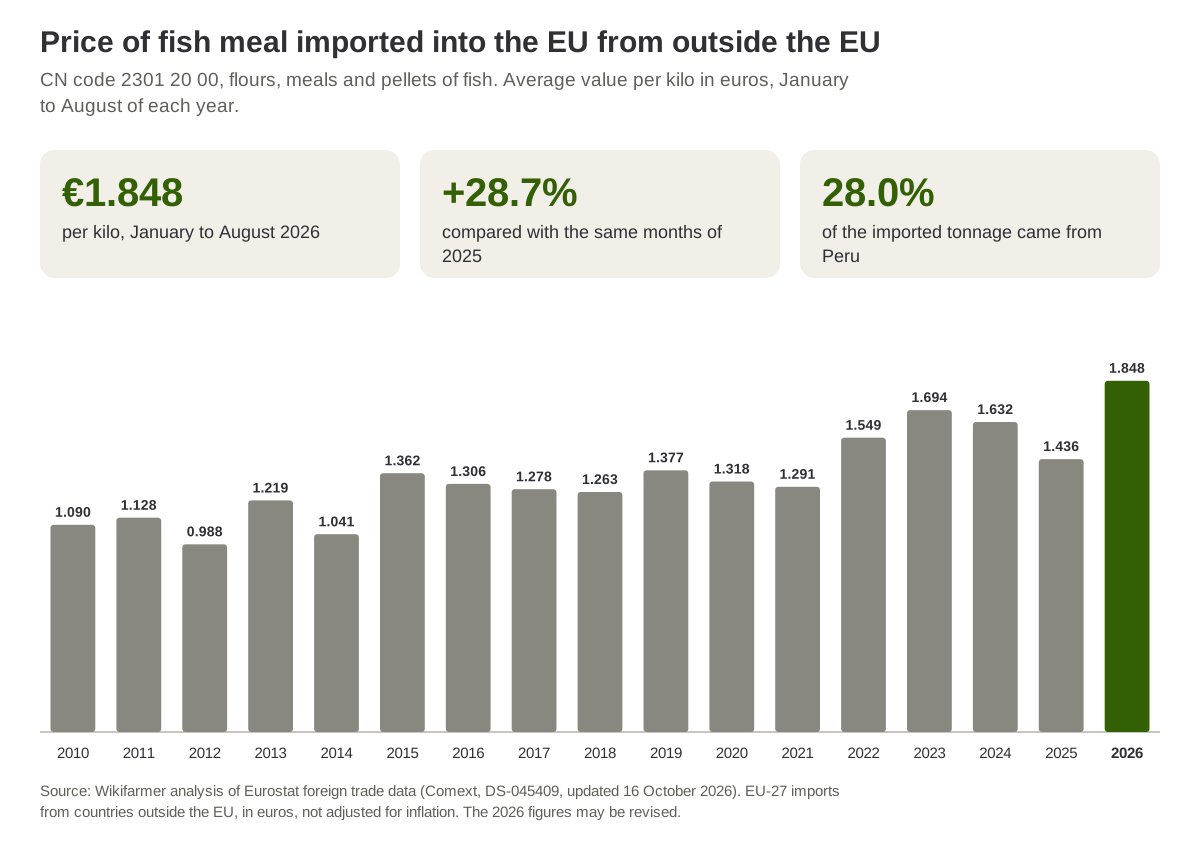
Source: Wikifarmer analysis of Eurostat foreign trade data (Comext, DS-045409, updated 16 October 2026), CN code 2301 20 00. The 2026 figures may be revised.
Peru will not allow a second anchovy fishing season in 2026
Peru's Ministry of Production (PRODUCE) announced that it would not allow a second anchovy (Engraulis ringens) fishing season in 2026 because of a very low biomass, which the publication links to El Niño, according to NutraIngredients on 19 October. According to the same report, the Peruvian Marine Institute (IMARPE) estimated the anchovy biomass off the north-central coast at about 5.12 million tonnes, 27.9% lower than in its estimate for the southern hemisphere summer of 2026, with juveniles making up 79% of the fish by number and 65% by weight, and the fishing ban in place since 27 May had already been extended because of the high share of juveniles. The Peruvian anchovy is the main raw material for the fish meal and fish oil that the country produces, so cancelling a fishing season affects how much of both it can sell.
The decision was announced after the price rise of July to September and after the eight months covered by the import data. Since July, the World Bank series has quoted herring meal priced in northern Germany, not Peruvian fish meal.
Five El Niño episodes since 1979 are too few to show an effect on the price
The World Bank's fish meal series starts in 1979 and, leaving out the current episode, covers five strong El Niño episodes with twelve months of data after them, based on the Relative Oceanic Niño Index (RONI) of NOAA's Climate Prediction Center. Twelve months after the month the index first reached +1.5 °C, the price was higher in four cases, by 57.7% after the 1982 episode, 13.6% after 1997, 19.0% after 2009 and 5.0% after 2015, and lower by 11.1% after the 1991 episode, a median change of 13.6% in a year. Over all twelve-month windows since 1979, however, the fish meal price was higher a year later in 58.7% of cases, so four rises in five episodes cannot be told apart from chance.
The 1982, 1991 and 1997 episodes also fall in years for which the World Bank file does not describe the specification, and the twelve-month windows used as the benchmark cross the changes of 1999, 2021 and 2026. Measured the same way, cocoa and coffee prices rose about one time in two after a strong El Niño, while palm oil rose after six of seven episodes. In the current episode the RONI reached +1.69 °C in July to September 2026, the first three-month season above the strong El Niño threshold.
The rise matters to fish farms and feed makers
Fish meal goes mainly into feed for farmed fish and shrimp and, to a lesser extent, into pig and poultry feed, so a higher price matters to fish farms, feed manufacturers and livestock farmers in every country that buys imported fish meal, in a year in which the 2026 El Niño is linked to risks for crops and food prices. How much it changes each farm's costs depends on the share of fish meal in the ration and on how easily it can be replaced with plant proteins, which varies by species and stage of production.
The picture in the coming months will depend on Peru's next decisions on the anchovy fishery, NOAA's monthly update on El Niño, the World Bank's November prices and Eurostat's import data for September.
The comparisons use months with the same World Bank specification
The analysis is by Wikifarmer, based on the World Bank's monthly fish meal price (Pink Sheet, November 2026 edition, data to October 2026, US dollars per tonne) and on EU-27 imports from outside the EU under CN code 2301 20 00 from Eurostat's Comext database (dataset DS-045409, updated 16 October 2026, data to August 2026, which may be revised). Prices are not adjusted for inflation. The World Bank revised its July 2026 price from $2,105 to $2,103 in the November edition, and the series changed specification in July 2026, January 2021 and January 1999; no specification is described for the years before 1999. The 2026 changes use only months with the same specification, while the El Niño comparison crosses these changes. The EU average import price is declared value divided by declared quantity and depends on the mix of grades and origins. El Niño episodes are the centre month of the first three-month season with NOAA's RONI at +1.5 °C or higher, and twelve-month changes are measured from that month's price. The figures on Peru's fishery come from a trade publication, not from the text of the ministry's decision, and the analysis does not test how much of the price rise is linked to Peru's fishery and how much to other factors, such as demand from fish farming or plant protein prices. All figures were recomputed independently from the original files. They describe what prices did and are not a forecast.
Sources
- World Bank. (2026). Commodity Markets, Pink Sheet monthly historical data, November 2026 edition.
- Eurostat. (2026). International trade in goods, Comext database (DS-045409), updated 16 October 2026.
- NutraIngredients. (2026, October 19). Peru cancels second anchovy fishing season amidst unprecedented El Niño event.
- NOAA Climate Prediction Center. Relative Oceanic Niño Index (RONI) and Oceanic Niño Index (ONI), retrieved 29 October 2026.