

After the seven strong El Niño events recorded from 1965 to 2015, the price of cocoa was higher a year later after 4 of the 7 events, arabica coffee after 3, robusta coffee after 4 and sugar after 4. That is about as often as in any month since 1960, according to a Wikifarmer analysis of World Bank monthly prices and the El Niño index of the US National Oceanic and Atmospheric Administration (NOAA). The result differs from palm oil, which rose after six of the seven events, and it matters this year because the 2026 El Niño has already reached the strength of a strong event.
NOAA says the strong El Niño is likely to last through the northern hemisphere winter
In its diagnostic discussion of 8 October 2026, NOAA's Climate Prediction Center (CPC) has an advisory in force for El Niño and reports that the sea surface temperature anomaly in the Niño-3.4 region of the Pacific reached +2.1°C above normal in the past month. The CPC says a strong to very strong El Niño is likely to last through January to March 2027, with a chance above 83%. The CPC's Relative Oceanic Niño Index (RONI), which it uses to measure the strength of an event, reached +1.69°C for July to September 2026, above the +1.5°C threshold of a strong event.
Seven strong El Niños since 1965 form the sample
The World Bank's monthly commodity price series start in 1960. From then to 2015, RONI first crossed +1.5°C in seven episodes: September 1965, September 1972, September 1982, November 1991, July 1997, December 2009 and August 2015. For each episode, Wikifarmer measured the change in the monthly US dollar price over the following 12 months and compared it with the share of all months from January 1960 to September 2025 after which the price was higher a year later, which gives a benchmark for an ordinary year.
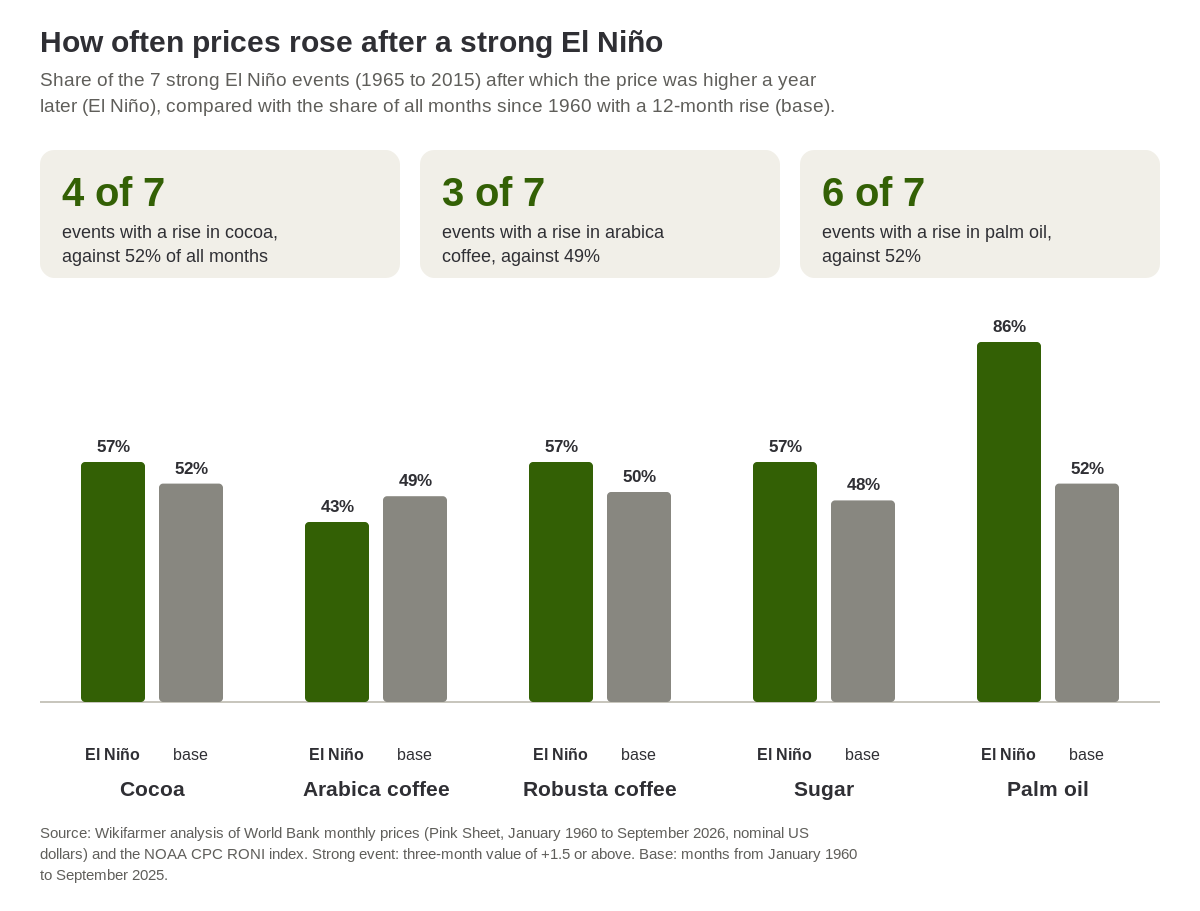
Source: Wikifarmer analysis of World Bank monthly prices (Pink Sheet, to September 2026) and the NOAA CPC RONI index. Strong event: three-month index value of +1.5 or above.
Cocoa rose after four of the seven events
The price of cocoa was higher a year after 4 of the 7 strong El Niños, with a median change of +2.4% over 12 months, while across all months since 1960 it was higher a year later 52% of the time. The large rises followed the events of 1965 (+38.9%), 1972 (+76.6%) and 1982 (+27.2%). After the more recent events of 1991, 2009 and 2015 the price fell by 17.6%, 12.6% and 3.8% respectively, and after 1997 it rose by only 2.4%.
Arabica rose after three events and robusta after four
Arabica coffee was dearer a year later after 3 of the 7 events, with a median change of −2.7%, against 49% of all months since 1960. The changes spread over a wide range, from −38.3% after the 1997 event to +56.7% after the 2009 one. Robusta coffee rose after 4 of the 7 events, with a median change of +6.8% over 12 months, against 50% of all months, and its largest rise, +34.4%, followed the 2009 event.
Sugar rose after four events with very wide swings
World sugar was dearer a year later after 4 of the 7 events, with a median change of +19.2% over 12 months, and after the 1991 event the price did not change. Across all months since 1960, the sugar price was higher a year later 48% of the time, or 55% if months with no change are counted with the rises; those flat months occur because the series gives the price rounded to two decimals in dollars per kilogram. The individual changes range from −25.0% after 1965 and −24.0% after 1997 to +61.5% after 1982 and +76.0% after 2015, so the median says little about what may happen in a given year.
Palm oil rose after six of the seven events
For comparison, palm oil was dearer a year later after 6 of the 7 strong El Niños, with a median rise of +32.7% over 12 months, while across all months since 1960 it rose 52% of the time. With the same method, palm, coconut and soybean oil rose after six of the seven strong El Niños, so the gap between these three vegetable oils and the products used in drinks and confectionery comes from the same data and the same comparison.
The ONI index adds the 2023 El Niño with large rises in cocoa and coffee
The Oceanic Niño Index (ONI), which the CPC also publishes, adds the 2023 episode, which reached strong El Niño level in September of that year. Over the next 12 months cocoa rose 80.6%, robusta 95.2% and arabica 51.1%, while sugar fell 22.4%. With the eight ONI episodes, cocoa rose after 5 of 8, robusta after 6, and arabica and sugar after 4. The median change for cocoa rises from +2.4% to +15.3% and for arabica from −2.7% to +3.3%, mainly because of 2023. For robusta, the one-month shift of the 1997 start also counts, from −3.4% starting in July to +6.7% starting in August. Sugar's median change, by contrast, falls from +19.2% to +9.6%.
Seven events are a small sample
With seven or eight events, none of the results for cocoa, coffee and sugar is statistically significant, either upwards or downwards, so the data do not show that El Niño raises or lowers their prices. They show that after a strong El Niño the prices of these products moved up in some years and down in others, much as in an ordinary year.
For producers and buyers of cocoa, coffee and sugar, the strong El Niño of 2026 is one of the factors that affect prices, together with supply from the main producing countries, stocks and demand, which also explain the record coffee and cocoa prices. The effect of the event on each country's harvest shows up in official production estimates, not in the index itself.
Frequently asked questions
Does El Niño raise cocoa prices?
After 4 of the 7 strong El Niños since 1965, the cocoa price was higher a year later, or 57% of the events, with a median change of +2.4%. That share is close to the 52% of all months since 1960, so the data show no consistent link.
Does coffee rise after a strong El Niño?
Arabica rose after 3 of the 7 events and robusta after 4, shares close to those of all months since 1960, 49% and 50% respectively.
What happened to sugar after strong El Niños?
The sugar price was higher a year later after 4 of the 7 events, unchanged after one and lower after two, with changes from −25.0% to +76.0%.
Which products rise more consistently after El Niño?
In the same analysis, palm oil rose after 6 of the 7 strong events, with a median rise of +32.7%, as did coconut oil and soybean oil.
How strong is the 2026 El Niño?
NOAA's RONI reached +1.69°C for July to September 2026, and the CPC gives a chance above 83% of a strong to very strong event through January to March 2027.
Important notes
Wikifarmer analysed the World Bank's monthly nominal US dollar prices (Pink Sheet) from January 1960 to September 2026 and the NOAA CPC RONI and ONI indices. The start of each episode is the centre month of the first three-month season with the index at +1.5 or above, and the change is measured from that month to the same month a year later. The benchmark is the share of all months from January 1960 to September 2025 with a positive 12-month change. The prices are international benchmark prices, not farm-gate prices, and the analysis shows associations, not causation. The article does not forecast 2027 prices and is not a recommendation to buy or sell.
Sources
- World Bank. (2026). Commodity Markets, Pink Sheet, monthly historical data, file updated October 2026.
- NOAA Climate Prediction Center. (2026, 8 October). ENSO Diagnostic Discussion.
- NOAA Climate Prediction Center. Relative Oceanic Niño Index (RONI) and Oceanic Niño Index (ONI), accessed 29 October 2026.