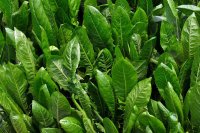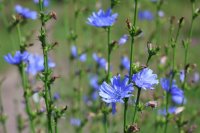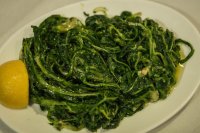

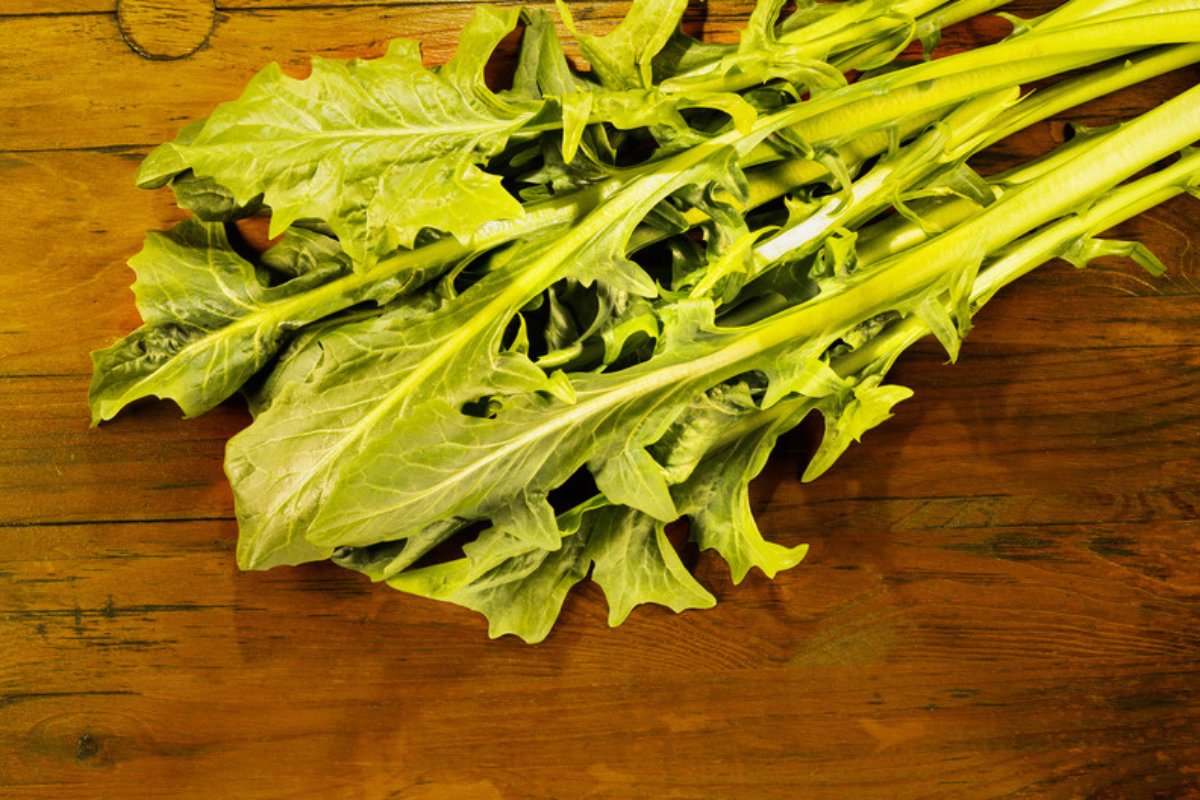
100 g of raw chicory greens (Cichorium intybus) provide 23 kcal, 4 g of dietary fibre and 420 mg of potassium, according to the US Department of Agriculture's FoodData Central database. They are also rich in vitamin K, folate and vitamin A, while their bitter taste comes from sesquiterpene lactones. Inulin, which carries an authorised health claim in the EU, is extracted from the root of the plant and has nothing to do with the leaves eaten as greens. People on blood thinners need care because of the vitamin K, and so do people with kidney disease who have been told to limit potassium.
Nutrients per 100 g
The table gives the values for raw chicory leaves. The percentage refers to the reference intake in Regulation (EU) 1169/2011, where one is set.
| Nutrient | Per 100 g | % reference intake |
| Energy | 23 kcal | 1% |
| Carbohydrates | 4.7 g | 2% |
| Dietary fibre | 4 g | - |
| Protein | 1.7 g | 3% |
| Fat | 0.3 g | 0.4% |
| Vitamin K | 298 µg | 397% |
| Folate | 110 µg | 55% |
| Vitamin A | 286 µg | 36% |
| Vitamin C | 24 mg | 30% |
| Vitamin E | 2.26 mg | 19% |
| Potassium | 420 mg | 21% |
| Manganese | 0.43 mg | 21% |
| Calcium | 100 mg | 13% |
| Iron | 0.9 mg | 6% |
| Sodium | 45 mg | - |
Source: USDA FoodData Central, Chicory greens, raw (FDC ID 169992)
Most FoodData Central values for chicory come from analyses made in 1984. Vitamin K was calculated from another form of the food or a similar food, and the carotenoids were taken from other food composition tables, so the figures show the order of magnitude and vary between varieties. The database also gives 3.43 mg of beta-carotene and 10.3 mg of lutein and zeaxanthin per 100 g, carotenoids that belong to the natural antioxidants found in plants.
How chicory differs from dandelion
Dandelion (Taraxacum officinale) is often called "wild chicory" in Greece, yet it belongs to a different genus of the same family. Wild chicory proper is the wild form of Cichorium intybus, which has very bitter leaves, according to the University of Wisconsin. The two greens are cooked the same way, but their composition differs quite a lot.
| Per 100 g raw leaves | Chicory | Dandelion |
| Energy | 23 kcal | 45 kcal |
| Dietary fibre | 4 g | 3.5 g |
| Vitamin K | 298 µg | 778 µg |
| Vitamin A | 286 µg | 508 µg |
| Folate | 110 µg | 27 µg |
| Vitamin C | 24 mg | 35 mg |
| Calcium | 100 mg | 187 mg |
| Iron | 0.9 mg | 3.1 mg |
| Potassium | 420 mg | 397 mg |
Source: USDA FoodData Central, Chicory greens, raw (FDC ID 169992) and Dandelion greens, raw (FDC ID 169226)
Dandelion has almost twice the calories, 2.6 times more vitamin K and more calcium and iron, while chicory has four times more folate. In potassium and fibre the two greens are close. Stamnagathi, which belongs to the same genus as chicory, provides even less energy, 15 kcal per 100 g according to the analyses of Zeghichi and colleagues.
Why chicory is bitter
The bitter taste of chicory comes from sesquiterpene lactones, mainly lactucin, lactucopicrin and 8-deoxylactucin, according to the review by Janda and colleagues. Their amount changes with the variety and with where the crop is grown. In a 2006 study on forage chicory grown in West Virginia and Pennsylvania, the same cultivars had at least twice as much lactucopicrin at the West Virginia site as at the Pennsylvania site in the same year, and the researchers note that soil phosphorus may influence the difference.
Bitterness also depends on how it is grown. Drought and a late harvest make the leaves more bitter and tougher, according to Utah State University, and the same happens when chicory is stored with apples or pears.
Steady moisture in the field and a timely harvest therefore matter for flavour too, while in the kitchen larger leaves are cooked to soften the bitterness, as the University of Wisconsin notes.
What holds for inulin and chicory coffee
Inulin is the energy store of the chicory root. According to Janda and colleagues, root chicory varieties are grown mainly for inulin extraction and for making a coffee substitute. During roasting, inulin turns into fructose and caramel, which give the root its dark colour and a slightly bitter taste. Chicory coffee is therefore made from the root, while the leaves eaten as greens have a different composition.
Inulin is one of the prebiotics, and Regulation (EU) 2015/2314 authorised the claim that chicory inulin contributes to normal bowel function by increasing stool frequency. The claim may be used only for foods that provide at least 12 g of chicory inulin per day, in the form of an extract with specified characteristics. The leaves provide 4 g of total dietary fibre per 100 g, so the claim does not apply to boiled chicory greens.
Nutrition and health claims
Under Regulation (EC) 1924/2006, a food is low in energy when it contains no more than 40 kcal per 100 g and is a source of fibre when it contains at least 3 g. It is a source of a vitamin or mineral when 100 g provide at least 15% of the reference intake, and high in it when they provide twice that. On FoodData Central values, raw chicory leaves meet the conditions for low energy, fat-free and low sodium. They are a source of fibre, vitamin E, potassium and manganese, and high in vitamin K, folate and vitamin A, while vitamin C, at 30%, sits exactly on the threshold for high. The rules on nutrition claims concern labelling, and for a packaged product they rest on the composition of that product.
Health claims are a different matter. In the EU every health claim for a food has to be authorised and included in the Union list. The properties that tradition attributes to chicory and its cooking water, such as benefiting the kidneys or regulating blood sugar and cholesterol, are not authorised health claims. Reviews record effects of chicory extracts in laboratory studies and animal trials, and Birsa and Sarbu note that more studies are needed to judge whether they have any therapeutic use.
Precautions
Vitamin K and blood thinners
100 g of raw leaves provide 298 µg of vitamin K, almost four times the reference intake of 75 µg, and dandelion provides even more. According to the Office of Dietary Supplements of the US National Institutes of Health, people taking warfarin or similar anticoagulants keep their vitamin K intake steady, because sudden changes affect how the drug works. Chicory is not off limits. The amount stays roughly the same from day to day, and any big change in diet is discussed with the doctor first.
Potassium and kidney disease
With 420 mg of potassium per 100 g, raw chicory leaves exceed the 200 mg per serving above which the US National Kidney Foundation counts a food as high in potassium. This matters for people with chronic kidney disease whose doctor has told them to limit potassium.
For high-potassium vegetables, the Foundation describes soaking for at least two hours in ten times their volume of warm water and cooking in five times their volume of water, a method that removes some of the potassium but not all of it. The potassium that leaves the greens passes into the water, so people limiting potassium throw the cooking water away. The cooking water of chicory, which tradition holds to be good for the kidneys, is exactly the part of the dish they avoid.
Chicory allergy
Allergy to chicory is rare. According to Janda and colleagues, about 20 cases have been recorded over the last 100 years, mostly in adults who handled the plant at work. Most reactions were caused by the leaves, raw or cooked, after skin contact or inhalation, with symptoms ranging from rhinoconjunctivitis and asthma to anaphylaxis and contact dermatitis.
Frequently asked questions
How many calories are in chicory greens
100 g of raw leaves provide 23 kcal, with 4.7 g of carbohydrates, 1.7 g of protein and 0.3 g of fat. They meet the EU condition for low energy, which is up to 40 kcal.
How many calories are in boiled chicory
Boiling adds no calories, so boiled chicory stays low in energy. The calories of the dish come mainly from the olive oil, about 119 kcal in one 13.5 g tablespoon, according to FoodData Central.
Which vitamins does chicory contain
Per 100 g of raw leaves, 298 µg of vitamin K, 110 µg of folate, 286 µg of vitamin A, 24 mg of vitamin C and 2.26 mg of vitamin E, according to FoodData Central. The values vary with the variety and the growing conditions.
Is chicory cooking water good for you
The properties attributed to it are not authorised health claims. Part of the potassium in the leaves passes into the cooking water, so people with kidney disease who limit potassium avoid it.
Is dandelion healthier than chicory
Not in every respect. Dandelion has 45 kcal per 100 g and more vitamin K, calcium and iron, while chicory has fewer calories and four times more folate. They are two genera of the same family, Taraxacum and Cichorium.
Who should not eat chicory
People taking warfarin or similar anticoagulants keep their intake steady because of the vitamin K, and people with chronic kidney disease who limit potassium need care, always following their doctor's advice. Allergy to chicory is rare.
Important notes
Health information is provided for general guidance and does not replace medical advice. Nutrient values come from published databases and vary with the variety, the season and the growing conditions of the plant.
References
- US Department of Agriculture, FoodData Central. Chicory greens, raw, FDC ID 169992.
- US Department of Agriculture, FoodData Central. Dandelion greens, raw, FDC ID 169226.
- US Department of Agriculture, FoodData Central. Oil, olive, salad or cooking, FDC ID 171413.
- Janda, K., Gutowska, I., Geszke-Moritz, M. and Jakubczyk, K. (2021). The common cichory (Cichorium intybus L.) as a source of extracts with health-promoting properties, a review. Molecules, 26(6), 1814.
- Foster, J.G., Clapham, W.M., Belesky, D.P., Labreveux, M., Hall, M.H. and Sanderson, M.A. (2006). Influence of cultivation site on sesquiterpene lactone composition of forage chicory (Cichorium intybus L.). Journal of Agricultural and Food Chemistry, 54(5), 1772-1778.
- Zeghichi, S., Kallithraka, S. and Simopoulos, A.P. (2003). Nutritional composition of molokhia (Corchorus olitorius) and stamnagathi (Cichorium spinosum). World Review of Nutrition and Dietetics, 91, 1-21.
- Birsa, M.L. and Sarbu, L.G. (2023). Health benefits of key constituents in Cichorium intybus L. Nutrients, 15(6), 1322.
- Gibson, R. and Drost, D. (2020). How to grow chicory in your garden. Utah State University Extension.
- Mahr, S. (2025). Chicory, Cichorium intybus. Wisconsin Horticulture, University of Wisconsin-Madison, Division of Extension.
- Regulation (EC) No 1924/2006 on nutrition and health claims made on foods, consolidated text.
- Commission Regulation (EU) 2015/2314 authorising a health claim on chicory inulin and amending Regulation (EU) No 432/2012.
- Food Safety Authority of Ireland. Regulation (EU) 1169/2011, Annex XIII, reference intakes.
- NIH Office of Dietary Supplements. Vitamin K, fact sheet for health professionals.
- National Kidney Foundation. Potassium in your CKD diet.