
Aphids are probably the most common pest you'll meet in the garden or among your potted plants. They appear in spring almost out of nowhere, cover the tender shoots and flower buds, and within a few days, they've multiplied into hundreds. Most people rush to spray with something. Few stop to ask why aphids appear so fast, and why spraying usually only buys a short-term fix.
Here we'll look first at how aphids actually work. Once you understand their biology, you'll see that dealing with them becomes easier, more effective, and often doesn't need chemicals at all.
What aphids are
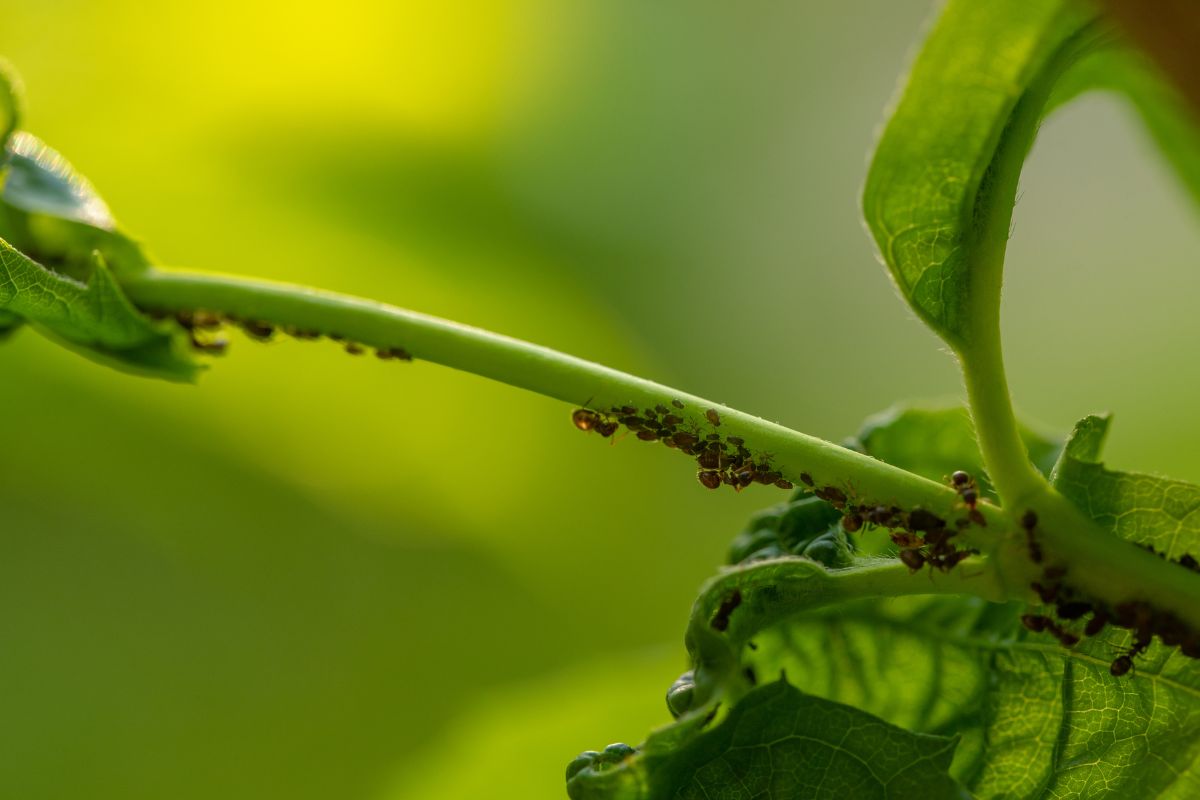
Aphids are small sap-sucking insects in the family Aphididae. There are around 5,000 species worldwide, and gardens host quite a few of them. They rarely grow larger than 2-3 mm, and their color varies, green, black, yellow, brown, or pink depending on the species.
Aphids pierce the plant's tissue with a fine needle-like mouthpart and draw sap from the phloem, the tubes that carry sugars around the plant. They gather on the most tender parts, the tips of shoots, the undersides of young leaves, and on flower buds.
Why do they multiply so fast
This is where the explanation lies for how a small infestation becomes a whole colony in a single week.
In the warm seasons, aphids reproduce by parthenogenesis. The females produce offspring without mating, and they don't lay eggs; they give birth to live young that are already identical copies of the mother. Each female produces dozens of offspring, and those start giving birth themselves within just a few days.
The most striking part is that a young woman can already be carrying the next generation within her before she's even born. Biologists call it telescoping generations. It's like a doll inside another doll, and that's why the population multiplies so rapidly the moment conditions turn favorable.
When crowding gets too high or the plant starts to give out, the females begin producing winged forms. These fly off to neighboring plants and start new colonies there. That's how an infestation that began on one plant quickly spreads across the whole garden. In autumn, as the days shorten, males appear too, normal mating takes place, and the females lay frost-resistant eggs that overwinter and start the cycle again in spring.
This is why aphids can't be dealt with in a single treatment. You aren't fighting a few insects, but a rate of reproduction that doesn't stop.
What damage they cause
Aphids don't harm the plant only by sucking its sap. That's the most visible damage, but not always the most serious. There are three kinds of damage worth knowing about.
Distorted growth. When aphids feed on young leaves and shoot tips, those grow out twisted, curled and stunted. The damage stays visible even after the insects are gone.
Honeydew and sooty mould. Aphids excrete a sticky, sugary substance called honeydew. A black fungus, sooty mould, grows on top of it and coats the leaves like black dust. The mould doesn't attack the plant directly, but it blocks light and reduces photosynthesis.
Virus transmission. This is the damage most people overlook, and often the most dangerous. Many aphid species carry viruses from plant to plant. The green peach aphid (Myzus persicae) transmits more than 100 different viruses, while the cotton and melon aphid (Aphis gossypii) transmits at least 44. The moment an aphid bites an infected plant and moves to a healthy one, it passes on the virus within seconds.
This has an important practical consequence. Viruses pass into plants when aphids move around the garden, not when they settle into a permanent colony. That's why, as we'll see below, spraying often doesn't catch the spread in time.
The relationship between aphids and ants
If you notice ants constantly running up and down an infested plant, it isn't a coincidence. Ants and aphids have one of the best-known mutually beneficial relationships in nature.
Ants love the sugary honeydew that aphids excrete. In return, they protect the aphids from their natural enemies. They drive off the ladybirds, lacewings and parasitic wasps that would eat the aphids, and sometimes they even carry them to more tender parts of the plant. In effect, ants farm aphids like livestock and milk them for honeydew.
This matters a great deal in practice. As long as the ants are protecting the colony, the natural enemies struggle to do their job, and the aphids keep coming back. If you break this relationship, the aphid population often drops on its own, as the natural enemies regain access.
In practical terms, you can stop ants reaching the foliage of trees and shrubs with a sticky band around the trunk, or you can find and treat their nest. It's a step most people skip, and it often makes the difference.
Why spraying often fails
The most common way people deal with aphids is a quick spray with an insecticide. The result is often disappointing, for specific reasons.
It kills the natural enemies too. Broad-spectrum insecticides don't discriminate. Along with the aphids, they kill the ladybirds, lacewings and parasitic wasps that would have kept the population in check. The aphids, with their explosive reproduction, bounce back much faster than their predators do. The result is that after spraying, the infestation often ends up worse than it was.
Resistance. Species like the green peach aphid have developed high resistance to many insecticides, precisely because they reproduce so fast and every surviving generation passes the resistance on.
It doesn't reach the target. Aphids hide on the undersides of leaves and inside the curled shoots. A hasty spray from above never touches them.
It doesn't stop viruses. As we saw, the aphid transmits the virus within seconds of biting. By the time the insecticide acts, the damage is done.
How to deal with aphids the right way
The right approach is a sequence of steps in order of priority, starting with the gentlest and most effective. In horticulture, this is called integrated pest management.
Prevention and monitoring
Check your plants regularly, especially in spring and on fresh tender growth. An infestation caught early is easy to deal with. Pay attention to the undersides of leaves and the tips of shoots.
Watch your feeding. Too much nitrogen fertiliser produces lush, soft, tender growth, which is exactly what aphids prefer. Balanced feeding makes the plant less attractive to them.
Mechanical removal
For small infestations, the quickest method is a strong jet of water that knocks the aphids off. Being slow and soft-bodied, they struggle to climb back up. On individual shoots with a dense colony, you can simply cut off and remove the affected part.
Breaking the link with ants
If you see ants, deal with them immediately. As long as they're protecting the aphids, no other method works fully. A sticky band on the trunk blocks their access to the foliage.
Encouraging natural enemies
This is the most neglected step and perhaps the most powerful tool you have. In nature, aphids have plenty of enemies that can keep their numbers low without any intervention from you, as long as you don't wipe them out with sprays. We'll look at them in detail below.
Gentle treatments
When a treatment is needed, start with the gentlest. Insecticidal soap (potassium soap) kills aphids on contact by breaking down their protective coating, and is relatively kind to beneficial insects once it dries. Horticultural oil works similarly, coating and smothering the insects. Both need to be applied with good coverage, especially on the undersides of leaves where the aphids hide.
Spray early in the morning or late in the afternoon, never in strong sun, and avoid the hours when bees and other beneficial insects are active.
Chemical treatment as a last resort
If the infestation is severe and nothing else has worked, chemical treatment is the final step. Choose selective products that target aphids without wiping out the beneficials, and use only approved products following the label instructions.
The natural enemies of aphids
Many gardeners only know the ladybird. In fact, aphids have far more natural enemies, and it's worth learning to recognise them so you don't kill them by accident.
Ladybirds: both the familiar red adult beetles and their larvae (which look like tiny blue-grey and orange "alligator" grubs) eat huge numbers of aphids. A single larva can eat hundreds of aphids before it matures.
Hoverflies: they look like small bees or wasps hovering in the air, but they're harmless flies. Their larvae, small translucent "grubs", are among the most effective aphid predators of all.
Lacewings: delicate greenish insects with transparent wings. Their larvae are voracious aphid predators, fittingly nicknamed "aphid lions".
Parasitic wasps: tiny wasps (mainly of the genus Aphidius) that lay their eggs inside aphids. The affected aphid turns into a brown, swollen "mummified" shell. If you see these brown mummified aphids, it means the natural enemies are already at work, and you shouldn't spray.
You can encourage these enemies by planting aromatic and flowering plants that attract them, such as dill, fennel, yarrow and various small flowers, and above all by avoiding the broad-spectrum sprays that wipe them out.
Which plants they attack most often
Aphids attack almost everything, but some plants draw them more than others. In gardens and containers, the most frequent victims are roses, oleanders, citrus, peppers, tomatoes, aubergines, beans, and nearly all young vegetables in spring. On houseplants they show up mainly on the tender new shoots.
Plants given too much nitrogen fertiliser, which keep pushing out soft growth, are always the most vulnerable.
Frequently asked questions
Are aphids dangerous to humans? No, aphids aren't dangerous to people and don't bite. They're strictly a plant pest. The only nuisance is the sticky honeydew that can drop onto surfaces under infested trees.
Do aphids go away on their own? In many cases yes, if you let the natural enemies do their work. By late spring and summer, populations of ladybirds and other predators usually bring aphids under control. The problem is when ants are protecting the aphids, or when you've killed off their enemies with sprays.
Why do aphids keep coming back after I spray? Usually for one of two reasons. Either you killed the natural enemies and the aphids, which breed faster, came back first, or there are ants constantly protecting new colonies. Check both.
Does household soap help? The insecticidal soap sold for the purpose is the safest. Ordinary dish detergents can damage the foliage of some sensitive plants, so use them with care and always well diluted.
When should I really worry? When the infestation is on young plants or seedlings that may stop growing, when you see heavy distortion of the growth, or when you're growing plants susceptible to viruses. On mature, healthy plants, a moderate infestation rarely causes serious harm.
Important notes
Every garden and every plant is unique. The severity of an infestation and the right response depend on the type of plant, the season, your local climate and whether or not natural enemies are present. The guidance above is general and a starting point rather than a strict rule.
For serious or persistent infestations, particularly on commercially important crops, consider talking to a horticulturist or agronomist for accurate identification of the species and targeted treatment.
Use plant protection products with care. Try non-chemical methods first wherever possible, such as cultural practices, insecticidal soap, horticultural oil, and encouraging natural enemies. When chemical intervention is needed, use only approved products, follow the dosage on the label, and avoid spraying when bees and other beneficial insects are active in the garden.
References
- University of California Statewide IPM Program. Aphids, Floriculture and Ornamental Nurseries.
- University of California Statewide IPM Program. Green Peach Aphid and Other Early-Season Aphids, Tomato.
- University of California Statewide IPM Program. Aphids, Corn.
- Srinivasan, D. G., Abdelhady, A., & Stern, D. L. (2014). Gene Expression Analysis of Parthenogenetic Embryonic Development of the Pea Aphid. PLOS One.
- Kanturski, M., et al. Aphid polyphenisms, trans-generational developmental regulation through viviparity. PMC.
- Current Biology. Aphid-farming ants.
- Scientific Reports. A symbiotic aphid selfishly manipulates attending ants via dopamine in honeydew.