The 2026 season for Greek rice was marked by a substantial reduction in cultivated area, according to the European Commission's Joint Research Centre in its September crop monitoring bulletin. How large that reduction was is not yet known with any precision, because the farmers' area declarations under the integrated administration and control system have not been published, and the sector's own estimates differ widely. On the cause, however, the sector's sources agree. Growers sowed less because farm-gate prices had fallen to roughly half their level of previous years while the cost of growing the crop rose.
Harvesting began in late September and will continue into October, so the size of the crop will become clear over the coming weeks. Until then the picture has to be assembled from the JRC at European level and from the cooperatives and growers of Chalastra, Central Macedonia and Serres, where most Greek rice is grown.
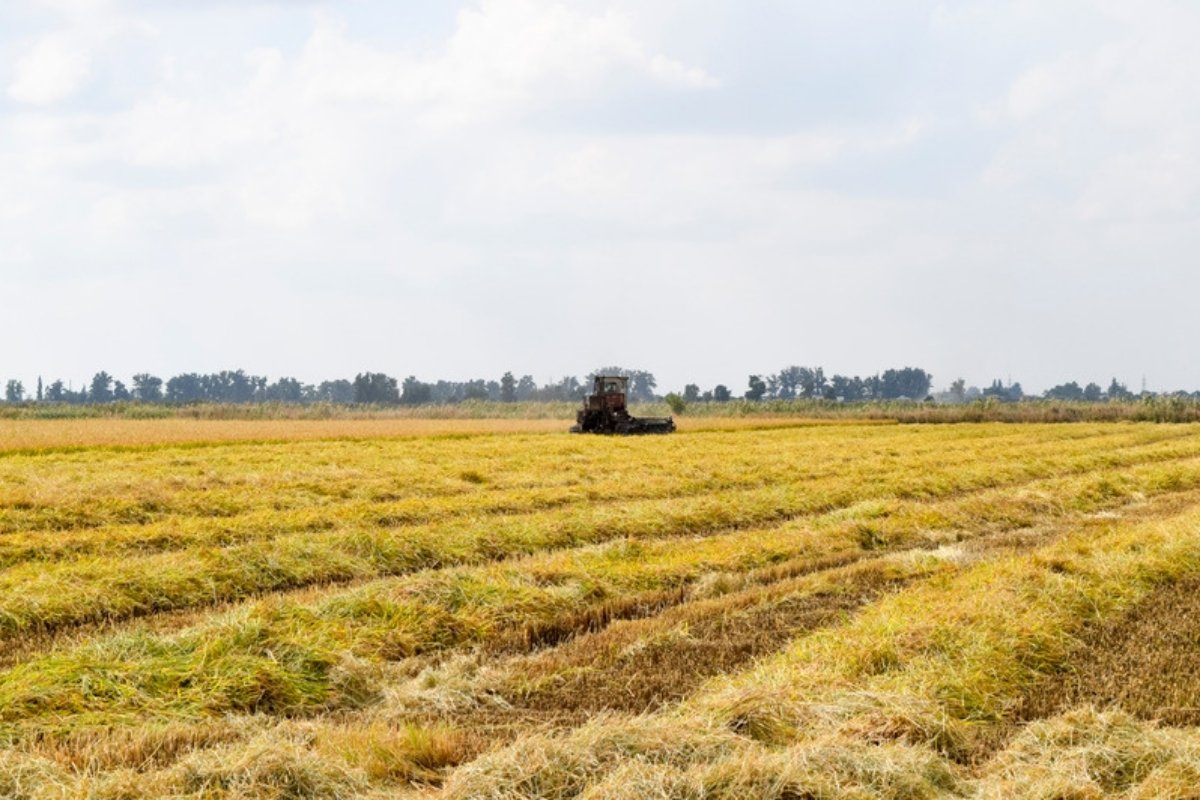
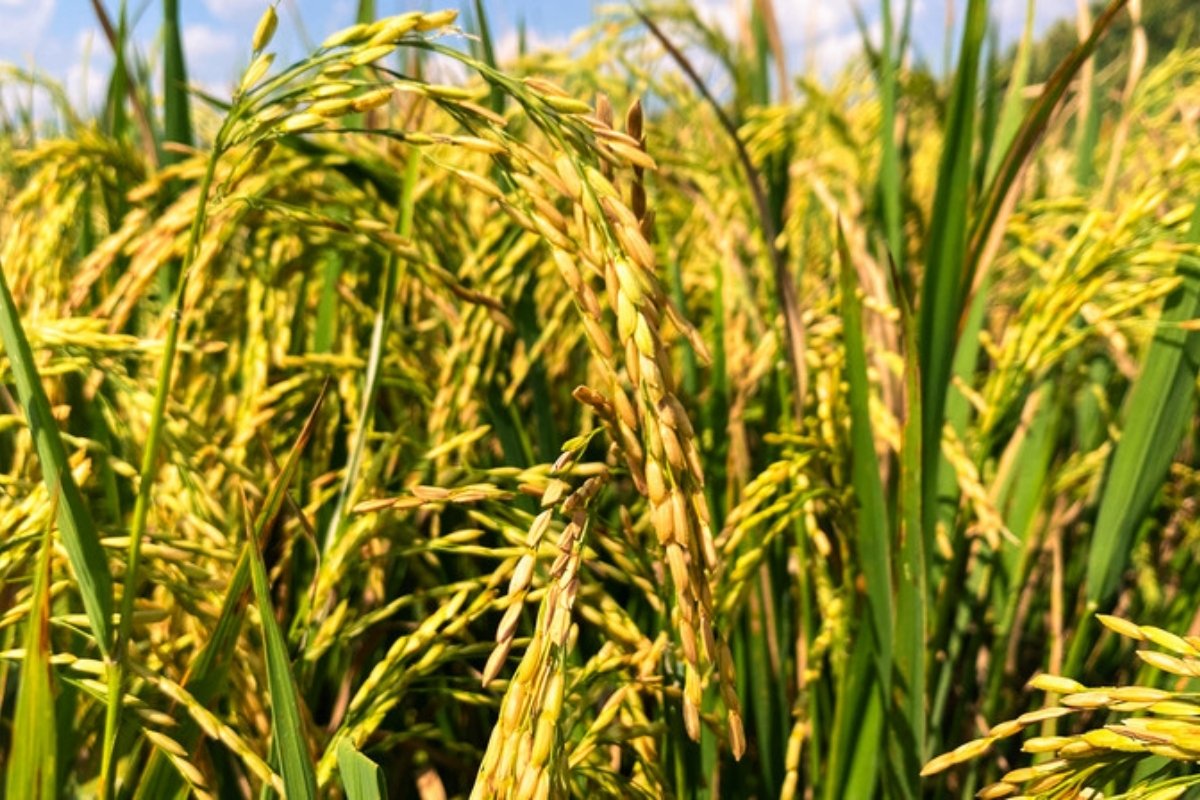
A combine harvester in a ripe rice field. The Greek rice harvest began in late September and will run into October.
Italy accounts for most of Europe's rice losses
At EU level, the JRC forecasts rice yields at 6.14 tonnes per hectare, 3% below the five-year average, mainly because of Italy. Italian rice reservoirs reached critically low levels as early as mid July, the snowmelt contribution ended earlier than usual, and the rotation scheme for water supply was particularly restrictive in the north-west. Fields at the margins of the main irrigation channels went short of water for long periods, leading to local crop failure and field abandonment, while hailstorms struck the smaller growing areas of Emilia-Romagna and Veneto after mid July. The Italian yield is forecast 10% below the five-year average.
Where irrigation held, the picture was better. Spain remains well above average and close to last year's level, France was revised upwards close to last year's high, and Romania was revised substantially above average. In Portugal the cultivated area fell slightly, by around 5%.
For Greece, the JRC reports that after initial delays in irrigation water delivery, water availability remained adequate and crops developed satisfactorily under warm summer conditions. Weed pressure caused local problems without widespread damage, and the yield is forecast around the five-year average, at 7.98 tonnes per hectare, 1% below the average and 5% above last year.
Estimates of the area differ widely
Sector sources give different figures for how much rice was planted this year, and all of them are estimates rather than official statistics.
| Source | Area this year | Comparison | Production |
| First Rice Growers' Cooperative of Chalastra, 17 September | 24,000 to 25,000 ha | 30,000 to 31,000 ha last year | 150,000 to 160,000 t, against about 280,000 t |
| Chalastra growers via ERT and Parallaxi | 23,000 ha | out of a total of 30,000 ha | down 30% |
| Report by The Opinion | 20,000 to 22,000 ha | from 30,000 ha | down 24% |
| EU RICE information trip to Chalastra, 22 to 25 September | 28,000 ha | 31,000 ha last year | down 15% to 20% |
The spread runs from a fall of about 10% to one close to 30%. Christos Gkantzaras, president of the First Agricultural Cooperative of Rice Growers of Chalastra, which handled around 50,000 tonnes last season, told AgroTypos that this year's area figures are estimates, since the declaration data are not yet available.
On yield, growers and the JRC disagree. Gkantzaras expects fewer kilograms per hectare and production a further 20% to 25% lower on top of the area reduction, and growers who spoke to the public broadcaster ERT said resistant weeds had affected yields. The JRC forecasts a yield around the average, with only local weed problems. Which estimate proves right will be settled by the harvest.
Farm-gate prices have fallen by about half
The fall in price is the main reason for the reduction in area. Before sowing, in April, Gkantzaras put farm-gate prices at about EUR 250 per tonne for medium-grain rice, EUR 240 for long-grain and EUR 400 for Carolina, against up to EUR 500 per tonne in earlier years, close to double. Carolina fetches a better price but is grown less because it yields less per hectare. In 2025/26 many growers did not cover their costs, with losses of around EUR 150 per stremma, or EUR 1,500 per hectare, while demand was weak and stocks unusually high for the time of year.
Growers attribute the pressure to duty-free rice imports from third countries. Reporting from the EU RICE information trip, AgroEkfrasi wrote that the EU's failure to activate its safeguard clauses allowed large duty-free volumes into the market, and growers quoted by Parallaxi also point to a doubling of the ceiling for duty-free imports. For the new season, Gkantzaras hopes for somewhat better prices without being confident they will cover costs, and warns that if the pattern of the past year continues, rice growing will leave Greece.
Costs rose and weeds demand more field passes
At the same time, inputs became more expensive. In April Gkantzaras said that filling a tractor with around 600 litres of diesel could cost up to EUR 1,200, and that the herbicide active substances available are limited and do not meet the crop's needs. He added that even for the same active substances, products cost considerably more in Greece than in other countries.
Weeds add to costs in a second way. Growers on the EU RICE trip explained that controlling resistant weeds with milder methods requires more mechanical cultivation, which sharply raises fuel consumption and operating costs.
Few crops can replace rice in Chalastra
Growers with an alternative moved mainly into cotton and maize. In Chalastra the choice is narrow, because saline soils leave many fields unable to carry other crops, and rice often remains the only option despite the higher risk. Around 10,000 hectares of the area's rice fields lie inside the National Park of the Axios, Loudias and Aliakmonas Delta, where the flooded paddies act as artificial wetlands that support the river's biodiversity.
The sector is trying to adapt through collective investment. According to AgroEkfrasi, producer groups in the area invested EUR 3.5 to 4 million over three years, including EUR 2.5 million in silos and a dryer, EUR 800,000 in a high-technology harvester and EUR 600,000 in high-horsepower tractors and software-controlled sprayers.
Support arrived late and not for everyone
For losses in the 2025 season, rice growers received de minimis aid of EUR 70 per stremma, equivalent to EUR 700 per hectare, under the joint ministerial decision published in Government Gazette B 4670/2026. Professional farmers receive the full amount and other beneficiaries half, up to EUR 50,000 per business over three years. Payment was made on 21 August, but around 680 rice growers were left unpaid without knowing why, in a year when several still owe money for crop protection products.
Sources
- European Commission Joint Research Centre. (2026). JRC MARS Bulletin, Crop monitoring in Europe, September 2026, Vol. 34 No. 8. Section 4, rice analysis. 28 September 2026.
- AgroTypos. (2026). Rice: first harvests from next week, lower production and concern over imports. 17 September 2026.
- AgroTypos. (2026). Rice: reduced area, low prices and strong caution before sowing. 2 April 2026.
- AgroTypos. (2026). De minimis for rice: around 680 growers remain unpaid. 26 August 2026.
- AgroTypos. (2026). Joint ministerial decision signed for de minimis aid to rice. 29 July 2026.
- AgroEkfrasi. (2026). Greek rice: farm-gate prices halved under pressure from imports. 24 September 2026.
- Parallaxi. (2026). Thessaloniki: rice growers in despair as production falls 30%. September 2026.
- The Opinion. (2026). Rice growers send out an SOS. September 2026.