
Olive oil market digest for week 40 of 2026
The Junta de Andalucía put the region's 2026/27 olive oil output at 1,261,200 tonnes on 29 September, 23.9% above its final figure for the campaign that ends on 30 September. It is the first official production number for the new season, and it arrived in a market that barely moved during the week. Spanish origin prices on Poolred held at €3.38/kg for extra virgin, Greek deals ran between €3.20 and €4.00/kg, and the latest stock figures stood at 475,434 tonnes in Spain and 233,377 tonnes in Italy.
Stay up to date with our Weekly Olive Oil Market Digest
Spain's olive oil market
The regional government presented its harvest estimate (aforo) in Mengíbar, Jaén. It forecasts 1,261,200 tonnes of olive oil from 6,849,200 tonnes of olives for milling, 44.1% above the average of the last five campaigns. The ministry's regional table, published on 1 October, shows Andalusia up 29%, because it compares the forecast with a lower figure for 2025/26, of about 975,500 tonnes. Jaén is forecast at 575,000 tonnes (+47.8%) and Córdoba at 339,700 tonnes (+37.6%), which together make up 72.5% of the regional total (our calculation). Table olives are forecast at about 466,000 tonnes, up 9.1%.
That answers the question our mid-September outlook left open, namely how much the summer heat would cost the crop. The trade inspection cited in that article had projected rises of about 50% in Jaén and 30% in Córdoba, close to what the Junta now expects. Regional agriculture minister Ramón Fernández-Pacheco said a very wet winter favoured the groves, while temperatures well above normal limited their productive potential.
Rain-fed groves are already under severe water stress and need autumn rain before the harvest, El Español reported, and the Ministry of Agriculture (MAPA) has not yet published its national estimate. Andalusia produced about three-quarters of Spain's olive oil in 2025/26 (our calculation from AICA figures).
Poolred data compiled by ASAJA-Jaén for 22 to 28 September show slight fluctuations with barely any change, and Poolred's weighted average across all grades was €3,303.96 per tonne, about €3.30/kg, for 23 to 29 September, on 2,706.2 tonnes traded (provisional).
Farm unions UPA and COAG said on the day of the aforo that origin prices still do not cover the costs of some farms, especially traditional ones. AEMO's 2026 cost study puts the cost of a kilo of oil in traditional groves at €4.18 to €5.31, so at €3.30 only the intensive irrigated and super-intensive grove types cover their costs.
AICA data put Spanish stocks at 475,434 tonnes on 31 August, with 264,799 tonnes at mills, 206,615 tonnes at bottlers and 4,020 tonnes in the Patrimonio Comunal Olivarero. Luis Carlos Valero, manager and spokesman of ASAJA-Jaén, said that even if 120,000 to 125,000 tonnes are sold in September, the carryover into 2026/27 would be around 350,000 tonnes. At the July sector round table, the carryover had been estimated at around 260,000 tonnes.
Current origin quotations (Poolred, 22 to 28 September):
● Extra Virgin Olive Oil (EVOO): €3.38/kg
● Virgin Olive Oil (VOO): €3.27/kg
● Lampante Olive Oil: €3.15/kg
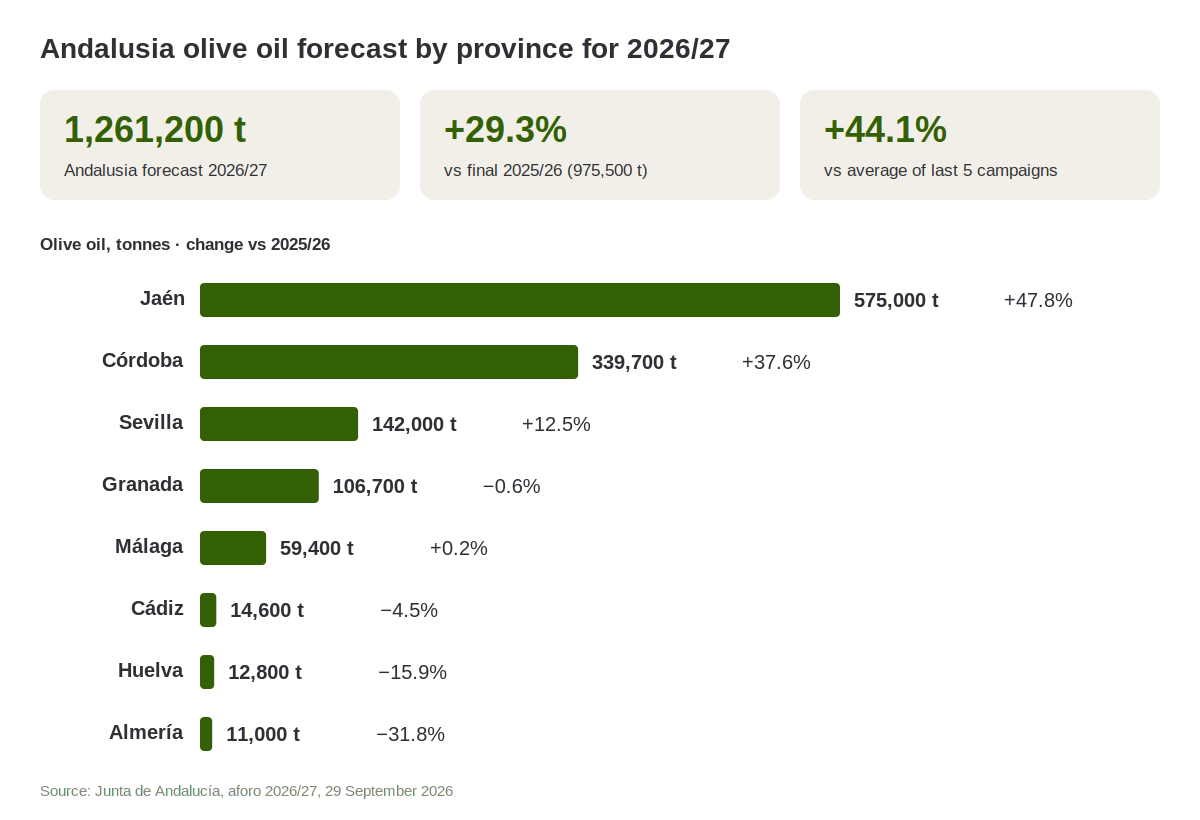
Andalusia's olive oil forecast by province for 2026/27, with the change against final 2025/26 output. Source: Junta de Andalucía, 29 September 2026.
Greece's olive oil market
Trading picked up slightly in Greece as the harvest approaches, although deals remain few. Elaias Karpos reported on 25 September that deals were done in a range of €3.20 to €4.00/kg, with a few tankers leaving Laconia at up to €4.00 and prices in the Peloponnese generally closer to €3.45 to €3.50. On the Oleista platform, Greek extra virgin stood at €3.74/kg in week 39.
Early estimates put Greek 2026/27 production at 280,000 to 330,000 tonnes, with about 300,000 tonnes the most likely outcome, and the estimates of Manolis Giannoulis, president of the National Interprofessional Organisation of Olive Oil, point to the same level. Giannoulis has said that if a crop of around 300,000 tonnes is confirmed, the producer price can stay around current levels, within about 10%. Starting from €4/kg, Powergame puts that band at roughly €3.60 to €4.40/kg. "The barometer is Spain," Giannoulis said.
On 28 September Giannoulis put the shelf price at about €8.50 a litre and the producer price at about €4/kg. Producer and trader Nikos Kapsampelis said harvest wages run from €60 to €80 a day. The harvest usually runs from late October to February. For the new season, the tax authority AADE has set the olive fruit fly control levy at €0.030 per kilo of olive oil (circular E.2050/2026).
Current quotations (reported deals, to 25 September):
● EVOO: €3.20-4.00/kg
Italy's olive oil market
ISMEA, the public agrifood market institute, estimates Italy's 2025/26 output at 325,000 tonnes, up 31% on the previous season. Presenting at Terra Madre in Turin, it said Italian extra virgin quotations remain above those of Spain, Greece and Tunisia, and above their levels before 2022. ISMEA called it too early to forecast the 2026/27 crop.
The inspectorate ICQRF put Italian stocks at 233,377 tonnes on 31 July, up 43.9% on a year earlier. Extra virgin made up 185,373 tonnes, of which 108,299 tonnes were Italian (+139.6%), and Puglia alone held 73,559 tonnes.
In Puglia, farm union Coldiretti Puglia expects the 2026/27 crop to fall by about 40% in Foggia and Taranto, by more than 40% in Brindisi, by 30% on the Gargano and by 20% in Bari and BAT. It expects Lecce to rise by about 60%, as groves replanted after Xylella come into full production. These are one farm union's percentages, not tonnages.
Current quotations (Oleista, first Italian quote in several weeks, reported 25 September):
● EVOO: €4.82/kg
Tunisia's olive oil market
ONAGRI data show 381,200 tonnes exported between November 2025 and August 2026, up 50.8% in volume, for revenue of 4,780.4 million dinars, up 41.2%. Bulk oil made up 85.5% of the volume. The EU took 56.6% of exports, led by Spain with 31.9% and Italy with 19.8%, while the United States took 19.3%. The average export value across all grades was 13.31 dinars per kilo in August, against 12.42 a year earlier, a rise of 7.1%.
Current quotations (ONAGRI, average export value, August):
● All grades: 13.31 TND/kg
Portugal's olive oil market
Olivum, the association of Portuguese olive growers and mills, expects 2026/27 output to grow by about 10% on last season's roughly 160,000 tonnes, which would bring it close to the 177,000 tonnes of 2024/25. This is one association's early view, not an official statistic. Portuguese ministry data run about two weeks behind, and the latest SIMA bulletin covers 7 to 13 September.
Current quotations (SIMA, national weighted average, bulk, 7 to 13 September):
● EVOO: €3.70/kg
● VOO: €3.50/kg
EVOO cross-market snapshot
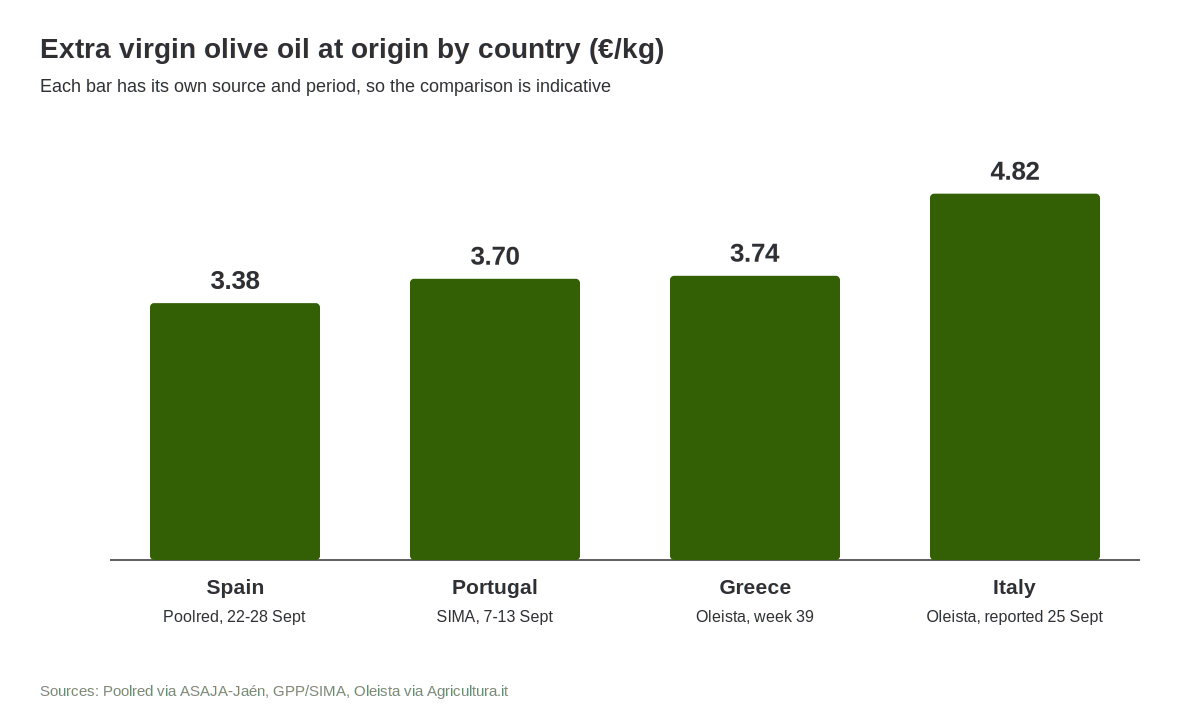
Extra virgin olive oil at origin, €/kg. Each bar comes from a different source and period, shown under the country name, so the chart is indicative. Tunisia is not shown because the only verified figure is an average export value in dinars.
Market outlook
The 2026/27 campaign opens on 1 October with Andalusia forecasting a crop 23.9% larger than last season's. ASAJA-Jaén's projection of a Spanish carryover of around 350,000 tonnes is above the 260,000 tonnes estimated in July, and Italian stocks at the end of July were 43.9% higher than a year earlier. Spanish origin prices were almost unchanged in the week of the aforo, at €3.38/kg for extra virgin on Poolred, while in Greece Giannoulis describes Spain as the barometer for producer prices. Spanish farm unions say current prices do not cover the costs of some farms, especially traditional ones.
The next figures that will fill in the picture are the Ministry of Agriculture's national estimate for Spain, AICA's September data due in mid-October with the final 2025/26 balance and the actual carryover, the start of the Greek harvest in late October and the Turkish olive council UZZK's estimate, which usually comes in October or November. The FAO Food Price Index, which includes vegetable oils, is published on 2 October.
Source olive oil with confidence on Wikifarmer's Marketplace
Looking for gold standard EVOO?
Disclaimer: The information provided on this website, including market prices, insights, and projections, is for general informational purposes only. While we strive to ensure accuracy and timeliness, we make no guarantees regarding the completeness, reliability, or suitability of the information presented. Users are solely responsible for independently verifying the data and assessing its relevance to their specific circumstances before making any decisions. Wikifarmer and its operators shall not be held liable for any losses, damages, or consequences arising from the use of the information provided herein.